1-YEAR DIGITAL SUBSCRIPTION
to FLAPPERHOUSE Four PDF issues $10US(16.666% off the cover price!)
For just$10 US (that’s 16.666% OFF the cover price!), you’ll receive a full year’s worth of FLAPPERHOUSE– that’s 4 PDF Issues delivered right to your emailbox on the day of release (typically on or around the first day of each season). You’ll get all the stories, poems, essays, and unusual advertisements each issue has to offer, (months before they’re all available online) and all in one handy digital document, all neatly laid out and typed in our very pretty signature fonts that read real good ontablets, computers, and smartphones!
Our Fall 2014 issue is so wonderfully bizarre & freakishly beautiful it’ll make your cheeks quiver & explode. It begins with an Alternate Reality Game, ends with a Choose-Your-Own-Adventure, and in between there’s pink slime, raving gods, naked alligator rides, regurgitated Raymond Carver, a bunch more fiction that’s too bizarre to summarize here, and some phenomenal poetry.
FLAPPERHOUSE #3 is no longer available for sale in digital (PDF) format because it’s NOW AVAILABLE FOR FREE right here!
We’re absolutely giddy to present the first excerpt from our Fall 2014 issue today! “ARG” by Anthony Michael Morena is what you’d normally call “flash fiction,” but we think that’s an inadequate term for this explosive, subversive, wickedly enjoyable story. We think it should be called something like “blast fiction” instead.
{ X }
WE ALL HAVE OUR SPECIAL ROLES TO PLAY. Some of us have cameras. Some of us are handing out leaflets. Some of us are in a van idling across the street, waiting for the right moment. Everything has been planned and everything is going according to plan. We are gathered together at the park. This makes sense. You would want to launch an alternate reality game in a highly trafficked area. Everything makes sense.
The plot of our alternate reality game centers around the fight between aliens who have infiltrated all levels of society, a cult built around resisting them, and our players. The aliens cannot be recognized on sight. There is no way to tell who is an alien and who isn’t an alien. The distinction between the aliens among us and normal humans will be up to the players to figure out. A player might even consider him or herself an alien. The pretense of secrecy suggests that everyone is being watched.
Everything is set. We have a plot, websites, email addresses, hidden objects, puzzles, codes. The flyers we are about to hand out contain an oblique warning that is actually a clue for where players can find out more. We are dressed in black jumpsuits and riot gear. We are dressed as the hidden threats among us, in Giants jerseys. This park is one of the most highly trafficked parts of the city. Its proximity to subway access and retail markets make it the perfect place to introduce our ARG. Everything is going according to plan. Everything makes sense.
The grand finale of our Summer 2014 Issue is Robin Wyatt Dunn‘s short story “San Vicente,” a surreal, shadowy, sensual, and satirical tale about the purposes of art, the products of revolution, and a few other things we’re kind of scared to examine too closely.
{ X }
THE KUMBAYAH SCENE AT THE END WAS THE BEST PART: The Jews, and the gays, and the Uzbeks, they all held hands and danced in a circle, singing pretty songs. I was crying throughout it, though I knew Janie found it a bit much. Still, it had great production design, the color was beautiful. I think they’d actually shot it in 35. It was a shame we had to watch it over the noise of the generator.
Afterwards we went out to get a cup of coffee from the man on the street; shootings were way down this month and the air smelled okay to me, so Janie and I stood there for a bit, drinking the coffee and sharing a French cigarette.
“What the fuck was that movie about?” she said.
“I don’t know, umm, overcoming personal obstacles. Empowerment. A new spirit of internationalism.”
“It sucked,” Janie said. Her eyes were hard, and flat.
“Well, I liked it,” I said. “You can pick the next one.”
“Why would you go to all the trouble of making a movie about a bunch of random people who all hate each other only to have them improbably embrace, sing and flow their tears at the end?”
“Well, Shakespeare had a lot of improbable endings like that,” I said. “What’s the matter with it? Besides, people like it.”
“It sucks,” she said.
“Shall we go home?” I said. “You want me to call a cab?”
“I’ll walk home,” she said.
“You don’t want to walk home at this hour,” I said. “Come on, I’ll call a cab.”
“No,” she said. “I’m walking.” And she took off. I followed.
San Vicente got a lot weirder after the revolution. It was not unique in this respect, I knew, but I knew its weirdness was unique. For one thing, we had no cars at all now, only jitney-cabs.
FLAPPERHOUSE #3 contributor Anthony Michael Morena shot this cool little Vine-like video of the books in his bathroom library, which he claims is “designed to restart civilization.”
Jeff Laughlin‘s yet-unpublished poetry collection “Life and Debt” is a sad, sardonic howl of rational insanity from the trenches of 21st Century office drudgery. We were extremely lucky to have two poems from that collection in our Summer 2014 issue: “Lunch,” which we posted online back in July, and “The Workaday World,” which you can read below:
{ X }
DON’T LAMENT THE HORIZON’S AFFECTATION, the sun only does its job every day.
Don’t forget the simpleton orators,
their brilliance has so little say.
Don’t dissuade a boss’s gentle import,
even if they have such brittle ways.
Don’t permeate your intelligence,
it will only give your hair some gray.
Don’t forget there’s little to work for,
you’ll never earn your needed play.
Don’t egress unless you’ve something more,
be penniless as you overstay.
{ X }
JEFF LAUGHLIN writes about the Bobcats Hornets forCreative Loafing Charlotte & about sports in general forTriad City Beat in Greensboro, NC. His 1st book of poetry, Drinking with British Architects, is riddled with mistakes but available free if you want it. His 2nd book is Alcoholics Are Sick People, and If you ask nicely, he’ll probably give that to you too. Contact Jeff on his seldom-used twitter (@beardsinc) or email him (repetitionisfailure @gmail.com). He likely needs a haircut.
Lonnie Monka‘s poems “Waning & Waiting” and “Erotics of Silence”, included in our Summer 2014 issue, are very brief but very powerful, so without further ado:
{ X }
“Waning & Waiting”
BULLETS WHIZ past people’s ears
every day
on city streets;
I have shot
the same gun
others have used
for suicide.
The stop signs have
no gun holes here,
the sun is blocked
from flirting strands
of light, flickering
with the rising
& the setting
of lust-filled days:—
Maybe tomorrow
I’ll find her,
perhaps I will pull
hard on her hair.
Every day
I wake up
a blinded bird
that craves to fly:
Who can resist
the savage pleasure
of pushing hard
against the air?
{ X }
“Erotics of Silence”
IF ONLY—OH! IF ONLY THE BURNING, scorching bits
of I-don’t-know-what
would stop.
{ X }
LONNIE MONKAis a U.S. native now living in Jerusalem. He loves the finer things in life, like reading & writing. Lately, he’s been happily hard at work developing Jerusalism, a literary community based in Israel.
Our good buddy & hobo journalist extraordinaire Todd Pate gets personal and shares “Still Shooting,” a plaintive account from some of his darker days, which you can also find in our Summer 2014 issue.
{ X }
I CAME UPON THE OLD JUNKIE at the corner of 111th Street and 3rd Avenue. Spanish Harlem. He’d just finished shooting up in the middle of the sidewalk. The thin rope he’d used to cut off the circulation to his left arm dangled loosely around the elbow. The syringe lay on the sidewalk at his feet but he still held his right hand to his left arm in shooting position, pressing his thumb down on the invisible plunger, over and over. People passed by with Spring afternoon speed, going in and out of the bodega, dollar store, fried chicken shack, Cuban or Chinese joint or liquor store. Never noticing, never caring.
I can’t say I cared, either. I’d quit drinking that Winter, I cared about very little then. I had no compassion for myself, much less for that old junkie, in those early months without the drink. I didn’t even know what compassion was anymore. I knew nothing about anything in those days. Without the drink, everything was one greasy unformed thing. The only thing that made sense was drinking and I wasn’t drinking anymore and the only thing to do about that was to walk, day and night, above freezing or below, around Spanish Harlem. The noise in my head faded a little when my feet were moving. While in motion, I could forget about the gaping hole running through the center of me, quit worrying if it would ever close up. I took each step as if they’d been predetermined. But my feet froze about 10 feet from that old junkie. Seconds after I stopped, the noise rushed in. I fought to push it away, putting all my focus on the old junkie…
His eyes were broken windows in his sagging gray face, curtained by stringy, salt-and-pepper hair. Sparse cactus-needle whiskers grew around his open mouth that looked to be stuck on a syllable of a word he’d failed to finish. A skinny and bony creature, but rogue flab managed to collect about his midsection. Shoulders rose and fell with each slow breath. Dirty sweater, holes in it. Dirty pants hanging below a pale ass. Belt buckled in the last hole, excess of belt swinging about like the withered remnants of some mysterious appendage. Sockless feet disappearing in tattered tennis shoes much too large.
He took three tiny crab steps toward me as if to balance against a wind blowing in his mind. Once stabilized, he looked at me. I looked down. I was wearing a sweater, too. Belt buckled on the last hole, too. My green cargo pants too big, cuffs shredded. The pants I wore the last time I drank. I pulled them up over my waist and there were my black tennis shoes. I felt the hole in the right heel. I wore them the last night I drank, also. I looked up just as the wind blew the junkie again. He crab stepped closer, I crab stepped further away as if he were the bull and I the matador. I couldn’t take his eyes anymore so I looked down. The same pants, the same shoes. But I can’t remember anything else about the last time I drank. Crab steps, crab steps. I just know Mount Sinai was the hospital…
Daniel Ari has spent the past few years working in an original poetry form called “queron,” in which each poem contains three quintets and a final couplet, an interweaving rhyme scheme, and a question. We’re thrilled to include two of Daniel’s queron poems– “The fallow months” and “What’s cooking”— in our Summer 2014 issue.
{ X }
“The fallow months”
MY HUNGER, LOVE, IS LIKE AN ALIEN MOON. I know you feel its phases subtly
as tired nights pale from busy afternoons.
The strange globe with its aching liquid pull—
astronomical and inopportune—
has stirred storm clouds lately, love. It grows full
and stirs tides and winds into two hoarse cries.
In here, we’ve battened down, sorted the mail.
Do you remember the last time that eye
closed in satisfied rest in the cocoon,
turbulence muted under the duvet
of earth’s shadow? Did you know sixty-two
moons (nine of them provisional) fly by
Saturn, not to mention the rings? And do
you know how insistent my orbital
gravity winds up? Even typhoons blow!
You’re the sovereign sea, but I’m thirsty, too.
{ X }
“What’s cooking”
MY GRANDMOTHER CALLED THIS “SNARE-A-HUSBAND.” She never wrote out the recipe but
made me memorize it before she died.
I’m humming the song of ingredients,
stirring around your name, my bowl, my bird.
Yet your freedom’s what I love most, my heart,
and I’m far too giddy to bake a trap
even if I wanted to. When we part
tonight with our bellies full, night will wrap
its separate dreams around us. My David,
will you dream of me? Earthy smells rise up
layering the edible atmosphere
held steaming beneath the coal-crusted tarp
of stars. If you will be mine, then we’re here
for that purpose. Eat, my friend. Fill your plate.
Two birds told me about the weight you bear.
Swallow that bite then share, please, share your thoughts.
Many clowns are silly, and sad, and terrifying, but we doubt many clowns have experienced as many absurd twists of fate as the title character of John Grey‘s short story “Boko” from our Summer 2014 issue.
{ X }
MY REAL NAME IS JEREMIAH STEPHEN DENNIS KUNITZ, though people call me Boko. My story begins when I had just graduated clown school and was excited to be entering the real world of false noses and big stick-on ears. However, much to my dismay, the circuses were not hiring that year. My gloomy red smile drooped even gloomier.
And so it was that I spent at least two months pounding the pavement on my unicycle looking for work. Sadly, many doors were slammed in my face. If you’ve ever wandered down Fifth Avenue and wondered why many of the door-knobs are smeared with grease paint, then wonder no more.
I did think myself fortunate when, after sending in my résumé, I received a call from Human Resources at Bestial Labs. I was ushered into the office and steam-bath of a Professor Stamp. Unfortunately, there’d been a misunderstanding. The company was under the impression that my background was in cloning.
“Oh no,” I explained. “I’m a clown. I do squirting flowers and I’m absolutely amazing with a rubber chicken. Oh yes and I can ride an ostrich.”
Professor Stamp set his cloned voles upon me. I was lucky to escape with my red wig and pantaloons intact.
Without a job and no money, I soon found myself being kicked down the stairs by my landlady and almost strangled by her boa constrictor.
I tried an employment office. The woman assigned to interview me merely laughed in my face. Now whether that was because she had nothing for me at that time or she thought clowns to be hilarious creatures, I cannot say. The bites in my leg from her pit-bull service dog would indicate the former.
I must confess I was a very depressed clown and I had the scars on my wrists to prove it. But I refused to give up my dream and go into chicken sexing like my father. No way I would follow in anyone’s footsteps. Besides, my size three-foot-long shoes precluded such a mode of walking. I vowed to stick it out no matter what. I’ve always believed that people need a good laugh. Or any kind of laugh. Besides, my head was designed for shoving in the barrel of a cannon, not retail or banking.
For two sticky summer nights, I slept on a park bench. No one bothered me. A serial killer dressed as a clown had been disemboweling ballerinas up at the dance studio in the Heights. The lowlifes kept their distance in case I turned out to be the Baggy Pants Butcher.
On the third night, however, I was shaken out of my shaky dreams by a cop.
 1-YEAR DIGITAL SUBSCRIPTION
 $10 US (that’s 16.666% OFF the cover price!), you’ll receive a full year’s worth of FLAPPERHOUSE– that’s 4 PDF Issues delivered right to your emailbox on the day of release (typically on or around the first day of each season). You’ll get all the stories, poems, essays, and unusual advertisements each issue has to offer, (months before they’re all available online) and all in one handy digital document, all neatly laid out and typed in our very pretty signature fonts that read real good on tablets, computers, and smartphones!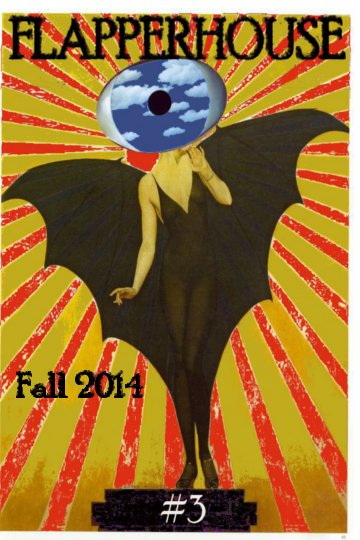




 FLAPPERHOUSE