Category Archives: Fiction

“Mange” – Fiction by Cyndisa Coles-Harris

Wild_coyoteMysterious coyotes & ominous heat lightning inhabit “Mange,” Cyndisa Coles-Harris‘ surreal, semi-apocalyptic tale from our Summer 2016 issue.

{ X }

SKINNY COYOTE, WILD WITH MANGE, won’t stop rubbing up against the northwest corner of this house’s foundation.  She leaves rucked tufts of red-silver hair, scabs caught at the edge where the siding meets the cinderblock.

Some nights there’s heat lightning over Lake Los Angeles.  Heat lightning has no color and makes no sound.  You see the light, and you feel a fraction of a second’s gap in the air around you.  Time and the possibility of breathing; that’s where the thunder is.  No sound, but there’s a crack in time and in the air.  I stand out on the back porch and watch the clouds strobe, and I kick the loose hair free of the house’s northwest corner.

And sometimes I think that coyote is Cinderella or Snow White or anyway is somehow enchanted, is trying to set me up for something.  I should collect her hair and spin it on a spinning wheel.  I should stock up on silver bullets.  Something.

In this season, I let my backyard hose drip under the last living Joshua tree day and night.  I feel like I have to.  I didn’t kill the rest, I didn’t make the ungodly heat, I didn’t make my own tree the last one.  It’s only, I’ve been here long enough that I feel responsible somehow.

Once, in a September as hot as this one but years ago, I saw a roadrunner loping circles along the shoulder of the highway, staggering.  Out of its mind, that bird, dying of thirst.  If the coyote is Snow White, then I could’ve called a dying roadrunner the prince, except that these things happened in the wrong order.  The roadrunner stumbled in and out of my life ages ago, before all the rest of the desert died of the heat, long before the coyote started leaving clumps of her filthy hair at the corner of my house.  So I never thought to call that bird a prince.  I missed my chance, missed half the myth.

{ X }

I watch cartoons when the aerial is working.  Often it doesn’t; something in the weather out here sends noise down the wire to the screen, so it snows most days.  Not outside, not ever; this place was always desert, even before the drought.  But it snows on the screen.  Cable out here is expensive, I can’t pay bills with coyote hair.  But like I say, the problem with the aerial is atmospheric.  I’ve learned that if the television is working by noon, then there’ll be heat lightning at night, so it’s useful for guessing the weather, at least.  And when I can, I watch cartoons.

There’s just the one station, and they show cartoons.  Only the coyote and roadrunner.  There are six or seven of these manic short films, and they play on a loop.  Cliff, slingshot, TNT, poor coyote, over and over.  Either the station only broadcasts those six, seven cartoons on a loop, or else it airs more and different things, but if so it’s one hell of a coincidence: always coyote and roadrunner playing when the snow stops and the screen functions.

Then at night there’s heat lighting, and every flash brings that silent gasp of thunder.  Always, the moment, and then the moment’s gone and there’s sound and space again.

{ X }
Continue reading “Mange” – Fiction by Cyndisa Coles-Harris

“Helpful Notes Regarding Your Purchase” – Fiction by Brandon Barrett

By David Shankbone from USA [CC BY 2.0], via Wikimedia Commons
Cavalier King Charles Spaniels by David Shankbone [CC BY 2.0], via Wikimedia Commons
Should you dare to sample a sneak-peek of the extraordinary weirdness that awaits in FLAPPERHOUSE X, our Summer 2016 issue, please help yourself to Brandon Barrett‘s flash fiction “Helpful Notes Regarding Your Purchase.” Our 10th issue officially flies on June 20 and is currently available for pre-order in print for $6 US, & in digital (PDF) edition for $3 US.

{ X }

  1. DEAR (REDACTED): Congratulations on your purchase!
  1. Please understand that once the device is activated, refunds are impossible. All of us here at (redacted) realize that you paid a considerable price–both monetarily and otherwise–and so please read all notes below prior to activation.
  1. Assembly is required. It shall be no easier but also no harder than it appears on first glance. We recommend setting aside 2-3 weeks of vacation to dedicate to this project, assuming productive 10-hour days. The time commitment may be less if you possess a strong background in the Classics and/or quantitative eschatology. More if this does not describe you.
  1. If you are currently employed in such capacity that vacation time of this sort is inconceivable or financially inviable, then educational retraining and vocational placement programs can be facilitated. Please call during regular business hours.
  1. The set of assembly manuals are shipped separately as the crate requires special handling by experienced movers.
  1. Take a deep breath. You are no doubt still apprehensive about the financial outlay that this purchase represented. Pause for a moment to appreciate the fine craftsmanship of the storage box, which is hand-carved from a single large piece of lignum vitae. They used to make turbine bearings for hydroelectric plants out of this stuff.
  1. The device itself will have no worth after activation (see #2 above) and in fact will have lost all structural integrity. This is the “brown goo” stage of the device’s lifespan and it marks the end of your time together.

Continue reading “Helpful Notes Regarding Your Purchase” – Fiction by Brandon Barrett

“This Year’s War” – Fiction by Nickalus Rupert

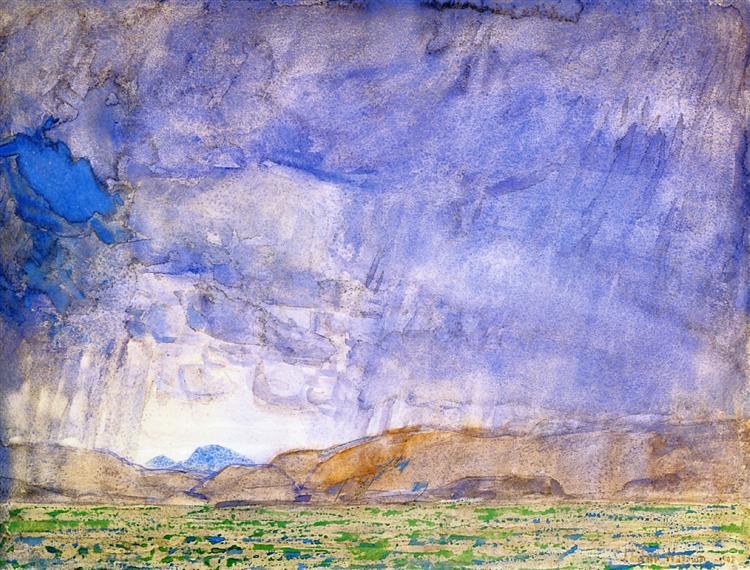
Thunderstorm on the Oregon Trail - Childe Hassam, 1908
Thunderstorm on the Oregon Trail – Childe Hassam, 1908

The grand finale of our Spring 2016 issue is “This Year’s War,” Nickalus Rupert‘s satirical yet tender tale of civil war in a not-so-improbable America.

{ X }

I’M GETTING TOO OLD FOR WAR, even the fictional kind. Our Reclusive Fifth hasn’t fought a real battle in years, and we don’t care to. Like so many others I’ve spent the better part of my adult life waiting for the thundering trumpets and molten skies that’ll finally herald the end times. Makes sense that the lesser cataclysms I’ve witnessed might set the table for a more proper apocalypse.

On the first Monday in April, we conduct our biannual meeting with the governor of New Oregon. Colonel Rivera reports heavy enemy casualties as usual. According to the records, we’ve laid low scores and scores of Cumberland soldiers, which is why Governor Swerth lets us keep our costly horses. Swerth drinks liberally from a flask looped around her shoulder. Her eyes moon with pride as Rivera embellishes the details of a battle we never fought. The more our colonel lies, the more I sweat, worrying that Swerth might want more details, might start demanding proof of battle.

Governor Swerth assures us that our victory is imminent and that Cumberland is run by unenlightened parochial mouth-breathers. Everyone knows that Swerth’s brother claims himself governor of Cumberland’s New Georgia, but no one mentions him. Swerth is so impressed she throws a few pieces of reformatted gold in with our usual bounty. Not that we need more gold.

On Tuesday, we march through another ruined town. Medford, maybe. Weeds and young trees spring from building foundations, confusing them for planters, while goats and rabid horses graze between toppled tombstones. Silas keeps chomping his bit and throwing his mane as we pass through. Even from a distance it’s obvious that many of the remaining townsfolk are delirious from heavy metal poisoning. Through my collapsible spyglass I watch two raggedy derelicts club each other with rusty appliances.

Shadowy mountain ranges tumble up from the northeast as we pass, their peaks sharp and frosted. Mt. McLoughlin reveals itself by degrees, a newly-formed tooth. To behold such a place, you might believe there’s more to the world than what we’ve seen ruined.

Rivera waxes sentimental about Crater Lake, that great barnacle nestled among the Cascades. He talks about the purity of its waters, which pool over three hundred fathoms deep inside the rim. It’s irritating to hear him go in like this. I’m not one who likes to get distracted by the landscape, which can kill you just as well as anything else out here.

On Thursday we round a river bend to find a brick-red canoe lashed to a tree on the opposite bank. The dozing fisherman’s pole is still poised over the water. We all smile easily until Doris motions to the faint ribbons of smoke curling over the pointed hemlocks behind the canoe. We hush our horses and scuttle under the firs. Echo huddles beside me on the dry loam. She and I are the only gray-heads in the bunch, she several years my senior, and already showing symptoms of toxicity. Over the years, I’ve seen her stove in her share of skulls, but now she sits with a fledgling bird in her coat pocket.

“I named her Pickles,” she whispers.

“Why Pickles?” I ask.

“Because that’s what I was hungry for, Clark.”

A few minutes later, we see the first enemy soldier. He parts the hemlocks along the opposite bank and swoons in the sunshine, shoeless and shirtless, his chest bearing three tattooed feathers—an emblem trademark of the Cumberland flag. He saunters along the river, pulls a serrated knife from its scabbard, and belches. The sleeper in the canoe doesn’t stir, so the soldier tickles the inside of the sleeper’s ear with the blade. That wakes him up. Without a word, the soldier hauls the man up by his hair and drops him onto the muddy bank. The fisherman pleads with the soldier, who laughs. Another Cumberland grunt appears at the soldier’s side and they begin laughing and kicking the fallen fisherman, either man lean as a bayonet. One of them pulls the guy’s oars out and chops his ribs good. I’m surrounded by gaping mouths. Few of our regiment’s soldiers are old enough to have encountered any significant conflict. No way they’ll risk their lives for this stranger.

A Cumberland soldier spits into the mud and starts piling river stones and driftwood into the canoe. The other soldier nods and adds branches of his own. They load the flimsy fisherman back into the canoe, pinning his legs beneath a snarl of branches and anchoring the branches with more rocks.

The fisherman doesn’t dare move, not even when his canoe lists over, water already threatening to spill over the gunwales. The soldiers swell toad-like as they taunt. They’ll drown this man. They’ll probably kill me if I try to interfere, but that’s not reason enough to stay hidden. Better to make a worthy sacrifice, no matter how feeble the effort.

Continue reading “This Year’s War” – Fiction by Nickalus Rupert

“Multnomah,” “Consolation Prize,” and “Projection” – Flash Fiction by J. Bradley

By Woo from irvine, ca, USA [CC BY 2.0 (http://creativecommons.org/licenses/by/2.0)], via Wikimedia Commons
Multnomah Falls, Oregon – by Woo from irvine, ca, USA [CC BY 2.0 (http://creativecommons.org/licenses/by/2.0)%5D, via Wikimedia Commons

From our Spring 2016 issue, “Multnomah,” “Consolation Prize,” and “Projection” are three parts of J. Bradley‘s novella-in-flash about multi-generational kidnappings.

{ X }

“Multnomah”

NEIL CLUTCHES MY WRIST AS WE WATCH THE WATERFALL from the bridge suspended above the park. I shift us away from the tourists as they take pictures of or selfies with the falls.

“I wanna go back down,” Neil says.

Neil fights as I perch him on my shoulders. He smacks the top of my head once or twice. I fight my father’s advice and keep Neil and I away from the railing. I fight my father’s advice and don’t back into the railing behind us, loosen my grip on Neil’s shins. I fight my father’s advice, for once. Continue reading “Multnomah,” “Consolation Prize,” and “Projection” – Flash Fiction by J. Bradley

“Likenesses” – Fiction by Leona Godin

From our Spring 2016 issue, “Likenesses” is Leona Godin‘s touching tale of love & life after death, inspired by her own family history. In the video above you can hear Leona read the story, and you can even see some of the old photos referenced in the text. You can also hear Leona read from this story and chat with Ilana Masad in episode 63 of “The Other Stories” podcast!

{ X }

{ 1981 }

WHEN THEY FOUND LEONA’S BODY it was curled about an old grey cat, also curled and stiff. The funeral director’s assistant (who did all the dirty work with the fluids and convex plastics to keep skin from sagging, while the funeral director—the artist, he called himself—fussed with lipstick and wigs and hands folded just right) said he’d never had such a hard time prying two bodies apart, said he’d almost given up and buried them together, “but of course one can’t find a casket shaped like that.” He was telling his cronies at the bar after work and they all laughed to hear how the cat’s stiff paws would not let go of the human hand. “The thing that gets me is how they must have died at the same damn time,” he said and drank his whiskey dry. “That’s some crazy bond.”

{ Mama and Papa, 1910 }

Mama was born Katherina Wiget, of the original Canton Schwyz Wigets who boasted a family crest of gold wheat on a field of blue. If she had been a joyous child, nobody in America knew, for her unhappiness blossomed with her youth when she was unceremoniously shipped off to distant relatives after her father married a younger woman to replace her dead mother (the young wife having no use for her predecessor’s children). At age twenty, Mama found herself working as a seamstress in St. Louis, where she met Albert Beynon, another Swiss, but from the other side. He spoke no German and she no French. Their common language was their adopted tongue of English.

A young and charming rake, whom the Americans called Frenchie, Papa worked as a mechanic on the ford Model T for much of Leona’s childhood, first in St. Louis and then in San Francisco. Not the factory type, Papa managed always to steer clear of the assembly line, working independently as a mechanic who fixed cars for the youngsters who’d grown up wanting them, not making them. Having apprenticed in Geneva in the early days of the internal combustion engine, he was a tinkerer at heart. If he had not the temperament nor genius nor entrepreneurial spirit of a Ford or a Benz, he shared with them a great facility for putting things together and taking them apart, as well as a soft spot for the new and ingenious which found expression in his trade of mechanics and his hobby of photography.

In Leona’s photograph of them, Mama dwarfs Papa, whose head is nearly level with (and not quite as big as) her enormous breasts. Dressed in calico, she seems painfully aware of how ludicrous they must appear in the eyes of posterity and hence refuses to meet our gaze. She stares off camera and away from her husband. For his own part, Papa adored posing for pictures almost as much as he loved taking them. Hence he looks directly into the camera, seeming almost to delight in his new wife’s embarrassment. The result is a portrait of a couple whose eyes’ trajectories form an acute angle, symbolic of their married life.

{ Papa, 1923 }

Papa left on his first solo sojourn when Leona was thirteen. She cherished the photograph he sent back in which a swashbuckling Papa wearing tilted hat and lace-up boots is surrounded by otherworldly trees with knotted flowered arms that stretch to the sky, on the back of which he wrote, “6 November, 1923, Mojave Desert Love Papa.” Leona felt not the least resentment towards him for leaving (Mama felt enough for the two of them) and rather admired the rugged jauntiness of his likeness, as well as the cleverness of the timer-camera and the hand-built automobile, which, though they did not make it into the frame, add greatly to the charming picture of independence.

As the ‘20’s roared along, Papa spent less and less time in San Francisco, so that when the Crash of ’29 hit, his absence was more fixed than his presence. The sporadic letters wrapped around small bundles of cash had also grown scarce then vanished altogether, but by then Leona was a woman. She took jobs cleaning Nob Hill houses to help support the family, which also included her little brother Arthur who, being eight years her junior, was almost more son than brother.

Mama had a tyrannical disposition which, if it were not for Leona’s being her equal as a workhorse on the one hand and impervious to black moods on the other, would have made the double-mother household unbearable. As it was, the two balanced each other out, and raised Arthur with much discipline and coddling respectively. Arthur rewarded their ministrations by being the first in their family and their acquaintances to go to university. Good at math and eager to travel the world like Papa, Arthur studied mining, a subject which had, since the Gold Rush days, become a marvel of science and engineering, while it maintained its adventuring mystique. Continue reading “Likenesses” – Fiction by Leona Godin

“Redfield” – Fiction by Stephen Langlois

1906FireA mysterious name turns out to have a sinister history in “Redfield,” Stephen Langlois‘ chilling short story from our Spring 2016 issue. (And now, you can hear Stephen read this story & chat with Ilana Masad on The Other Stories podcast!)

{ X }

FIRST TIME SHE SAID IT—well, it hardly sounded like anything at all. She was aside me, asleep. Her eyes were doing that thing–that rapid movement thing–and her lips kinda pursed for a second before going all slack like she was struggling to tell someone something real important. The second time it was just two disconnected syllables. Third time there was words. There was definite words that third time.

“Red field,” she was saying and what it brought to mind was like a field of thick reddish grass like what you might see in a painting of some distant countryside somewhere. That, or it was like a field which had caught fire—ablaze is what they’d call it—radiating a deep red hue there in the twilight.

“Redfield,” she said again and that’s when I understood it was a name. A man’s most likely. For a second my brain even latched onto the idea of another lover—like how in movies they’re always accidentally confessing to secret affairs—but there was a kinda fearfulness in her voice that made me decide otherwise.

I was wide awake by this point. Had been really for hours. It was the medication I suppose. The doctor said if we was to keep upping the dosage it’d start interfering with my sleep cycle and he was right. It did.

“You know anybody goes by the name of Redfield?” I asked her in the morning.

“Redfield?” she said, thinking on it for a while. I liked that about her. She was what you’d call a deep-thinker. “No,” she said. “No Redfield.”


Next night, though, was the same damn thing. “Redfield,” she kept on saying and it was like she was unconsciously –or is it subconsciously?—trying to issue a warning about this individual. It was unsettling laying there in the dark, listening to that. It was like maybe this Redfield was out there, leaning against the chainlink between the yard and Riverside Park, looking up at the bedroom window, just kinda enjoying the fact that someone was up here uttering his name with what might be described as a sorta dread.

“Sure you don’t know anybody by the name of Redfield?” I asked her over coffee.

“I know Redfield,” her kid said, coming into the kitchen in search of breakfast. “I know about Redfield anyways. I had a whole dream about him last night. His name’s Redfield,” she told us, “and he lives in a field. A red field,” she said.

Though I knew I weren’t supposed to—not after what happened the previous time—I decided to skip my meds. I was getting sick of laying awake after working my ass off all day and come eleven o’clock that night I pretty much passed right out. Stayed that way, too, for a good two or three hours before waking up like I ain’t never been asleep in the first place. I’d been saying his name. I knew it somehow.

“Redfield,” I said—trying it out like for investigative purposes—and I admit I was a little spooked by how familiar it sounded coming outta my mouth. It was like probably I’d spoken his name quite a bit before that night. Like I was trying to speak to him directly almost, a prayer you might say of the unhallowed variety.

“Redfield,” said a voice, louder this time, and I figured it was my own before comprehending it was the woman aside me, still asleep. It weren’t too long before another voice could be heard from down the hall joining in—it was the kid’s—and I tell you it was almost like Redfield was there in the house now. It was like our late-night utterances really had somehow gone and conjured this man a body with all the fleshy weight that came along with it, the unrestrained limbs, the brain matter sparking with what it is they call cognition. I could picture Redfield peering around the doorways into each room, envisioning to himself what sorta devastation he might someday bring about to this otherwise unharmed space.

Continue reading “Redfield” – Fiction by Stephen Langlois

“The Libidinal Economy of the Suburbs” – Fiction by Joseph Tomaras

Smiling Blonde - Marjorie Strider
Smiling Blonde – Marjorie Strider

“Things said and unsaid that cannot be unheard” make up “The Libidinal Economy of the Suburbs,” Joseph Tomaras‘ flash fiction from our Spring 2016 issue.

{ X }

YOU HAVE TO FLUSH THREE TIMES to send all your excreta to the town café’s septic system. It was the kind that is pleasurable but leaves you feeling a bit dirty afterwards, no matter how vigorously you wipe. You wash your hands and leave the bathroom, book in hand, three-quarters of your second mug of coffee gone lukewarm on the table.

She, overtanned with sun-brightened hair in the manner of white American women of the middle classes, says as you sit, “Have I seen you before?”

“It’s possible,” you reply from your Saturday morning stubble, your hair uncombed and two months overdue for a cut, in your faded jeans and the blue, buttoned-down shirt whose threadbare state is visible only at close range.

“No, I mean, here, today, earlier this morning. Have you been here a long time?”

“What time is it?” You ask honestly. You wear no watch and left your phone at home.

She flashes her tennis-braceleted left wrist and says “A quarter past a freckle,” chuckles, then looks at the iPhone in her right hand and says, “No, really, 10:32.”

“About an hour, then.”

“You said something to me on the line.” You never speak to people on the line. “I stopped in here after I dropped my son off at soccer, and you were with a group of people.”

“You must have me confused with someone else.”

“Actually I’m just trying to pick you up.” Her sons, five-to-eight years older than your kids, roll their eyes at one another as you steal a glimpse at her breasts, five-to-eight years lower than your wife’s. “No, I’m just driving my kids crazy.” By which she means:

“Really I am trying to pick you up but with my sons here I have no idea how to make that happen and you don’t seem interested and this is embarrassing, abject really, please help me out.”

Continue reading “The Libidinal Economy of the Suburbs” – Fiction by Joseph Tomaras

“The Libertine’s Lament” – Fiction by Rob Hartzell

Máquina De Coser Electro-Sexual - Oscar Dominguez, 1934
Máquina De Coser Electro-Sexual – Oscar Dominguez, 1934

Our Spring 2016 issue is perhaps our sexiest issue yet, thanks to pieces like “The Libertine’s Lament,” Rob Hartzell‘s highly stimulating short fiction on the future of virtual pleasures.

{ X }

I REMEMBER THE OLD VIDEO-STREAMS I used to collect of Japanese women making love to each other in cramped Tokyo apartments, or of Americanized women from various parts of Asia kissing languidly at poolside in California, or caressing each other in the hotel rooms used to make so much of the pornography of that era, and I remember thinking even then that the actual Japanese women were much less arousing than the Americanized fantasy women when they kissed, the Japanese women almost violently groping each other with their mouths. Even then, the semblance was better than the real thing—but the point is moot here in the Cloud, where there is neither real nor illusion, nothing but perception, whether the sense data comes from cameras and haptic devices or experience files stored on one of the local servers. For those of us who have uploaded, anything can be real enough; the question is, does it make us feel enough? At this particular moment, it is still not quite possible to produce a satisfying dinner-experience: taste is the last frontier of the digital divide, though there are other pleasures open to those who have left their inhibitions behind with their bodies…

{ X }

Playmate #3—we are known to each other only by our numbers—is my current favorite. It’s considered bad form to ask personal details of another playmate, but it’s nearly impossible not to imagine the stories behind the scenarios we enact with each other. She has a fetish for Japanese rope bondage, which is why most of #3’s fem-dom scenes find me floating in a snug cocoon of ropes, like an embrace that grasps me everywhere. Her latest refinement: she does not permit me to see her or her toys of choice until we’re well into the scene, even if it is the cat she usually uses first, snapping and flogging my back awake, as if the tendrils of the whip pass through the rope on their way to my (virtual) flesh.

{ X }

Our developers are nothing if not clever code-monkeys: once intoxication routines had been hacked, orgasm was only a quick hack beyond that. The hard work was getting it to sync properly with sense data, to make it happen the way it did in the flesh. It wasn’t long before someone hacked an orgasm button, but we agreed amongst ourselves not to use it. The point of our little club, after all, is to prolong and refine our pleasures, not to crassly flip a bit-switch and get a little jolt of the old petit mort the way one might order a coffee. This is something the moralizers, who accuse my kind of seeking instant, constant gratification, will never understand: the difficulty that’s involved in achieving real pleasure. That it is difficulty itself which, more often than not, defines real pleasure, especially among connoisseurs such as us. Continue reading “The Libertine’s Lament” – Fiction by Rob Hartzell

“Doodlebug” – Fiction by Emily Linstrom

Immortality - Henri Fantin-Latour, 1886
Immortality – Henri Fantin-Latour, 1889

Our Spring 2016 issue is our most invincible issue yet, its pages resounding with time-slaying stories of immortality, reincarnation, and eternal recurrence. And setting the table for this otherworldly affair is “Doodlebug,” Emily Linstrom‘s haunting tale about a family of monstrous immortals hiding out in “a part of London even London has no recollection of…”

{ X }

{ Prologue }

THE HOUSE IS SITUATED ON A CRESCENT ROW, nicknamed by the rustics the “h’moon.” It is not a street you will ever stumble upon, and count yourself lucky for it. The crescent is located in a part of London even London has no recollection of, a corner canopied by centuries of soot and smog, fog off the Thames tapping at the streaked glass panes with wraithlike fingers. The row is silent and, one would suspect, largely abandoned.

Except for one house.

Standing four stories and flanked by an equal number of fluted columns, it is a study in Grecian symmetry: wide steps leading to imposing double doors, the Gorgon’s head knocker stiff with disuse; an iron gate clenches the house—the whole row, in fact—in its jaw, nothing that enters may escape. The silence is a sound unto itself, a weird sort of life that is not alive at all.

The family has a name, ancient and unpronounceable, and that name has been etched over the front door for centuries. And so too have they resided within. For centuries.

Back when Britain was a wild isle ruled by tribes, a general carved a highway into the land and conquered those tribes, and built great temples and fortresses, and erected gods that were not their own, then toppled those gods and replaced them with one. The old ways were set afire, and strong Roman feet trampled the ashes. The city went up, one they could not stop building, expanding, adding on to. The general believed himself a god, and worthy of a god’s lot, and so he built himself a home that could only be called a temple. And did things only a god would dare, until he damned himself and his kin right into monstrous immortality.

Monsters, they truly are. Or would be called, had the world even the vaguest notion of them. Their lives are delivered to the door by an equally obscure messenger, unnamed and unseen, and the h’moon keeps its secrets. Continue reading “Doodlebug” – Fiction by Emily Linstrom

FLAPPERHOUSE Podcast #2 – Reading #6

In case you missed our 6th reading— or if you didn’t miss it but would like to relive the experience in podcast form– you may now stream or download it through the Soundcloud file below!