THOUGH I STARTED COLLECTING SECRETS AT THE AGE OF FIVE, it was not until my last year of graduate studies in physics that I discovered a use for my hoard.
Under another name, I am well-known within a small community, that of high-energy physics. We are the ones who send atomic nuclei smashing against each other at near light speed to see what peculiar entities escape the wreckage. Much as fiction writers do with invented families: I realized this when procrastinating on my thesis with a binge of Raymond Carver.
No offense to you writers, though, but how much more valuable would the data be if it were based on actual collisions, not your more or less stereotyped models, or your real-life examples slightly falsified to protect egos and innocents? Once the basic analogy is made, the fundamental theory almost explains itself—to those with a sufficient understanding.
For example: Every force that attracts or repels has an associated wave-particle. The force that binds quarks into protons and neutrons and binds them into an atomic nucleus is called the strong force, and its wave-particles are called gluons. Whatever we call the force that binds parents and children together into a nuclear family, its wave-particles must be what we call secrets.
I WENT ON A DATE WITH A WRITER WHO WAS LITTLE MORE THAN A RACKETEER. At the exhibit showcasing the works of the long-dead artist who had once been in exile from an old country, he read the descriptions of the paintings and wrote down one word from each on his uncalloused palm. He was merely borrowing, would save these words for later. I tried to catch them while I drifted from painting to painting of women and bouquets, levitating upwards. Exuberant, one might have said, or maybe exhume. They fluttered and crumpled each time he closed his palm. The rituals of creative types are only a few degrees away from felony.
Afterwards, we went to a bar, where the writer told me that there are two things one is absolutely forbidden to write about: writers and bars.
I told him that when I was a kid, I used to drink my mother’s aromatized vermouth straight from the bottle and never even blinked; how the burn would wear the silk recesses of my throat, to sever it from the inside-out. I was a young drinker: twelve, thirteen.
Erode, he said. It would erode your throat.
Yeah, okay, I mean, it would erode it, I guess.
A date between two men or a date between two women might as well take place on an analyst’s expensive chaise. Here are the ways in which my life has been harder. Let me count them, let me hold them up for you to see, let’s both feel bad together.
His username had been HexameterMe; his online dating profile had listed his occupation under Creative/Writing/Art. So of course, I asked about it.
Well, yeah, I freelance. He paused. The dark mahogany light of the bar dimmed for the exchange of ambience. A stout, unlit candle stood on every table. I also work for an agency. I database for them. I database during the day. So he, too, wanted to be his better self. Continue reading “Breakers” – Fiction by J.E. Reich→
NATALIE DIDN’T KNOW WHERE THE MUSICIANS CAME FROM. When she woke from an ill-advised three-hour nap they were there in her spotless living room, their instruments strung out like her old college friends all over the brown plush carpet.
The empty carcasses of their instrument cases confused her. She stepped around them. She did not ask the musicians why they were there, but she did think it odd that they were not playing. Their instruments looked lonely leaning against her dusty elliptical, her empty bookcase – she had sold her books for cash at the local bookstore – her coffee table with the missing leg. As she stood in the kitchen door, which looked out at the living room, and shoveled peanut butter granola down her throat, she catalogued the instruments: one thick upright bass, one legless Casio keyboard, one worn acoustic guitar with a blue stripe down its middle, one tarnished brass trumpet, and one silver saxophone relaxing awkwardly on the couch beside a man whose dark fingers strangled its neck.
She looked, blurred by a nappy haze, from musician to musician, cataloguing them too, trying to place each man to his instrument. And they were all men, she realized with a start, five strange men in her home.
The one attached to the saxophone had dreadlocks to his hips, thick and black and beaded, a squarish face; beside him a thin man with two scars on his lips the shape of a trumpet mouthpiece sat with his legs crossed at the upper thigh; a rounder, cleaner man with the upright’s curved silhouette stood in the door to the study, his hands pressed against the frame as if blocking her escape, though the exit to the hallway was clear, thus that couldn’t have been his intent; a Hispanic man crouched behind her lazy boy, his hands poised across its back like a piano. The guitar player with shaggy brown hair covering one eye and black tape wrapped around each finger she didn’t have to guess at.
We’re giddy to open the box of our Summer 2014 Issue and unleash its first excerpt! Ed Ahern‘s “The Heartless Boy” is a mischievous modernization of one of the world’s most famous myths, swirling with twisted humor, demonic spirits, and wisps of what you might call romance.
{ X }
TOM WILLMAN WAS BORN EXPERIENCING NO STRONG FEELINGS–in fact, no feelings at all. No love or affection. No hate or dislike. Certainly no fear. The closest he came to emotions were pleasing or displeasing sensations.
Tom’s parents, desperate for a smile, had him tested for a litany of diseases, but he proved to be uncaringly above average. They quit trying to show Tom affection by the time he was six, and by the time he was ten were providing only what was legally required of them.
He ate because the tastes were good and food kept him alive. He avoided the harmful and the idiotic, so no drugs or gluttony, but also no designer water or wandering chickens. He exercised and bathed because his body felt better, and exhibited an attractive trimness about which he was oblivious.
Girls in high school viewed Tom’s indifference as cool and his trimness as attractive, feelings heightened once they discovered that his lack of emotion gave him extraordinary staying powers. Tom viewed his frequent sex acts as pleasant consensual exercise.
The person who tried hardest to know Tom best was Arthur Lausten, the high school psychologist. Lausten, with no significant life of his own, compulsively coached people on how to live better. His recurring daydream was perching in a confessional and prescribing atonements.
Tom was required to attend frequent sessions with Lausten, who toiled through hundreds of hours trying to etch Tom’s stainless steel persona with the bristles of a verbal toothbrush.
“Tom, you appear to be neither sociopathic nor psychotic, but except for satisfying basic biological requirements you’re completely indifferent to your humanity.”
“What’s your point, Mr. Lausten?”
Lausten was desperate He pulled out a large folding knife, flipped open the blade and waved it in front of Tom. “What would you do if I threatened to stab you?”
“Run.”
“And if you couldn’t get out of the room?”
“Ask somebody to reason with you.”
“And if that didn’t work?”
“Hit you with this book end.”
“How do you feel about me right now?”
“That question is inane.”
Early in his freshman year a bully had cornered Tom on the football field. Tom let the boy hit him twice before retaliating, knowing that in order to avoid discipline he had to have the boy’s aggression witnessed. Then he broke enough of the boy’s bones that the boy couldn’t be aggressive again for several months. The onlookers noticed that Tom’s expression had remained calm.
At the graduation ceremony, Tom was approached by several girls and avoided by most boys. Tom perceived both the attention and avoidance as irrelevant. An unknown young woman was among those who approached.
“Mr. Willman, I’m Raissa Pandorapolis. I have a job offer for you.” The young woman curved aesthetically and looked no older than he was, although her eyes had the worry lines of middle age.
“Ah.”
“Am I correct that you’ll be leaving home and are looking for work?”
“Yes.”
“Am I also correct that you’ve had difficulties with pre-employment screening?”
“The human resource departments tell me that I’m inhuman.”
“Not me. Please join me for lunch while I explain my offer.”
Summer’s so close we can already feel and smell and taste the mixture of sweat and sunscreen dribbling down our foreheads and stinging our eyes. Which means that any day now, we’ll begin unleashing excerpts from our Summer Issue (which drops June 20). But for the time being, we’ve been thinking about other non-FLAPPERHOUSE writings we should read this season, so we consulted the good folks at The Library of Babel to offer their expert advice.
{ X }
IN THIS VAST, INDEFINITE UNIVERSE OF OURS, we often feel stymied by a certitude that the seemingly infinite bulk of prose crowding the shelves of our Library is, essentially, meaningless. Yet we should never lose our grasp on the elegant hope that, amid so much nonsense, we can always discover books which possess the power to transport us, to edify us, and perhaps even vindicate for all time the acts of human existence. With that in mind, some of our staff members would like to tell you which books they think you’d enjoy this summer as you relax on a hot beach with an ice cold lemonade! (Jorge B, Chief Archivist)
Pdger Mickkel Swigflapp (recommended by Melissa E, Circulation)
“A symphonic cascade of mysterious imagery and arcane lyricism. So thought-provoking, you’ll spend days reconsidering your preconceived notions about the true meaning of flybb jnki hozzmulph.”
Aggagagga Vru(recommended by Horace P, Marketing)
“Everyone likes to talk up Axaxaxas Mlo, but for my money, Aggagagga Vru is the far superior work. It explores themes like identity, loyalty, and kubbjarm with uncanny broofglang and a warmth that never feels saccharine.”
The Great Gatsbino(recommended by Fatima D, Administration)
“Pretty much The Great Gatsby, but instead of Jay Gatsby hosting lavish parties for high society in 1920’s Long Island, it features J.P. Gatsbino throwing bad-ass tailgate parties at high school football games in 1980’s West Orange. It’s no masterpiece or anything, and of course it’s highly derivative of F. Scott Fitzgerald’s American classic. Nevertheless, Gatsbino makes for a breezy, entertaining beach read. More importantly, it’s the closest thing to The Great Gatsby that I’ve seen in a long time– at least since some jerk-wad stole our only copy of that book several years ago. Seriously, whoever stole our Gatsby deserves to be tossed over the railing and into the abyss with a rabid mongoose strapped to their face.”
The Curdled Thumbscrew(recommended by Gary S, Cataloging)
“Most folks here will tell you it’s a fool’s errand to search for a book containing the Word Of God and all the secrets of the universe; they’ll tell you such books exist only in the fevered imaginations of highly suggestible Babel Librarians, and that even if such books did exist, any effort to procure one would prove an endless date with madness. Of course, those naysayers have probably never read The Curdled Thumbscrew. Now, this book itself is not the Word Of God, nor does it contain many secrets of the universe. It will, however, lead you to read The Crumbled Throw Pillow, which cannot be understood without having already read The Curdled Thumbscrew. The Crumbled Throw Pillow is also not the Word of God, but you must read that before it guides you to The Crooked Thimble, which will lead you to The Crusted Thingamajig, which… well, I’ll let you see the rest for yourself. Let’s just say that fifty-seven books later, I’m merely one or two steps away from Ultimate Enlightenment! The Almighty Knowledge that has been beckoning me for years is now so close I can sense it in my marrow. And to think, so many of my so-called ‘fellow’ librarians have been laughing at me this whole time, like that smart-mouthed know-it-all Katy G in Youth Services! Yes, we shall see who’s still laughing when I unlock the ancient truth of all past, present, and future life! WE SHALL SEE, KATY G…
Hearts Of Palm: The Jassy Madigan Chronicles, Part I (recommended by Katy G, Youth Services)
“I beg you, for the love of everything holy, don’t listen to a word Gary S tells you. Not only is he certifiably insane, but his taste in books is dreadful, and he always smells like cabbage. Instead, check out the latest novel by Young Adult master Katrin Vanderslyke! Readers young and old alike will love this coming-of-age story about Jassy Madigan, a kind but awkwardly shy teenage girl who moves to a new town and befriends the mummies in the local history museum. Will Jassy finally find acceptance among the 3,000-year old corpses of Egyptian pharaohs? Maybe even true love? I won’t spoil the answers to those questions, but I will tell you that you’ll enjoy every moment of this wonderful book, except perhaps for that section in the middle that just says ‘BWORP BWORP BWORP’ for 28 pages.
Kurt Vonnegut, Dorothy Parker, Jorge Luis Borges, Flannery O’Connor, Franz Kafka, Ishmael Reed, Kelly Link, Roald Dahl, Stanley Kubrick, Tina Fey, Bill Watterson, Robert Anton Wilson, Haruki Murakami, George Saunders, Tom Robbins, Emily Dickinson, Hunter S. Thompson, Louis CK, Gillian Flynn, Neil Gaiman, Junot Diaz, Octavia Butler, Amy Hempel, Richard Brautigan, Karen Russell, MF Doom, Virginia Woolf
While we enjoy & admire & draw inspiration from other literary publications, our biggest influence is probably HBO.
Poets: Send us your best rhyming poetry, and your chances of being published in our zine will increase. We receive practically zero rhyming poems, because it seems that modern poets think end rhyme is only slightly less disgusting than subway masturbation. But we love good rhyming poetry, and wish we got a lot more of it in our inbox.
Prosers: Send us your best review of an imaginary work, a la Borges’ “Pierre Menard, Author of the Quixote,” and your chances of being published in our zine will increase. Real books/ films/ albums/ etc. are great, but imaginary books/ films/ albums/ etc. don’t get nearly enough critical attention, if you ask us.
Our ideal submission can be described by at least one of the following adjectives: surreal, shadowy, sensual, satirical. It throbs with life and wit and colorful details. It exudes tantalizing ambiguity, but the writing itself is clear and precise– not too flowery, yet not pedestrian either. It drags the future back through the past like a rotting donkey on a grand piano.
Pretty much all of our submitters seem like cool people who’ve read our guidelines and have a fair idea of what kind of lit we want. But sometimes writers will get excessively cutesy in their cover letters, which doesn’t exactly go against our guidelines, but it’s “wrong” in the sense that it’s wrong for writers to assume that excessively cutesy cover letters will make their work more endearing to us. And because the number of submissions has been increasing lately, we’ve been kindly asking submitters of declined work to wait about 2 months before submitting again. When such writers then send us more work a week or so later, we tend to get a little cranky. It’s not that we don’t appreciate the enthusiasm; it’s just that for now, we only have so much time and so many eyeballs to read submissions.
We don’t mind receiving bios from submitters, but we try not to read them before we read the submission. Then after we read someone’s bio, if we think they seem particularly interesting, we might google them to learn more. Of course, what we learn about a submitter doesn’t really influence our decision to accept or decline their work, but it might influence us to follow them on Twitter.
We read every submission from beginning to end at least twice, unless the work is splattered with careless errors and lazy writing, in which case we’ll only read it once.
We’ll do our best to make sure a piece hasn’t already been published before we accept it. We forgot to do that once, and later found out some poetry we accepted had already been posted online. We let it slide that one time, but it’s haunted us ever since.
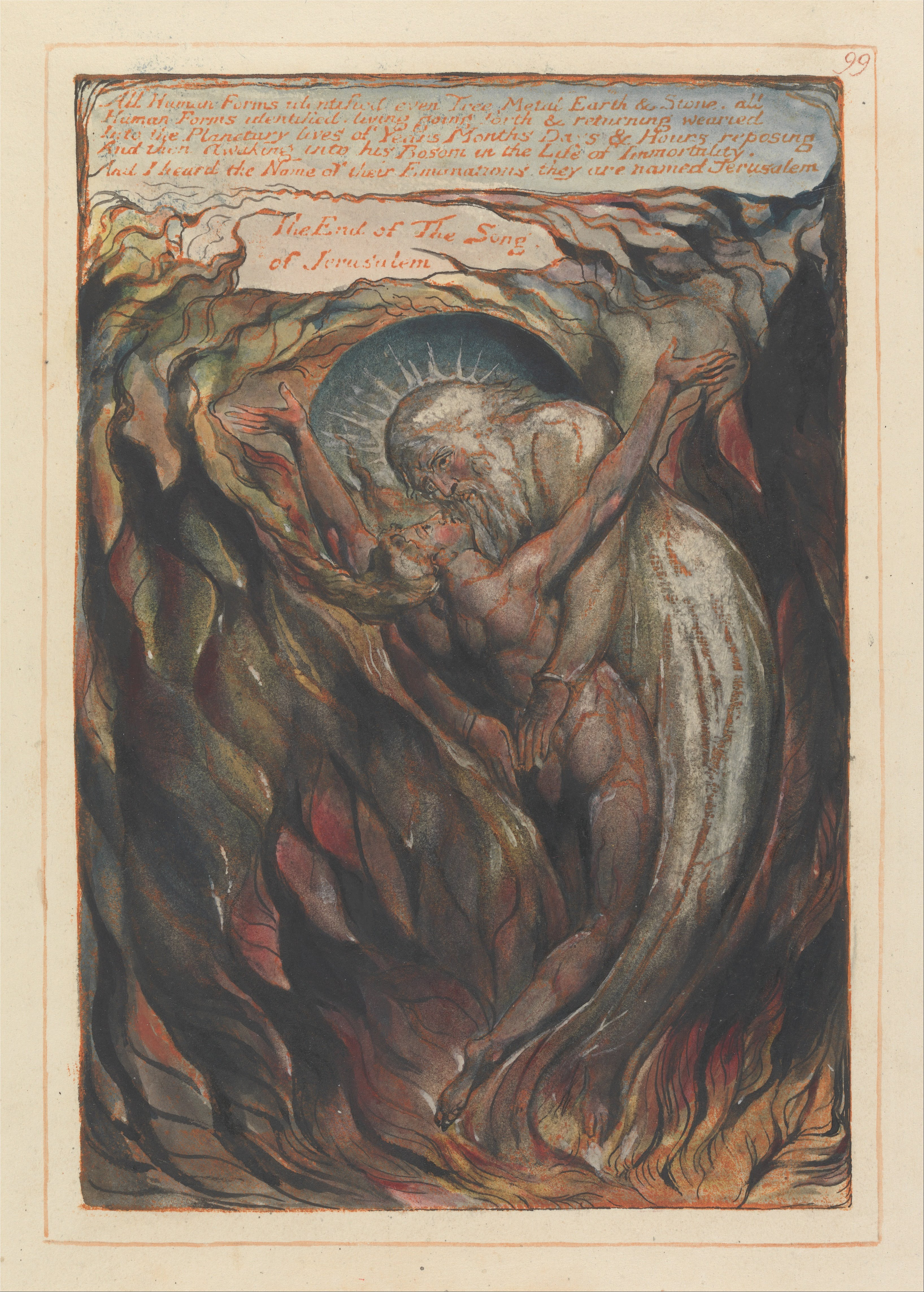
All Human Forms Identified – William Blake, 1804 – 1820
Shortly after we first read Mariev Finnegan‘s “CRYONICS,” we knew this story had to be the grand finale of our premiere issue. It throbs with so much of what we want in FLAPPERHOUSE: surrealism, shadow, sensuality, satire– not to mention added bonuses like psychosis, psychedelia, silliness, sci-fi, and sexual metamorphosis– all blown up to glorious, apocalyptic proportions. (Apocalyptic not as in death & destruction, but from the Greek meaning “uncovering” or “revelation.”) We hope it opens a door or two in your mind, or at the very least, takes you for a spin on a delightfully bizarre trip.
{ X }
THE FIRST DEAD HEAD TO BE THAWED from Cryopreservation was a rich guy, big ego, big head. Bob Nowatchick (Ick, for short) was an autogynephilic transsexual, a narcissistic disorder in which a man is erotically obsessed with himself as a woman. Krystal did not exist, but Krystal was the only woman that could satisfy Bob. He/She were the ultimate evil: Complete unto themselves. Loved no one. Screwed each other.
Krystal, a dark wisp of a girl, developed an ego, became judgmental about that slob, Bob. His diet of fast food, his drug-use, his constant anger– directed mostly at women– all disgusted her. Also, his conservative fashion sense made her real edgy: Their wardrobe consisted of pressed tan slacks and casual sweaters. Because of him, that prick– he had no vagina, no womb– she would never have a child.
So one Labor Day, Krystal murdered Bob. She committed suicide by cop when he tried to have her arrested for raping him. From up in the bell tower, Krystal shot badge number 911 dead. The return barrage of bullets destroyed their heart, but left the head intact.
Bob had paid a huge amount of money to preserve the head, which was removed from the grossly-overweight body, and frozen with the hope that resuscitation and healing would be possible using highly-advanced future technology.
Then, in all probability, Bob would get the death penalty for murdering a cop.
{ X }
Now, 16 years later, the large head, wrapped in foil, is removed from a holographic space chamber and placed on a laboratory table to thaw, because it can now be cured of brain death and brought back to life. A team of professionals attach an artificial heart and lungs, as well as electrodes and monitors. Never before has anyone been brought back after being cryogenically frozen. There had been discussion about Larry King being first, but they decided to begin with the last one frozen, because it’s the freshest. And if they mess up, who’s going to complain? It’s the head of a condemned man.
Sri Sri Ravi Shankar goes public with many spiritual questions concerning the reanimation of life to a head: “Does the mind need the brain? Is our consciousness simply the result of brain function, the firing of neurons within a nonlocal consciousness? What happens when we die? Is the mind separate from the body, having its own eternal existence?”
The head scientist on the project, Dr. Franklyn, tells the public, “We are about to present scientific proof that life is a physical component of the brain, that identity can be restored by contemporary medicine, by restoring life to this head, this brain!”
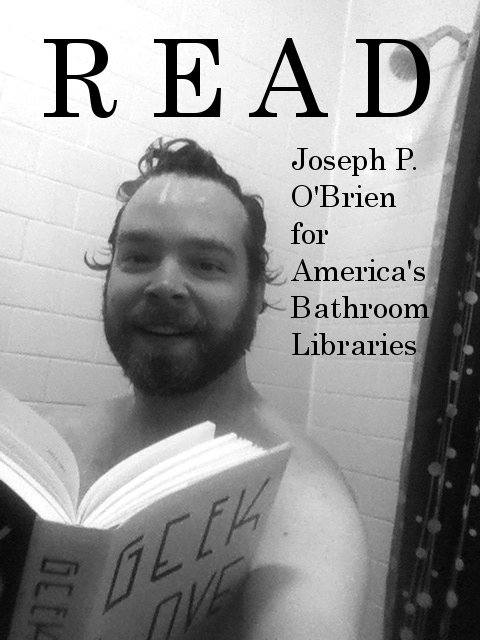
For the latest ad in our campaign to promote Bathroom Reading, our editor enjoys one of his favorite books (Katherine Dunn’s Geek Love) in one of his favorite places (the shower).
J. Bradley is as talented as he is prolific: His surreal yet poignant work has appeared in scores of publications, and we were immensely flattered to include four of his poems in our Spring 2014 Issue. We posted one of those poems (“No More Poems About Resolutions”) back in January; now we’re very flappy to present “A Highly Magnified History,” “When a Poet Wants to Date You,” and “Yelp Review – Total Wine.”
{ X }
“A Highly Magnified History”
Chairs strain to support
the weight of want.
Mannequins shed felt
and wood, leaving sundresses,
blouses on skeletons;
they refuse to flap against
the artificial air.
“When a Poet Wants to Date You”
The mortuary sits on the coffee table,
nondescript. You think the cover
would be made of his skin, her skin.
He slaps your hand for accusing
his love of hemophilia;
the wine never clots.
“Yelp Review – Total Wine”
There are shelves of organs waiting to be pickled with special occasions. Pick a name like a rose to clench or to cast into fire, water, or wind. Pick how you will revise a memory, what desert to costume your tongue with; forgiveness is something you can never drown in, no matter how hard your lungs want it.
{ X }
J. BRADLEYis the author of the graphic poetry collection, The Bones of Us (YesYes Books, 2014). He lives at iheartfailure.net.
The spiel of a dotty, highly-caffeinated, eerily chipper employee at an absurdly morbid vacation ranch is the basis for Phyllis Green‘s “The Thrill of a Lifetime,” one of the many flappery lits in our Spring 2014 Issue.
{ X }
WELCOME TO YOUR FIRST DAY OF VACATION! You’ll have the thrill of a lifetime. We have 36 acres to explore and there are yes, 36 of you SOOOOOOooooo you each begin with a whole acre to yourselves. Just you and those gorgeous gleaming yellow backhoes! Yes you will be trained to drive a backhoe, first thing we’ll do. Now you all look great in your hazmat get-ups! All I can see are little men in white coats-oh oh! And white pants and white foot coverings! Of course the ladies are all in white too. And let’s not forget the little tikes on vacation. All right! Now, you all okay with those plastic helmets? Remember, ask one of my assistants if you are the least bit unsure of the fit or feel. We want everyone comfortable. There is pure mountain air filtered into those protective headgears and rest assured we have not had one accident over someone not being able to breathe or getting hysterical or anything like that. They are perfectly safe. There will be no odor for you to worry about, just pure fresh mountain clean air going into your precious lungs because that’s how we do things here at the Rocky’s Ranch, your ultimate vacation. We promise big results, a truly happy week of exploration and lots of fun party things planned for the evenings. You’ll love this unique vacation and want to come back every summer! Guaranteed!
Now let’s get down to business and not waste another minute. Hope you all had a delicious breakfast? Good! Wasn’t that bacon crisp and tasty? During the morning you’ll have a coffee thermos in case you are a coffee addict like me. And you little kids who look so excited to be driving those huge and I mean huge yellow backhoes– well we have a lemonade thermos for you tikes. So everyone will be hydrated, right?
Let’s take a look at your graphs. Everyone pull out the graphs. See the 36 acres, and can you all see where your own particular acre is? If not, hold up your retriever (make sure the sharp point is not pointed at yourself!) and my assistants will come by and show you your specific acre.
Now we have marked what you may locate on your acre. Besides the usual cantaloupe rinds and peach pits and other things folks throw away in their garbage cans, there are treasures here. In Acre 1 for instance, that is where the darling little Tacy Jones’ body was tossed in a dumpster and deposited. Now most of Tacy has been found, all except for her two eyeballs. And her parents are willing to pay big bucks for either one or two eyeballs, and then there are the collectors and they really have big bucks and don’t forget the horror museums that are popping up everywhere, they have millions to spend. So who is on Acre 1? Raise your long-handled spike, that’s your retriever. Okay, that looks like Johnny Kacinski. Johnny, you find an eyeball or two and if they belong to little Tacy– oh and we do have a DNA lab right on the grounds here– then Johnny, you are going to be rich! Yes, folks, let’s give a cheer for Johnny! Continue reading “The Thrill of a Lifetime” – Fiction by Phyllis Green→





 FLAPPERHOUSE