We’re not sure how this Spaniard fellow in “Master of the Understatement” determines his preferences, but we are surely fascinated by his unique train of thought. This poem is just one of 5 that Catfish McDaris contributed to our Spring 2016 issue, and you can read all of them by purchasing the issue here.
{ X }
SPANIARD DECIDED TO START WRITING: I’d rather be a testicle than a rainbow
I’d rather be a tornado than a stinky fart
I’d rather be a cherry tree than a vagina
I’d rather be Wolfgang Amadeus Mozart than Frank Sinatra
I’d rather be a buffalo nickel than a burning American flag
I’d rather be a teardrop than a booger
I’d rather be a guitar than a sneeze
I’d rather be a cloud than a flounder
I’d rather be a thimble of love than a ton of gold
I’d rather be tiger shit in Vietnam than a man with an ugly penis
I’d rather be a clitoris than a tomato
I’d rather be William S. Burroughs’ amputated finger
than Adolf Hitler’s testicle he lost in World War One.
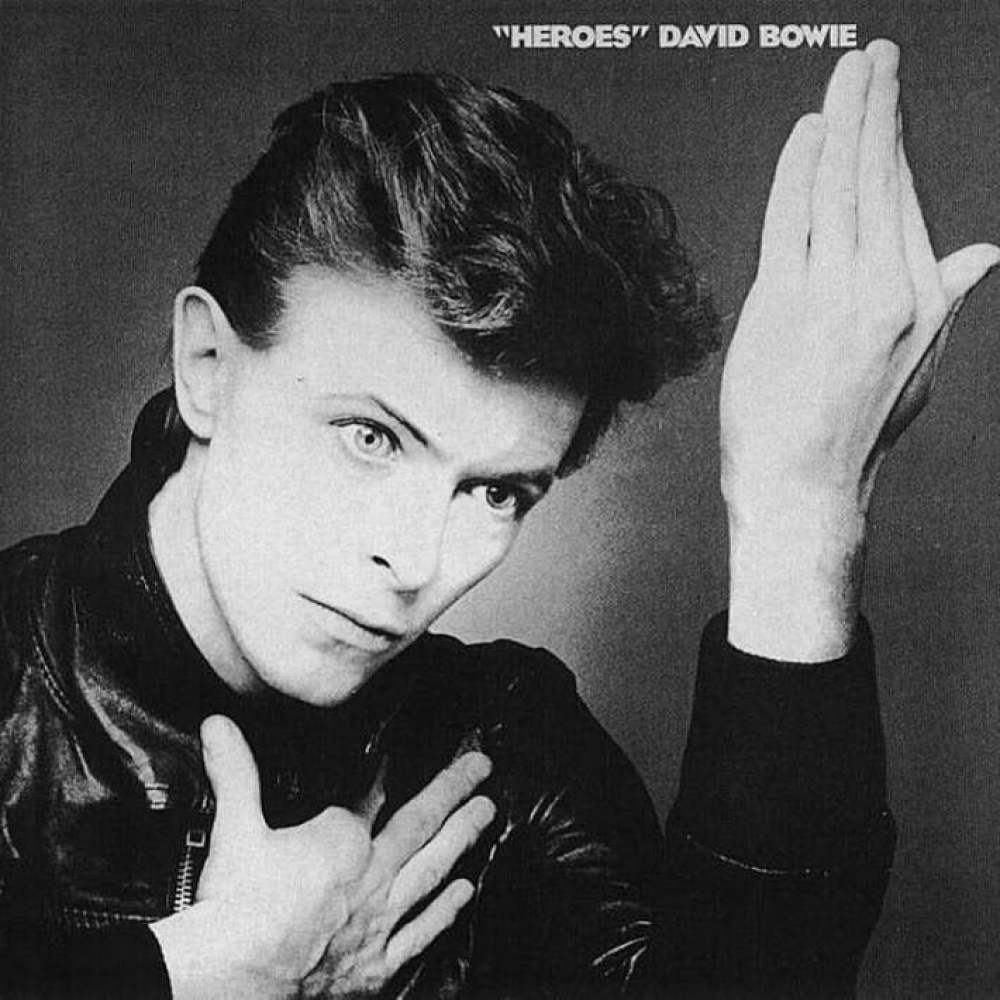
Even our most beloved gods & idols can reveal themselves to be mere all-too-human mortals– like in “A Fan Girl Meets David Bowie,” Sarah Lilius‘powerfulpoem from our Spring 2016 issue.
{ X }
CIGARETTE BUTTS IN A CRYSTAL ASHTRAY,opulence
with stink, curtains catch the smoke.
I see him watch me, wonder when I’d dance
but it’s not the 1980’s and my hair’s in place.
I think of the Labyrinth, a place to lose
myself, in my youth those tight pants
were everything, I dreamt of men
with makeup, men who sing
me to sleep, who laugh in different hats.
He never closes the door, doesn’t smile
as much as I thought he would.
His accent is faded a bit from the city
but still a Brit, I ask him about the Queen.
He looks out a clean window, flicks ash
to the floor and waits for the maid
to vacuum it up.
My dead fantasy is a sealed deal
when Iman walks in, tells me
it’s time to go.
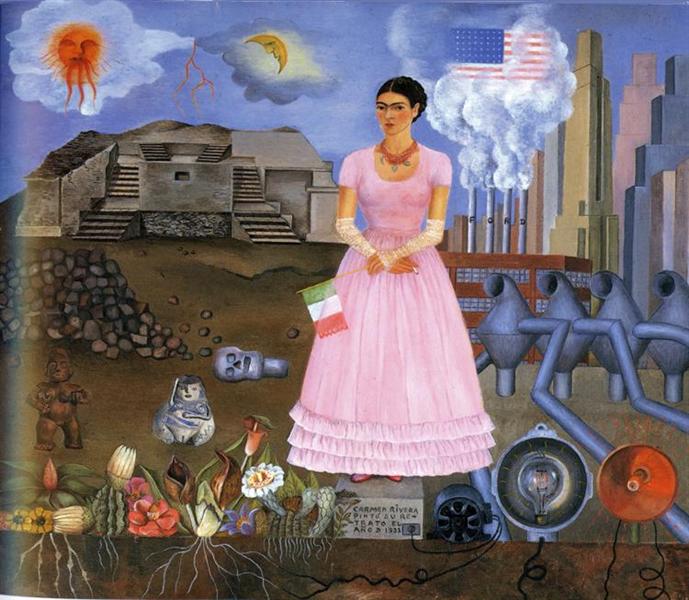
Self Portrait Along the Borderline Between Mexico and the United States – Frida Kahlo, 1932
From our Spring 2016 issue, Sarah Frances Moran‘s lyrical & thought-provoking poem “Rolling Out Tortillas” explores some of the tangled borders of culture & history.
{ X }
ROLL OUT THE DOUGH. Roll out the crossing of rivers and
sun scorched skin.
Roll out fingers brittle from a cotton gin
and a mind, only educated as far as picking a plant
can go.
Roll out dozens of siblings and cousins so vast
you have trouble remembering their names.
Roll out shame.
Roll out the way the white tongue has trouble
rolling the r Roll out and leave that part of you there, flattened.
Roll out eating ice cream outside because
only whites were allowed inside.
Roll out being told you can only speak English to my children Roll out losing your native tongue to love
Roll out your half-breed children
Roll out their light skin and the privilege they’ll
have the opportunity not to appreciate.
Roll out the Almendarez so Davis can fully set in.
Roll out the American Flag,
Roll it far and wide and so far and so wide
That you forget where San Luis Potosí
even is.
Roll out the Chicana in you.
Roll it out so it makes it ok to use wetback liberally.
Roll it until it’s so thin you can only see the white
reflected in your face, until your dark hair and dark eyes, pale.
Teach me how to hold that rollingpin;
So I can remember this labor.
So I can remember how we keep our bellies warm.
So I can remember why my hair stays so curly and how
sometimes, I can see my ancestors through this storm.
Roll out that tortilla and toss it on the comal.
When it hits your tongue,
tell me how you’ve worked so hard to forget,
and tell me,
when it melts in your mouth…
From our Spring 2016 issue, “Multnomah,” “Consolation Prize,” and “Projection” are three parts of J. Bradley‘s novella-in-flash about multi-generational kidnappings.
{ X }
“Multnomah”
NEIL CLUTCHES MY WRIST AS WE WATCH THE WATERFALL from the bridge suspended above the park. I shift us away from the tourists as they take pictures of or selfies with the falls.
“I wanna go back down,” Neil says.
Neil fights as I perch him on my shoulders. He smacks the top of my head once or twice. I fight my father’s advice and keep Neil and I away from the railing. I fight my father’s advice and don’t back into the railing behind us, loosen my grip on Neil’s shins. I fight my father’s advice, for once. Continue reading “Multnomah,” “Consolation Prize,” and “Projection” – Flash Fiction by J. Bradley→
From our Spring 2016 issue, “Likenesses” is Leona Godin‘s touching tale of love & life after death, inspired by her own family history. In the video above you can hear Leona read the story, and you can even see some of the old photos referenced in the text. You can also hear Leona read from this story and chat with Ilana Masad in episode 63 of “The Other Stories” podcast!
{ X }
{ 1981 }
WHEN THEY FOUND LEONA’S BODY it was curled about an old grey cat, also curled and stiff. The funeral director’s assistant (who did all the dirty work with the fluids and convex plastics to keep skin from sagging, while the funeral director—the artist, he called himself—fussed with lipstick and wigs and hands folded just right) said he’d never had such a hard time prying two bodies apart, said he’d almost given up and buried them together, “but of course one can’t find a casket shaped like that.” He was telling his cronies at the bar after work and they all laughed to hear how the cat’s stiff paws would not let go of the human hand. “The thing that gets me is how they must have died at the same damn time,” he said and drank his whiskey dry. “That’s some crazy bond.”
{ Mama and Papa, 1910 }
Mama was born Katherina Wiget, of the original Canton Schwyz Wigets who boasted a family crest of gold wheat on a field of blue. If she had been a joyous child, nobody in America knew, for her unhappiness blossomed with her youth when she was unceremoniously shipped off to distant relatives after her father married a younger woman to replace her dead mother (the young wife having no use for her predecessor’s children). At age twenty, Mama found herself working as a seamstress in St. Louis, where she met Albert Beynon, another Swiss, but from the other side. He spoke no German and she no French. Their common language was their adopted tongue of English.
A young and charming rake, whom the Americans called Frenchie, Papa worked as a mechanic on the ford Model T for much of Leona’s childhood, first in St. Louis and then in San Francisco. Not the factory type, Papa managed always to steer clear of the assembly line, working independently as a mechanic who fixed cars for the youngsters who’d grown up wanting them, not making them. Having apprenticed in Geneva in the early days of the internal combustion engine, he was a tinkerer at heart. If he had not the temperament nor genius nor entrepreneurial spirit of a Ford or a Benz, he shared with them a great facility for putting things together and taking them apart, as well as a soft spot for the new and ingenious which found expression in his trade of mechanics and his hobby of photography.
In Leona’s photograph of them, Mama dwarfs Papa, whose head is nearly level with (and not quite as big as) her enormous breasts. Dressed in calico, she seems painfully aware of how ludicrous they must appear in the eyes of posterity and hence refuses to meet our gaze. She stares off camera and away from her husband. For his own part, Papa adored posing for pictures almost as much as he loved taking them. Hence he looks directly into the camera, seeming almost to delight in his new wife’s embarrassment. The result is a portrait of a couple whose eyes’ trajectories form an acute angle, symbolic of their married life.
{ Papa, 1923 }
Papa left on his first solo sojourn when Leona was thirteen. She cherished the photograph he sent back in which a swashbuckling Papa wearing tilted hat and lace-up boots is surrounded by otherworldly trees with knotted flowered arms that stretch to the sky, on the back of which he wrote, “6 November, 1923, Mojave Desert Love Papa.” Leona felt not the least resentment towards him for leaving (Mama felt enough for the two of them) and rather admired the rugged jauntiness of his likeness, as well as the cleverness of the timer-camera and the hand-built automobile, which, though they did not make it into the frame, add greatly to the charming picture of independence.
As the ‘20’s roared along, Papa spent less and less time in San Francisco, so that when the Crash of ’29 hit, his absence was more fixed than his presence. The sporadic letters wrapped around small bundles of cash had also grown scarce then vanished altogether, but by then Leona was a woman. She took jobs cleaning Nob Hill houses to help support the family, which also included her little brother Arthur who, being eight years her junior, was almost more son than brother.
Mama had a tyrannical disposition which, if it were not for Leona’s being her equal as a workhorse on the one hand and impervious to black moods on the other, would have made the double-mother household unbearable. As it was, the two balanced each other out, and raised Arthur with much discipline and coddling respectively. Arthur rewarded their ministrations by being the first in their family and their acquaintances to go to university. Good at math and eager to travel the world like Papa, Arthur studied mining, a subject which had, since the Gold Rush days, become a marvel of science and engineering, while it maintained its adventuring mystique. Continue reading “Likenesses” – Fiction by Leona Godin→
The first of our readers who can correctly answer all the questions in “The Title is Buried Inside, Or What!”, Ahimaaz Rajesh‘s spectacularly surreal poem from our Spring 2016 issue, will win a 1-year subscription to FLAPPERHOUSE!
{ X }
NO. Who said “Take what’s in your head and leave it under my bed” and to whom?
“Like a broken record spin rascals SPIN!” – Whose galactic admonition is this?
Should I make a list of things to do in my next birth? True. Is revenge a fish?
Why does the incision scar under my wrist look like a stepped-on centipede?
How many days in a? How would you unravel an accident? a. Who are we?
What’s the circumference of a vicious circle? Who discovered time junk?
“First came the white, then came the shell.” – Is that a proper sentence?
Why skip sex education classes? Does all authority come from doves?
Would we feel less alone if we could cast our shadows for a bit more?
Who’s the recurring nemesis in Jesus Christ Superhero? Yes and No.
Can writers cackle? Can’t a proper capitalist be a reasonable person?
What’s the work routine of a turtle? Why isn’t titanium weightless?
Is there an Uniprose? Who first said “Let there be cheese”? N.
Is Dao Pal a pedo-masochist? Have you read Velli Kizhavi?
Is graphic novel alive? What’s the temperature of thought?
Is First Draft of a Lost Questionnaire real? Why will?
Would AIs invoke a pseudo-glorious past?
What’s wrong about good habits?
Who builds the nasal bridge?
Were we ever?
Where did?
What’s a spuake?
1. Is science fiction? c.
Who determines it’s enough?
Must governments run business?
How steep is success? Oh? Why be God?
How would you dismantle a dermonuclei weapon?
Really? Should we split science from physics? False.
How many months in a year would you like to be jobless?
Is there some place in your uniprose to stack my universe?
What intensity of quake’s required to collapse a card house?
What kind of fall is? When’s Karikalan the person a character?
Does a cat eat its? Why can’t peachicks survive amid chickens?
Would you trust an ice cream on a very hot day? What’s with the?
Does it cost much to step out in moon? Would you sell your sleep?
How long and how often should we bury our fingers in our armpits?
Is there any difference between one heaven and many other heavens?
How in the? Can your neighbors talk to you for free? How thin is fear?
What’s the average size of a super ego? Feminism can shave the world?
Where are your lies? When should writers speak? Who bottles fresh air?
Who says “what a fuck” and when? What’s ego-shaped? Right and wrong.
Must a wife know how to weave a trail? 3. How will you climb up to grace?
The mermaid/merman post-coitus, would you prefer my calling that state merlaid?
When over time masters in a field have waned will there then be postmasters?
Where’s my bitterness? Why does a newborn—lying face up—kick box?
Have you once hated eating because that’s what makes you defecate?
Should rivals in action-fiction be allowed to reconcile more often?
Why we shouldn’t ban tissues? Are husbands above hairclips?
Why are undue puns no fun? How to make an Acid Eastern?
When was the last time I watched a movie on television?
Who makes? Are governments above people?
When shall I stop being at many places?
What if bones are made of?
Do you make your?
Hells! No.
How’s sky?
Where are the?
Do house sparrows exit?
Who deals with Blood Gasoline?
Is it true CCTVs are often truant?
Would a hawk grasp a microsoft mouse?
What are some of the languages of birds?
When will our Gods learn to be responsible?
What the. How many lines does it take to draw history?
Can a man? What’s the distance from one instance to next?
Seriously? Do you like the way the apple products taste? (5)
Why are we dumb? Who can get us tickets to an underwater cave?
Why’s literature? Pass. Is there a country without geography? Why the?
Must a man wear burqa? What were? How come a monogamist a marvel?
Wrong. Did you save the dye? How do you say make yourself at home in Sinhala?
Will everything be? Is multiple organism a myth? Who others the another?
What’s the intention of the statement “May the bores be with you”?
Are we inside a globe-shaped egg that’s waiting to hatch?
How many bogies make a train of action? What time is?
What’s popular cult? What’s goodness got to do with?
How come there are many answers to one question?
Will I? What are the benefits of being shallow?
What’s so special about cracked walls?
How to type out an inner travelogue?
When’s verbal fellation an offence?
Who walks between the wicked?
Can a mirror be the witness?
Is anger thicker than water?
(1) Who runs?
Will a?
Y.
IT IS POSSIBLE TO BE POSSESSED BY THE ENTITY to which you have devoted your life.
That possession is not necessarily like they show it in horror movies; sometimes possessions are sacred offerings of synonymous identity, felt due to synonymous embodiment. The cave often calls through me, comes to me, begging for attending. I consider attending the cave a form of self-love.
As I was walking up the hill, after spinning and drowning in what I could only describe as the cave’s primal grief regarding any time it has ever been overlooked by the women that it serves, I began losing it. I was not yet up the hill in such a way that I could lean on Quan Yin (her statue was still hundreds of feet ahead of me) but I was also hundreds of feet away from the cave-proper. Would I remain alone in this moment: the practical and ephemeral moirologist for a complex, cosmic grief which, even in its need to express its depressions, its sadness at being overlooked by the populations in which it serves, it is also desperately in love with every woman who might or might not overlook it?
The cave’s love of and for women is both physical and mythic.
My sisters must have heard my cry just like I hear the cry of the cave.
In a manner of moments they had run over to me, were surrounding me, touching me on all sides. “Present and essential, your roots, your worms, your cave-holding that surges underneath all of these workings with light in the above…” Their touch, their words as touch, begin to bring me back to life.
“Yes, essential but not always celebrated as such.”
I am choking on the feeling. Cave synonym needs cave union.
Whenever I am not appreciated or acknowledged as cave I can feel the result is my slowly dissipating from behind my human woman eyes. This sensation is like slipping; it terrifies me. It is as if any moment in which I am not being touched, I am being overlooked. Kept out of the light. In these I can’t feel Sophia so obviously anymore.
“I feel so isolated from the circle when those who are in the circle are looking only into the circle and not into me (the Below).”
My sisters understand me. They are humming, rocking me, putting pressure on my body. I am crooning with the dark crown as it moves from the cave, below ground, up and through the blood in my veins in its manner of making its way to the top of my head.
The more pressure they physically put on me, the more they puja me as the cave, the more I am able to slowly return to the seat behind my eyes. They don’t let go of me until they know for sure that I am all the way back inside of myself.
“Bodies,” “Another Failed Poem about Unrequited Love,” and “Synesthesia” are three darkly sensual poems by Lauren Milici featured in our Spring 2016 issue.
{ X }
“Bodies”
STILL. TOGETHER WE smell of burning; lit votive
candles. Hit me, he said
so I did. Save me, so
I did. Right through new sheets, bled
and fucked like glass breaking. Once

![By Woo from irvine, ca, USA [CC BY 2.0 (http://creativecommons.org/licenses/by/2.0)], via Wikimedia Commons](https://flapperhouse.com/wp-content/uploads/2016/05/multnomah_falls_oregon.jpg)


 FLAPPERHOUSE