Tag Archives: Fall 2014 (#3)

“Blood Ties” – Fiction by Diana Clarke

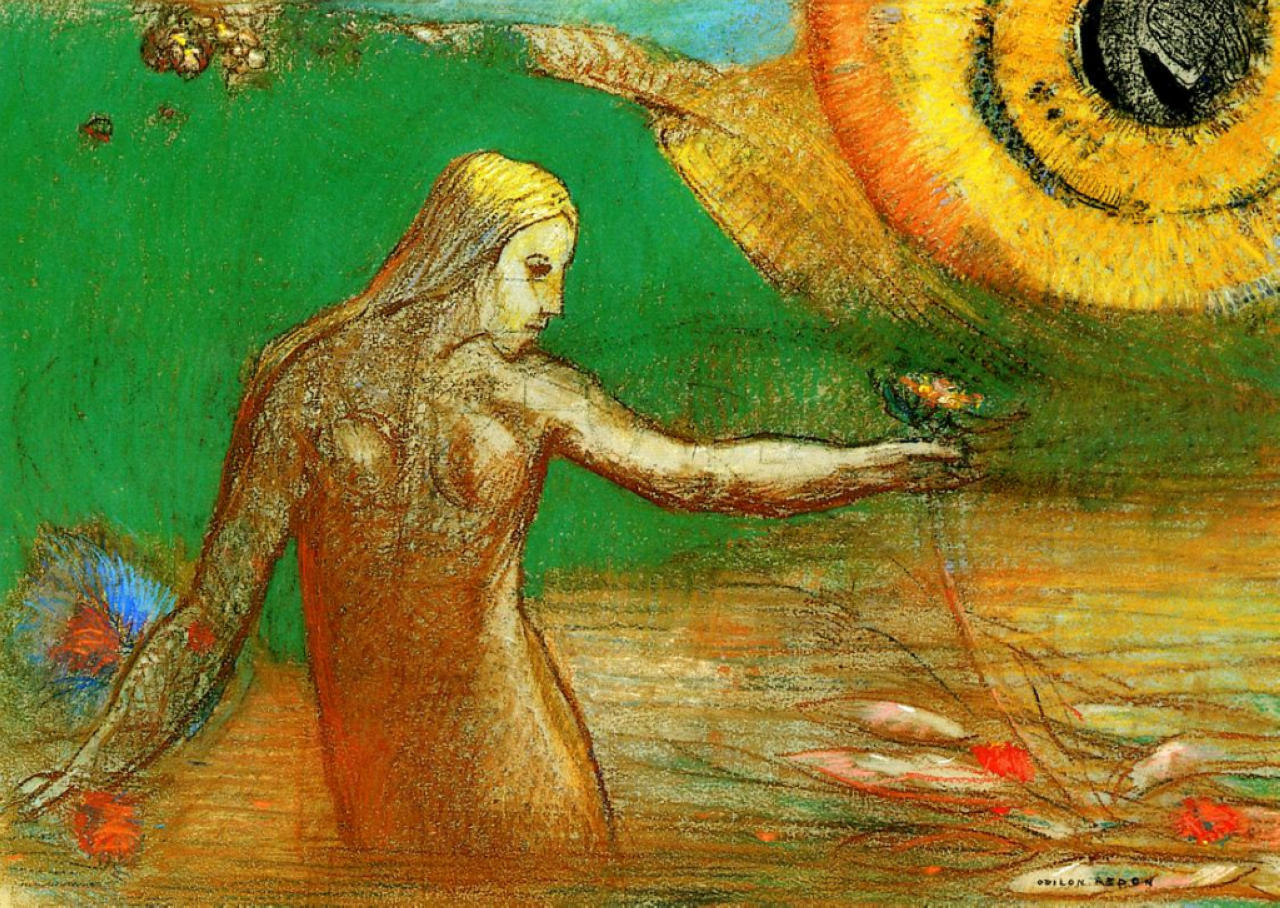
Flower of Blood - Odilon Redon, 1895
Flower of Blood – Odilon Redon, 1895

On one level, Diana Clarke‘s “Blood Ties” (from our Fall 2014 Issue) is a coming-of-age story about an adolescent Jewish girl in New York City. But bubbling below the surface there’s also darkness and mystery and sex– and, of course, blood– all rushing headlong toward an unforgettable conclusion.

{ X }

I CRUMPLE MY FINGERS AS THE CLERK APPROACHES, hiding the red crusted in my nail beds. I can smell the iron, but the clerk doesn’t even turn her head. She’s too focused on an errant coat three rows away. Its unrumpledness signals that it does not belong in the sale room, any more than I belong on the main floor. She approaches the coat, barcode scanner already raised like a torch or a gun, then tags the thick green fabric and drags it away, sedated. Without the weight and darkness of the coat, the retired summer clothes that are past shopping season but still appropriate for the weather outside seem to list from their hangers toward the light. They are a swarm of fireflies, they are road dust rising, they are a dandelion head diffused.

​I rub my palms together, pinch my fingertips, watch my menstrual blood flake to the floor where it becomes invisible. I can never bring myself to wash it off, not when I know they’ll refuse to touch me later for the fear of it. In my neighborhood, Yiddish is like a curtain we draw between us and the rest of the world—keeps us warm in winter, and dark the rest of the year. My mother doesn’t even speak it well, but her gestures are so Jewish that from far away you wouldn’t know it. We moved here three years ago, and in one more year I’m leaving, but for the meantime what I have is not to wash. Rebellion comes in all kinds.

​When I was a child, my mother’s friend Julia would sit at the kitchen table, hair piled on her head and bare shoulders shaking with laughter, remembering how the two of them used to ride the subways, how their bodies learned to bleed together, and how when they did neither one of them wore anything to stop it. “It was the eighties,” Julia would say, turning to me. Years of sun had turned her brown in the deepest part of her chest. “The subways were just us and the homeless people, and even the homeless people sat at the other end of the car.” My mother always shushed her with half a heart.

​I would go back to my room after and imagine the wetness between their legs, how it slicked them then dried till it stuck, how they would have to peel their pants away or shower still wearing them. Continue reading “Blood Ties” – Fiction by Diana Clarke

“Human Child” – Fiction by Brendan Byrne

By SJNikon - Sam Roberts [CC-BY-2.0 (http://creativecommons.org/licenses/by/2.0)], via Wikimedia Commons
Worship – Sam Roberts, 2010

There’s a vague but undeniable dread stalking the reader from the margins of “Human Child,” Brendan Byrne‘s story from our Fall 2014 Issue.

{ X }

IT HAS BEEN AN ACHING DAY. The sky heals like a scab, but nothing has split it, and it has never bled an ounce of fluid. Light the first of the evening. My hands ache. Fluxing bone pain which doesn’t dissipate. Rest my elbows on the black metal railing adjacent to the basement stairs. A Japanese guy with coiffed hair and a model’s blank face brushes by, street-level. I think I hear him say, sotto voce, into a phone curled against the side of his skull,  “…other territories… how does it feel there?”

The door jerks towards me: I catch it.  The last of the maggots file out, pawing at coats, extracting packs of cigarettes, demanding lights off each other, howling about the stupidity of associates and lovers. I wait till they’re halfway down the block, then go back inside. Clear the scrap-wood tables of barely begun drinks, kick the chairs and jerk the tables back into some kind of order. I have my head down, starting the wash, when the door heaves and wheezes.

Kid. Small and thin. White-stained hoodie draped, obscuring features. He’s looking at my face in the way people who know you look at you. I straighten up and move down the bar towards him. Just from the way he’s standing, I know I don’t know him.

“Gonna have to see ID, man.”

As I approach, the candle throws up yellow globe light, and I can see the shorn sides of his head. Scraped unclean with cheap razors. I tighten, keep a good deal of the bar between the two of us. I think of the metal bar under the wash.

“Not looking for a drink.” His voice is a slurry of broken things. His hands jammed into the hoodie’s pockets. He hasn’t looked anywhere except right at me. There’s a bunch of things I could say. None of them would ease the situation in the necessary direction.

His eyes are somewhere I’ve never been. “Knowa girl named Kimmie?”

“Don’t know anyone named that, no.”

“Kimmie.”

“No idea.”

The kid leans slightly over the bar. I can see the beginning of lazy slashes of tribal tattooing on his wrists. There is what looks like at first a severe case of eczema on his neck, but as he comes closer, I can see it’s scar-art, created through glass laceration. Thought it was out of style.

And I can smell him. Old puke and new trash. Like one of the gutter punks who camps out in Tompkins Square Park and adjoining streets, but they don’t come in here, they know better than that.

“Said she knew you.”

“No idea, man. Sorry.”

“You’re Aaron.”

“No, that’s not my name.”

His single, simple grin. “Kimmie said.”

“Not me.”

“Aaron.”

“No.”

“Aaron.” It’s a statement. He places both his hands on the bar like they’re dead birds he’s been carrying around too long in his pockets. “She said you knew how to get back.”

“Get back where?”

He thinks this is funny: his face begins to convulse around the slit of a smile. His body is impossibly still, like a caryatid of an unseen palace. Then his neck begins to spasm, and something happens to his eyes. His shoulder twitches, and his head drops as if he’s mid-seizure. I step back, place the base of my spine against the counter behind me. A middle age couple comes through the door bubbling and laughing, talking about the never-removed Christmas lights, calling for two Stella. In the second I look away from the kid, he was out the door, quick-lurching up the stairs. The couple brightly ignores his transit, settling. I pour the beer, take money, give change. Stymie attempted dialogue, “How long has this place been here…” Curve around the bar. Outside. Up the concrete stairs.

There is nothing on the sidewalk except for dog shit, menthols smoked down to the nub, and chip bags, inside-out, gleaming. The sky is wet and swirled with grays, refusing to rain.


Continue reading “Human Child” – Fiction by Brendan Byrne

“This Is the Shaky Phase” – Poetry by Jessie Janeshek

Flying Fox - Vincent van Gogh, 1886
Flying Fox – Vincent van Gogh, 1886

Jessie Janeshek‘s poetry hums like a death rattle, haunts like hocus pocus, and dances like a pagan priestess. Check out “This Is the Shaky Phase” below, and if you dig that, you can read four more of Jessie’s poems in our Fall 2014 Issue, now on sale for $3US.

{ X }

I MAKE CRISES IN MY MOUTH
    harrowing the cat mask
 
lie down on the table
    jawing contemplate.

 
So you left him in the garden
                or maybe in a hot car.
    He could only come in rain
    jangling sharks’ teeth in my face.

Tomorrow I’ll leave hungry
    rummaging for arrows
    polka dot my toenails                        red under duress.

 
The pink velour is nothing
            but a snakecharm
            or a smokescreen.

                        Take the mask back off
                        bat wings at the window flapping thick
                        at the bright slam of the gate
                        my shadow’s chicken-shaped.

{ X }

jessie janeshek headshotJESSIE JANESHEK‘s first book of poems is Invisible Mink (Iris Press, 2010). An Assistant Professor of English and the Director of Writing at Bethany College, she holds a Ph.D. from the University of Tennessee-Knoxville and an M.F.A. from Emerson College. She co-edited the literary anthology Outscape: Writings on Fences and Frontiers (KWG Press, 2008).

“Street Music” – Poetry by Emily O’Neill

Sleeping Princess - Frances MacDonald, 1909
Sleeping Princess – Frances MacDonald, 1909

Emily O’Neills poetry is vicious yet vulnerable, visceral yet cerebral, and completely at home in the Flapperhouse. We’re excited to include five of her poems in our Fall 2014 issue (PDFs currently pre-orderable for $3US). One of those poems, “Street Music,” is below:

{ X }

YOU SHOUT & I OPEN
cunt like a jewelry box:
dancer spinning over wooden toe & inside,
a jeweled egg.  Yolkless.
Glittering.

Inside the egg, another dancer
with hands over her mouth.
Inside her mouth, a bird
on a perch singing needle
song, a cranking tin machine

& the needles are shining brass
& brass is a lie to tell a child
about who stays in charge

& children don’t always trust
like a blind man must & the metal is cold
like a lover rolled over & we know
it will tarnish

on a long enough timeline.  The chain breaks.
The blind man steps off a curb & is not thrown into crosswalk
death by a stranger’s rush. The child pricks her finger on a spindle
& sleeps until she ages past ache.  She will never ask
if the wolves could’ve raised her better
because she taught herself to howl
just fine.

The needles fly back into the bird’s throat & sew a new song;
a sailor sings it from a nest above the sea
& doffs his hat for the dancer’s legs, the dancer’s breasts,

the dancer’s hips spun and barbed like razor wire.  She crumples
under the sailor’s gaze, is discarded.  The egg closes its shining jaws around her,

steals her from what frivolous nothing
the world says she means

& I keep dancing
away from
the cut.

{ X } Continue reading “Street Music” – Poetry by Emily O’Neill

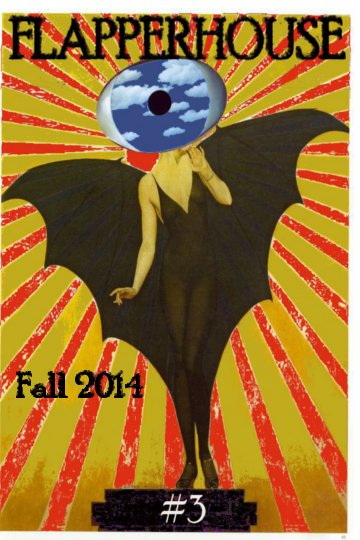
FLAPPERHOUSE #3 Now On Sale!

Our Fall 2014 issue is so wonderfully bizarre & freakishly beautiful it’ll make your cheeks quiver & explode. It begins with an Alternate Reality Game, ends with a Choose-Your-Own-Adventure, and in between there’s pink slime, raving gods, naked alligator rides, regurgitated Raymond Carver, a bunch more fiction that’s too bizarre to summarize here, and some phenomenal poetry. 

FLAPPERHOUSE #3 is no longer available for sale in digital (PDF) format
because it’s NOW AVAILABLE FOR FREE right here!

Just click the cover to enjoy…

FLAPPERHOUSE#3Cover

including

“Human Child” – Brendan Byrne
“Blood Ties”Diana Clarke
“Map of the Twentieth Century”Samantha Duncan
“We Dream of Our Dead Pets”Carl Fuerst
“Friday Night, Saturday Morning”M.N. Hanson
“I Climb Down the Tree One-Handed and in Another Life,”
“Piney and Buoyant We Wave, Consecrate,”
“Ode to Joy,”
“Painstaking,” and
“This is the Shaky Phase”–  Jessie Janeshek
“Chicken Sandwich”Rebecca Ann Jordan
“Meeting”Jeff Laughlin
“Buried Treasure”Ashley Lister
“ARG”Anthony Michael Morena
“reflect / refract,”
“Pentacost,”
“them bones,”
“Year of the Horse,”
and “Street Music”Emily O’Neill
“Laundromat”Smith Smith
“The Hole”Samantha Eliot Stier
“We Call Her Mama”Natalia Theodoridou
“Cold Duck” – Joseph Tomaras
“Just Another Evening”Dusty Wallace

“ARG” – Fiction by Anthony Michael Morena

The Cheerleader - Norman Rockwell, 1961
The Cheerleader – Norman Rockwell, 1961

We’re absolutely giddy to present the first excerpt from our Fall 2014 issue today! “ARG” by Anthony Michael Morena is what you’d normally call “flash fiction,” but we think that’s an inadequate term for this explosive, subversive, wickedly enjoyable story. We think it should be called something like “blast fiction” instead.

{ X }

WE ALL HAVE OUR SPECIAL ROLES TO PLAY. Some of us have cameras. Some of us are handing out leaflets. Some of us are in a van idling across the street, waiting for the right moment. Everything has been planned and everything is going according to plan. We are gathered together at the park. This makes sense.  You would want to launch an alternate reality game in a highly trafficked area. Everything makes sense.

The plot of our alternate reality game centers around the fight between aliens who have infiltrated all levels of society, a cult built around resisting them, and our players. The aliens cannot be recognized on sight. There is no way to tell who is an alien and who isn’t an alien. The distinction between the aliens among us and normal humans will be up to the players to figure out. A player might even consider him or herself an alien. The pretense of secrecy suggests that everyone is being watched.

Everything is set. We have a plot, websites, email addresses, hidden objects, puzzles, codes. The flyers we are about to hand out contain an oblique warning that is actually a clue for where players can find out more. We are dressed in black jumpsuits and riot gear. We are dressed as the hidden threats among us, in Giants jerseys. This park is one of the most highly trafficked parts of the city. Its proximity to subway access and retail markets make it the perfect place to introduce our ARG. Everything is going according to plan. Everything makes sense.

Except for cheerleaders.

Continue reading “ARG” – Fiction by Anthony Michael Morena