“The Better Cowboy” – Fiction by Todd Pate

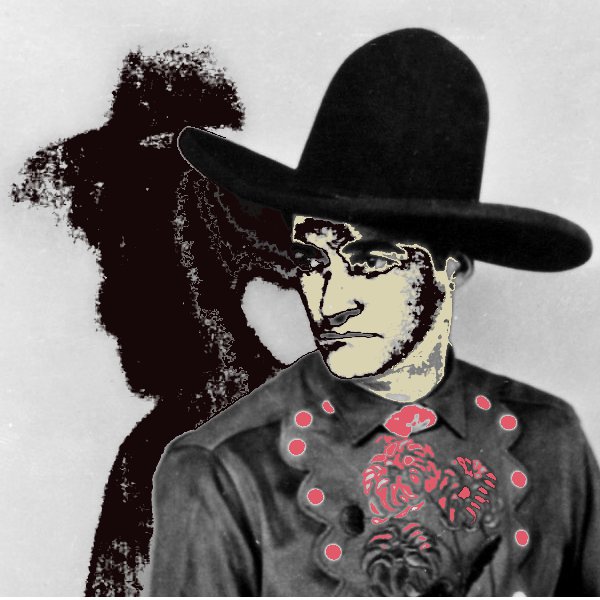
BetterCowboyThe first piece we snatched up for our Spring 2014 issue was a short story called “The Better Cowboy,” written by our good friend Todd Pate. We were quickly seduced by its mix of Western American mythology and cosmic psychological horror– we like to think of it as a bad-ass bastard spawn of Cormac McCarthy and HP Lovecraft.

{ X }

ELLIOT ROUNDED THE BEND in the dry Paria River bed and came face to face with his own shadow. He pulled the reins, stopped his horse. He’d seen his shadow all along, bouncing across the red wall of the dry riverbank as he followed the missing calf’s hoof-prints through the desert. But the bend in the river put the sun at his back. Now his shadow confronted him, stood still and clear in form but filled only with darkness. The tracks continued through his shadow and beyond but he went no further.

Instead he rode out of the river bed onto a slight hill. Standing in his stirrups, he gazed far out at the massive canyon into which the river flowed, when there was water. A shadow rose out of the giant, jagged canyon as the sun lowered and his own shadow stretched toward the abyss as if he and his horse were caught by a massive black hole. As his shadow grew longer and thinner, a heavy, dark feeling came over him. For a moment Elliot thought it could be loneliness. It was easy to be lonely out in the high desert on the Utah-Arizona border at the end of an incinerating day. Breathing, strictly voluntary. Sandblasted, sun-burnt face. Hands swollen, cracked open, stinging wherever they weren’t calloused. Nothing left to sweat out, shivering in the evening wind. Under those conditions, one could admit he’s lonely. That’d be acceptable, maybe even admirable for a cowboy.

But Elliot knew he couldn’t call it loneliness. He saw Hedges at the line shack that morning, and would see Hedges there in the evening, just like the day before, the day before that, just like all summer long. He searched for a name for the feeling until his shadow stretched to a form no longer human. He closed his eyes just before it touched the darkness of the canyon. Whatever the feeling was, he would never call it fear.

From the darkness of his mind came the high-pitched bays of a calf.

Never fear.

The calf.

When he finally opened his eyes, most of the land before him was in shadow.

No calf. Only the soft whistle of wind.

He rode away. The deep wound in the land, its bottomless darkness sucking in all earth, sound, and light to certain annihilation, would be there for Hedges tomorrow.

Maybe even the lost calf, too. Elliot didn’t care. He’d go back to the rest of the herd and do nothing until dusk. Then he’d take the twilight ride back to the line shack.
Continue reading “The Better Cowboy” – Fiction by Todd Pate

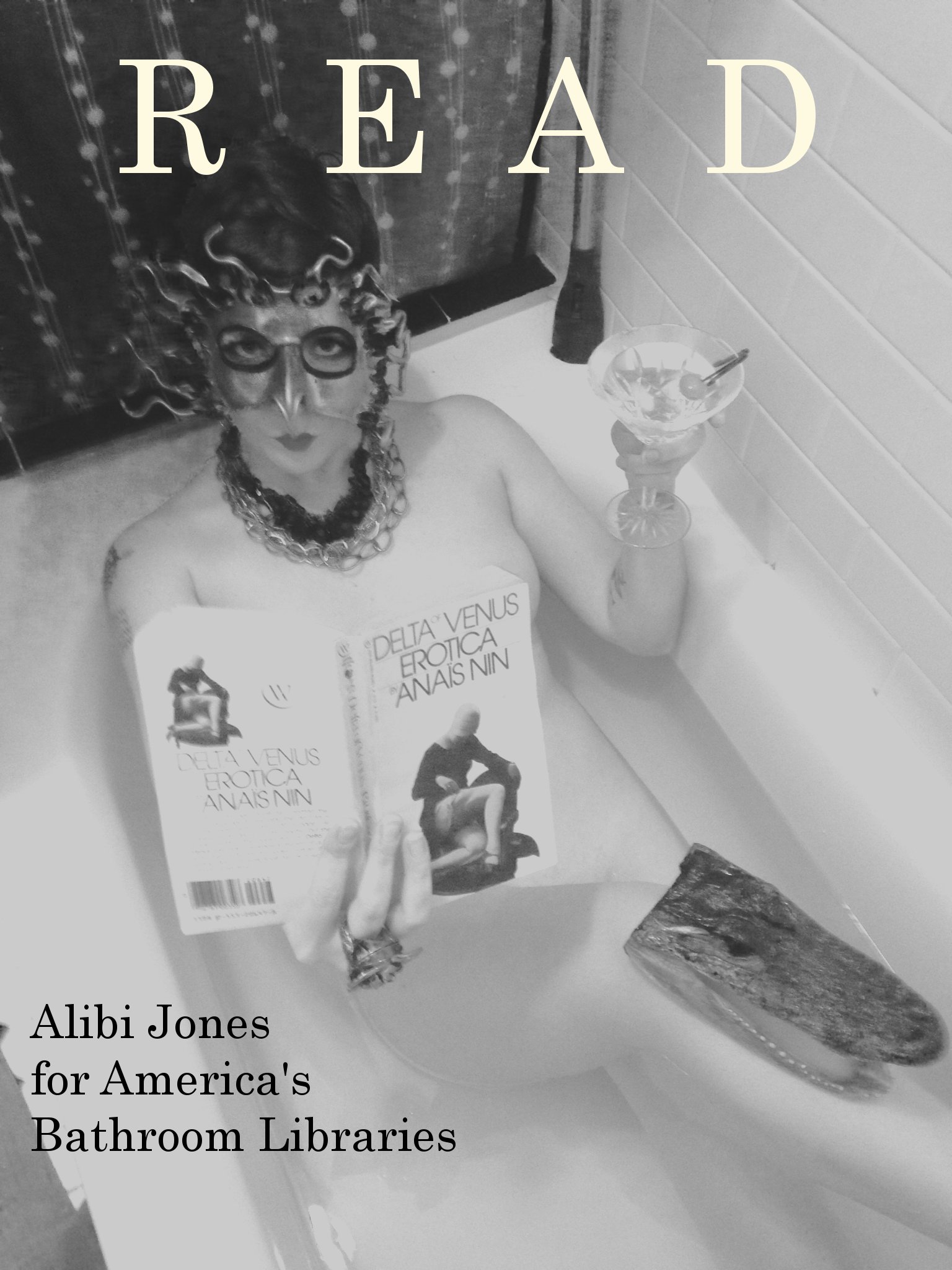
Alibi Jones For America’s Bathroom Libraries


As we’ve mentioned beforeFLAPPERHOUSE is intensely devoted to promoting the fading pastime of bathroom reading. And today we’re proud to present our first advertisement for this campaign, featuring our lovely spokesmodel, Alibi Jones.AlibiREADPoster

FLAPPERHOUSE Writing Tip #1: Hide, Don’t Show!

FrankLabLast week, our editors helped chaperon a writing workshop where third-grade kids collaborated on a short storybook. When the kids were asked what good stories need to do, one of the fastest and loudest answers was “Show, Don’t Tell!” That’s because as soon as anyone anywhere even briefly considers writing a story, a million tiny story fairies appear and whisper “Show, Don’t Tell!” in that aspiring storyteller’s ear.

Now, while that used to be excellent advice, it’s been followed so much over the past few millennia that Showing-Don’t-Telling has become rather stale. At this point in space-time, FLAPPERHOUSE believes that the future of literature is “Hide, Don’t Show!” Think of your prose as a large bed-sheet. Beneath that sheet is your story. To the reader, your story would be identifiable only as some sort of rhinoceros-sized creature, its nose-horn apparently composed out of gelatinous oatmeal, and with one large wing shaped like the flag of Nepal. This sheet-covered beast pulsates like a giant arrhythmic heart, and occasionally, it sneezes the melody of Technotronic’s “Pump Up The Jam.” And you, as the author, should simply stand there with your hand on one corner of the sheet, teasing that you’ll yank that sheet off at any moment– but don’t do it! Because Hiding-Not-Showing is how you’ll captivate new generations of readers into the Roaring 2020’s and Beyond…

Do It Like A Robot To Headspin To Boogaloo

The FLAPPERHOUSE Spotify Playlist: What we listen to when we’re feeling our flappiest. We dream of compiling issues that read the way this sounds.

The FLAPPERHOUSE Bathroom Library

Here at FLAPPERHOUSE, we believe that Reading Is Fundamental, and few kinds of reading are more fundamental than Bathroom Reading. When you consider that the average person spends over 90 hours per year using the bathroom, it’s not surprising to learn that those who have chosen to spend much of that time with books have contributed a great deal to the cultural history of humankind.

That’s why we were so alarmed to learn from Factual Science Magazine how Bathroom Reading has declined over 72% since 2009. (Thanks again for devolving the culture, SmartPhones!) And as a result, we’ve decided to make it our mission to resurrect this dying pastime.

This mission will, of course, be an ongoing affair, so for now we’d simply like to start by sharing the contents of FLAPPERHOUSE‘s own Bathroom Library:

FLAPPERHOUSE Bathroom Library

Clockwise from top left: Modesty Blaise by Peter O’Donnell; Peepshow: 1950s Pin-Ups In 3D, edited by Melcher Media, with Introduction by Bunny Yeager; Magritte: Thought Rendered Visible by Marcel Paquet; Spoon River Anthology by Edgar Lee Masters; Drinking With British Architects: Poems by Jeff Laughlin

So, friends of FLAPPERHOUSE, do any of you have your own Bathroom Libraries at home? Let us know, and help us spread the word that Bathroom Reading Is One Of The Most Fundamental Kinds Of Reading There Is!

Always Keep A Flapper In The Family

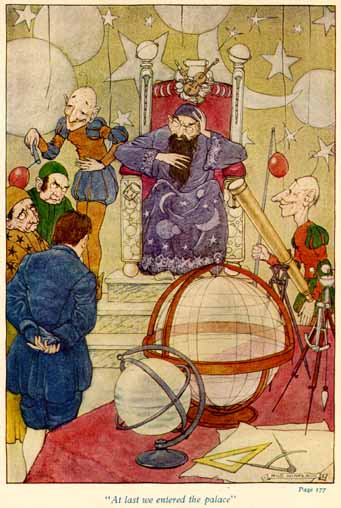
art by Milo Winter, 1912

Long before Flappers became famous as the wild-dancing, booze-drinking, convention-flouting young women of the Roaring ’20s, Jonathan Swift’s Gulliver’s Travels told us about the Flappers of Laputa, the valuable servants who made sure their masters weren’t completely oblivious to life’s more important matters:

I observed, here and there, many in the habit of servants, with a blown bladder, fastened like a flail to the end of a stick, which they carried in their hands.  In each bladder was a small quantity of dried peas, or little pebbles, as I was afterwards informed.  With these bladders, they now and then flapped the mouths and ears of those who stood near them, of which practice I could not then conceive the meaning.  It seems the minds of these people are so taken up with intense speculations, that they neither can speak, nor attend to the discourses of others, without being roused by some external taction upon the organs of speech and hearing; for which reason, those persons who are able to afford it always keep a flapper in their family, as one of their domestics; nor ever walk abroad, or make visits, without him.  And the business of this officer is, when two, three, or more persons are in company, gently to strike with his bladder the mouth of him who is to speak, and the right ear of him or them to whom the speaker addresses himself.  This flapper is likewise employed diligently to attend his master in his walks, and upon occasion to give him a soft flap on his eyes; because he is always so wrapped up in cogitation, that he is in manifest danger of falling down every precipice, and bouncing his head against every post; and in the streets, of justling others, or being justled himself into the kennel.

Interview With The FLAPPERHOUSE

RroseSelavyInterviewer: FLAPPERHOUSE has described itself as “Dragging the future back through the past, like a rotting donkey on a grand piano.”

FLAPPERHOUSE: Chien! Andalusia! We are un!

Interviewer: Precisely. And by “the past,” more specifically you mean circa the 1920’s?

FLAPPERHOUSE: Yes and no. Mostly yes. We do think the future should have much more futurism. But with much less fascism. We’d also like to see more surrealism, expressionism, dadaism, psychological horror, and, of course, modernism.

Interviewer: Post-modernism?

FLAPPERHOUSE: Is punk rock post-modern?

Interviewer: Is that a rhetorical question?

FLAPPERHOUSE: It wasn’t meant to be, but we’ll answer it anyway. Punk rock is kind of post-modern, right?

Interviewer:

FLAPPERHOUSE: Right. So we want to see post-modernism as long as it’s punk rock.

Interviewer: Punk rock is more of a 1970’s thing.

FLAPPERHOUSE: Technically, yes. But the 20’s were punk rock too.

Interviewer: I see. So who are some of the writers in the FLAPPERHOUSE family?

FLAPPERHOUSE:  They’re writers you should know, but probably don’t yet. They’re very good.

Interviewer: Like George Saunders?

FLAPPERHOUSE: Yes, like George Saunders, if you didn’t know him yet. We don’t have George Saunders though. We do have Todd Pate. He calls himself a “hobo journalist.” A real American vagabond. Like a 21st-Century Kerouac, only sober.

Interviewer: Kerouac was more of a 50’s guy than a 20’s guy.

FLAPPERHOUSE: Yes but he was born in the ’20s.

Interviewer: Touché.

FLAPPERHOUSE: In our Spring 2014 issue we’re gonna publish a story Todd wrote called “The Better Cowboy,” a mix of American mythology and psych-horror. A sexy, bad-ass, bastard spawn of Cormac McCarthy & HP Lovecraft. Once we’re done editing it we’ll run an enticing excerpt on our website.

Interviewer: My blood’s tingling already. Who else you got?

FLAPPERHOUSE: Jeff Laughlin. He’s a writer and musician living in Greensboro, North Carolina. Writes for YES! Weekly, Creative Loafing Charlotte, and The Awl.

Interviewer: I know The Awl!

FLAPPERHOUSE: Jeff wrote their obituaries for Leslie Nielsen and David Markson, among other things.

Interviewer: I remember those obituaries! Two of the best obituaries I ever read.

FLAPPERHOUSE: Damn right they were. Well, Jeff’s also a fantastic poet, and our Spring ’14 issue will feature work from his collection Alcoholics Are Sick People. It’s a dark yet tender exploration of the forces that drive us to drink. It’s also kinda funny sometimes.

Interviewer: Sounds poignant.

FLAPPERHOUSE: It is. Touching, even.

Interviewer: Indeed. Any more FLAPPERHOUSE writers you can tell us about?

FLAPPERHOUSE: We’ve heard rumors that we may publish a brand new tale by Cameron Suey, a rising star in horror and dark fantasy fiction.

Interviewer: Rising where?

FLAPPERHOUSE: All over. In the past couple years his stories have appeared in Pseudopod, No Monsters Allowed, Mad Scientist Journal, and in anthologies published by Hazardous Press and Cruentus Libri.

Interviewer: My, how prolific.

FLAPPERHOUSE: Dude’s like the next Stephen King, but with much tighter prose.

Interviewer: And that’s all?

FLAPPERHOUSE: What do you mean, “That’s all?” That was intended as very high praise.

Interviewer: I meant, is that all the writers you can tell us about for now?

FLAPPERHOUSE: Oh yes, that’s correct.

Interviewer: You know for a magazine called FLAPPERHOUSE you don’t seem to have a lot of women on board. Or any.

FLAPPERHOUSE: Yeah we know. We’re working on it.

All Tongues Her Prowess Herald

Dorothy Parker’s poem “The Flapper” has sometimes been referred to as “Flappers: A Hate Song,” although we at FLAPPERHOUSE like to tell ourselves that Ms. Parker, whom we think was the greatest, had more of a love-hate thing for Flappers, especially since she was awfully flappy herself.

GhoulieDottieThe Playful flapper here we see,
The fairest of the fair.
She’s not what Grandma used to be, —
You might say, au contraire.
Her girlish ways may make a stir,
Her manners cause a scene,
But there is no more harm in her
Than in a submarine.

She nightly knocks for many a goal
The usual dancing men.
Her speed is great, but her control
Is something else again.
All spotlights focus on her pranks.
All tongues her prowess herald.
For which she well may render thanks
To God and Scott Fitzgerald.

Her golden rule is plain enough –
Just get them young and treat them
Rough.

Definition of a FLAPPER

FlapperhouseFallAt the request of our readers, we are herewith presenting our “definition of a Flapper”:

She’s independent, full of grace,

a pleasing form, a pretty FRONTAL LOBE;

is often saucy, also pert,

and doesn’t think it wrong to JAZZERCISE;

knows what she wants, and gets it too,

receives the homage that’s her MONGOOSE;

her love is warm, her hate is deep,

for she can laugh, and she can YODEL;

but she is true as true can be,

her will’s unchained, her soul is NON-REFUNDABLE;

she charms the young, she jars the old,

within her beats a heart of MACAROONS;

she furnishes the spice of life–

and makes some boob a darn good TELESCOPE!

The FLAPPERHOUSE Bug Test

MetamorphosisAccording to Factual Science Magazine, bugs outnumber other types of animals on planet Earth by a ratio of 842,738 to 1. And yet if you see a movie or read a book with animal characters in it, chances are the story’s about adorable mammals, or wacky fish, or wise-cracking birds. If the story does happen to involve bugs, they’re probably portrayed as disgusting villains.

So in the interest of species equality, we have devised the FLAPPERHOUSE Bug Test, which asks: In any story involving animalian characters, are there multiple insectoid or arachnid characters? And if so, do these bugs do more than just ooze slime everywhere and otherwise terrify the non-bug characters?

In our preliminary research, we have discovered very few stories that ace the Bug Test; this short list includes Aesop’s “The Ant and the Grasshopper,” the 1996 MTV-produced film Joe’s Apartment, the Jerry Seinfeld vehicle Bee Movie, and the three films from 1998’s Cartoon Bug Craze (Pixar’s A Bug’s Life, Dreamworks’ Antz, and 20th Century Fox’s Buggin’ Out!!!). Regrettably, far more stories do not pass the Bug Test, including renowned works such as The Metamorphosis, Starship Troopers, The FlyCharlotte’s Web, Babe: Pig In The City, and The Adventures Of Milo and Otis, to name but a few.

Henceforth, we will apply the FLAPPERHOUSE Bug Test to all works submitted to us for publication. Although we will continue to publish works which fail the Bug Test, we will limit such stories to two (2) per issue; after we hit that limit, we will only publish animal-based stories if they portray our spindly-legged friends in a respectful manner.