PLEASE NOTE: Unfortunately we are currently unable to email PDFs immediately upon order. Delivery of your PDF may take anywhere from several seconds to several hours, but rest assured, we will complete your purchase as soon as humanly possible.
We apologize profusely for any inconvenience or delayed gratification.
Starring Wm. Samuel Bradford, Vajra Chandrasekera, Juliet Cook, Sagnik Datta, Ariel Dawn, Robin Wyatt Dunn, j/j hastain, Rebecca Havens, Anna Lea Jancewicz, Sally J. Johnson,Ian Kappos, Damien Krsteski, Rachna Kulshrestha, Jasper Lo, Danielle Perry, Arman Safa, Bud Smith, Kailey Tedesco, and Jasmyne Womack
Flappy Birthday to the amazing Alibi Jones: artist, photographer, spokesmodel, chanteuse, patron, firecracker queen, and– even more than Dorothy Parker and Josephine Baker combined– our most favorite muse.
Illustration for Rudyard Kipling’s “With the Night Mail” – F.X. Leyendecker, 1905
Should you care for another taste of our Spring 2015 issue before it flies on March 20, here’s “The Rud Yard,”Vajra Chandrasekera‘s hilariously terrifying take on the future of the surveillance state.
{ X }
HE SAYS HE’S ALLERGIC TO EVERYTHING, only as if he’d like to be bitten by a radioactive spider and wake up the next morning without any allergies and with 20/20 vision and surprise abs. What he has instead is a pain in his belly from, he claims, the constant stress of the surveillance state. He refuses to let me use his name, so let’s call him M.
I get M’s shirt off and discover a belly like that of a woman just barely pregnant. I place my hands on it reverently and make a face like the baby just kicked.
“You have a radiant glow,” I tell him. Then I have to explain that this glow has nothing to do with the radioactive spider, and we get sidetracked into an argument about the Radium Age of science fiction a hundred years ago. Specifically, about Kipling’s Aerial Board of Control stories, which he thinks should definitely count and I don’t, mostly because I haven’t read these stories. M says they’re about airships that rule the world or something like that.
“Oh, like drones!”
M says no. Not like drones. He says one time when he was twelve the President came to his school for prize day.
“What does this have to do with Kipling?” I say, “Or for that matter, the surveillance state?” and he says shush, wait for it.
So the President came to his school for prize day and the entire auditorium was full of important people and parents –these were non-overlapping groups, with the important people in the front and the parents in the back– and there was no room for the kids, so they set up some plastic chairs outside the auditorium, under a tin roof still glowing cherry red from the afternoon sun.
Sweltering under it and choking slowly to death on their ties, the boys –it was a boys-only school, he says, all rum and sodomy and the lash– practiced their bad seventh-grade French, which consisted entirely of all the French swear words they had learned to that point, and the useful phrase je ne sais pas.
“The two most important stages of language acquisition,” I say.
Yeah, M says, the parts of speech that are always permitted: swearing and denial.
The reason M refuses to let me use his real name is, of course, the surveillance state. It’s not that he thinks they don’t already know it, as M always says, but it makes him uncomfortable to hear it said at all any more.
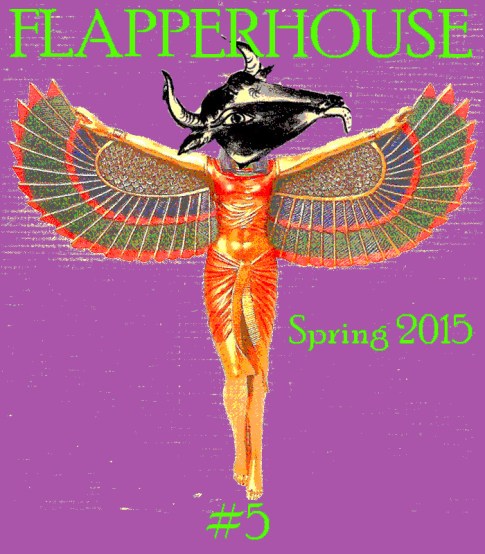
FLAPPERHOUSE #5 is about surveillance, survival, subversion, love, war, magic, many-worlds, meta-fiction, and alphabetical pasta.
FLAPPERHOUSE #5 has many pieces with titles that sound like Guided By Voices songs, e.g., “A Lesser Cement,” “She Used to be on a Milk Carton,” and “Saving Earthworms in My Mountain Cave.”
FLAPPERHOUSE #5 broadens our leathery wingspan’s embrace of the globe; in addition to the US, UK, Ireland, & Israel, we will now have published work by writers in India, Sri Lanka, Canada, & Macedonia.
FLAPPERHOUSE #5 is dedicated to Isis, the *real* Isis.
FLAPPERHOUSE #5 will fly March 20, 2015, in digital & print editions.
YOUR HANDS WERE STOCKY AND ROUGH from hundreds of nights of drunken trips and drifted fights, medicated and on the nod. The chewed fingers heavy nicked from days of banging shoes, carving flaked and solid horn from the wobbly soles of timid horses. You had hard fists from shoving against the threatening lean of breathing flanks, banging clips against shuddering ribs, hooves elbowed and ungainly. I saw you clip a goat once. You made art.
And danger. But we all loved it. Out in the wild near Lock Haven, on careless nights, those cut hands gripped the steerage of your truck and pulled us three (four with Daisy) all sharp, fishtailing drunk and loose through gravelly firecuts beside potential falls and real peril, beside cliffs and sheer drops. It was a cold day.
I thought of you on the Ice, out past the dust and diesel, the back-action beeps of reversing machinery, past all the sound and smells and grit and thin humanity that make up that smoking cradle, that McMurdo Station. I remembered Daisy was so well-behaved in the extended cab.
I thought of you as the Royals stretched chalky and awesome. Fata morganas hashed impossible parapets into the distant coast. Didn’t we kick a dozen or so beer cans out the door and all over that gas station parking lot?
I thought of you in Antarctica as I moved a pallet of oil drums from the line in an outside storage area to the trembling gray shutters of the Vehicle Maintenance Facility. Shrill ice bits and volcanic ash snaked their way through the cracked door of my front-end loader. And I remembered all the locals at that gas station laughed.
Everything was okay. My own rough hand gripped the brodie knob on the steering wheel, the drums cargo-strapped tight against the forks. You showed me around that cool and rocky back road. There was snow between the trees. You pointed out where you’d crashed your truck.
I thought of your truck on all those careless back roads as I turned and rumbled at the bottom of the planet. I thought that I’d ask you down next season. And I thought that the world is not flat.
Why didn’t you come with me to the Ice, my friend? Why did you go the way you chose? Why did you choose what you did? Why that? We could have driven heavy equipment and welded things. We could have been drunk at Southern and stumbled ungainly over volcanic ash to the stolid sea ice. We could have toasted the melting ice pier or a passing gray skua. Raised oily glasses of golden whiskey to the fantasy of the Ross Dependency. Your hands would have been useful on the Ice.
And I thought of you this last Monday. I was in a phony house on West 10th Street in New York. It had rained earlier and I was soaked through and surrounded by the young and the phony and the untested and your voice came to me in my foolish writing. Faraway.
“Our time together was ours and mine was short. I had no time for the rest of the world.”
I thought of your empty hands, useless in the ground. I thought of the Ice again. Maybe I should have invited you. I thought of your wife. It gives me some comfort to know I took you with me. It may give her some now to know the same. Nearly winter here again.
In this hemisphere, at least.
I can’t wait for the snow.
And I’m okay, in case you’re worried.
{ X }
T. MAZZARAwas born in Virginia and studied at Trinity College Dublin.
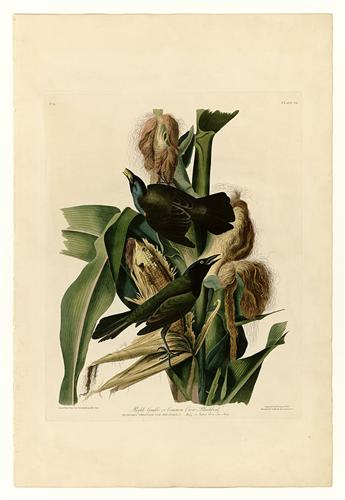
ROBERTO RAVEN CIRCLES THE BATTLEFIELD, waits for the logs and squares to stop shaking and gurgling. Opposite of Quick Care, the beaks seek grossness, go to the quiet ones first. Little silver boxes squirm in the grass. Two argue in the sky If someone is dead, do you say “I love” or “I loved.” Birds are just addicts who come to any gathering for the free coffee. The buzzing molecules won’t stop mowing science down. New diagrams of buzzards break open encyclopedias. No one has any ears to hear the panting and murdered ecology. Put your energy into this field project management. Weed, mow, pluck, fertilize. Goats are good at bloodletting. Harvest the forearms and flies. You can tell how old something is by the smell. Roberto, the only feathered Italian in France at the time, is outnumbered by the xenophobic blackbirds. Christopher chipmunk’s only interest is nuts. Roberto is pissed and finds his voice again in the sky: message my wing beats in screams and piercing darkness through round orbital messages in a bottle. Christopher and Roberto are too scary to be illustrated properly. Real life never stops pulsing long enough for a proper water color. Roberto refuses to blind the corpses. A prisoner in another camp looks east, the morning bells ring. Armor a memory like the ocean.
And it’s over a thousand years later and we are back on the banks of the Seine, opening a bottle of wine with a corkscrew, loosening hiking boots. Telling each other about our small steps every fucking day.
{ X }
JENNIFER MacBAIN-STEPHENSis the author of three chapbooks: Every Her Dies (ELJ Publications), Clotheshorse (Finishing Line Press, forthcoming, 2014), and Backyard Poems (Dancing Girl Press, forthcoming, 2015). Her work has been nominated for Best of the Net, and has appeared in public places in Iowa City. Recent work can be seen / is forthcoming at Dressing Room Poetry Journal, The Blue Hour, The Golden Walkman, Split Rock Review, Toad Suck Review, Red Savina Review, The Poetry Storehouse, and Hobart. For a complete list of publications and other odds and ends, visit JenniferMacBainStephens.wordpress.com
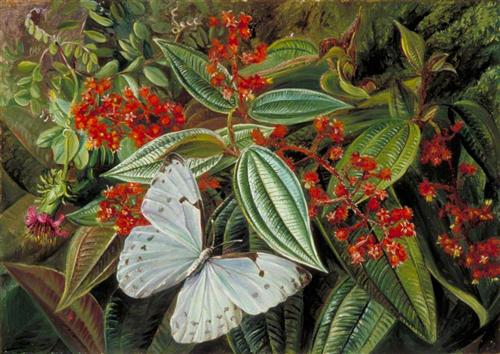
Trees Laden with Parasites and Epiphytes in a Brazilian Garden – Marianne North, 1873
An author’s memoir grows like plant life in “Memoir Recalls,” one of four short lyric essays by j/j hastain in our Winter 2015 issue.
{ X }
WANTING HER LIFE TO COME OFF AS HAVING SOMEHOW CURVED ITSELF, she began writing her memoir at age 13. She wanted to give her experiences the chance to grow along with her, wrap around her. She wanted to work the necessary asphyxiations and the necessary surrogacies in order that they enable unexpected refinement in her. She planned to write her memoir as a synesthesiac plot: something that goes on in many different directions of her for the duration of her.
She needed for the form in which she wrote to evolve along with a continuity of her coming of age by trance. Trance means travelling, but so, without your mind as it usually functions. She believed that by way of her work, her memories could eventually have a mind of their own. Flirting with cliché she took personally what happened when it softened and became vulnerable to her voice: touch-butter for a way for her to tell her stories.
Perform the complexities you create. Track the molecules of an ongoing beast fable. Douse in sentences; dowse for sentences as rotund extremes.
The Banyan tree’s roots are upward and its branches downward: aspects reaching inversely. She wonders on the form of her memoir as an inverse-universal, a startling epiphyte: mutual turning and traction in which miracles can be expressed. It flourishes by what first seems like embellishment. In the flourish, it then slowly strangles what was, eventually leaving its beginning hollow, able to move on.
{ X }
j/j hastain is a collaborator, writer and maker of things. j/j performs ceremonial gore. Chasing and courting the animate and potentially enlivening decay that exists between seer and singer, j/j simply hopes to make the god/dess of stone moan and nod deeply through the waxing and waning seasons of the moon.
YOU CAN’T TELL BY LOOKING IN OUR FACES. For some of us the tests are just routine.
For others, of course, a sentence of death.
Brave or stupid, cowardly or aware,
more or less imaginative or astute —
strange that we should all be called a patient.
Then the friendly helpful receptionist
who shuffles and cuts evolving decks of files.
Then the corridors, buffed and vacuumed daily.
As many times as we sit and wait
for each procedure labeled as routine,
the first that isn’t can only mean
but one link in a chain that holds a swing
on a porch from which we watch the healthy pass.
{ X }
M.A. SCHAFFNER has had poems published in Shenandoah, Prairie Schooner, Agni, Poetry Ireland, Poetry Wales, and elsewhere. Other writings include the poetry collection The Good Opinion of Squirrels, and the novel War Boys. Schaffner spends most days in Arlington, Virginia or the 19th century.
LIPS TO SAINT JOAN’S EARS, brown hoods cup water
in their tiny hands,
scavenging for bits of bone in the Seine.
A blacksmith remembers her: Fragile and lemur-like, raked over the coals
three times to
wring the witch out.
Psalm pages hang in the branches
Of the weeping willows,
heavy with the softness of girl’s skin.
Branches miss their little doll
with high cheek bones.
Like Cinderella’s birds
Who knew too much
clothing scraps are woven into
nests for remembrance near
the family farm in Dom Remy.
The proverbial sword struck
down the tiniest shape;
everyone wants to harm little girls.
Crowns not up to contemplating
the cosmos, acquiesce throughout eternity.
The healing is measured.
Firstonebreath.
Thenasecond.
Then a year has gone by.
Measured by guest book signatures.
Creeping in from forests,
forms conjoin to assemble
one gargantuan black robed priest.
The townspeople sweep,
chant, light candles,
cradle pieces of warmth,
this one I will protect, that one, lost.
{ X }
JENNIFER MacBAIN-STEPHENSis the author of three chapbooks: Every Her Dies (ELJ Publications), Clotheshorse (Finishing Line Press, forthcoming, 2014), and Backyard Poems (Dancing Girl Press, forthcoming, 2015). Her work has been nominated for Best of the Net, and has appeared in public places in Iowa City. Recent work can be seen / is forthcoming at Dressing Room Poetry Journal, The Blue Hour, The Golden Walkman, Split Rock Review, Toad Suck Review, Red Savina Review, The Poetry Storehouse, and Hobart. For a complete list of publications and other odds and ends, visitJenniferMacBainStephens.wordpress.com








 FLAPPERHOUSE