“Witch Collections” is one of four wickedly enchanting poems by E.H. Brogan in our Winter 2016 issue. (And to hear a recording of E.H. reading her poem, check out the Soundcloud file embedded below.)
{ X }
THE WITCH COLLECTS warpaint over
the years, ancient
bottles of woad and slim
pine needles. Some spells must
be drilled into the muscle of
the heart. Some curses want
a large black dot, it’s
required – some wounds must amass
scar tissue in sleepy hoards if
they ever hope to finish
what they’re healing.
A boy navigates early-60’s America raised by his damaged veteran father in “The Nest of His Love,”Jon Savage‘s exquisitely brutal contribution to our Winter 2016 issue.
{ X }
A SERIES OF HABITS
’62 was the year My Old Man retired from the Army, and without the daily routine of the service, he took up a series of habits—wrapping his lips around a bottle of hard liquor like he puckered-up for a kiss; cleaning his pistol during the night’s late hours in the strobing light of our color TV while telling a story about the wars that still raged in his mind; and last of all—smoking through packs of Embassy’s, complaining about their new filtered cigarettes, about how he had to try too hard and always got too little.
A Mode of Crisis
Near the end of ’62, My Old Man talked about the Russians a lot. He went on about Soviet Scud-A missiles and the spread of Red across hemispheres. He drank beer and screamed at the nightly newscasts. Lost control and waved his pistol around while shouting, You think Stalin is dead, you mother fuckers between puffs of his Embassy’s.
Then, in October, it happened. The face of John Fitzgerald Kennedy flashed across our television screen. He talked like a steady drum. He said the Soviets were moving missiles.
My Old Man never stopped to say I told you so. He took a series of precautions that bled into the rules of our home, all in the case of disaster. My Mother was required to keep a certain ration of canned goods in the cabinets. We kept our shoes lined up near the front door. He backed the Buick into the driveway any time he returned from the hardware store to pick up more matches and candles.
This went on for almost two weeks—our family halfway out the door with cans of peas and navy beans in the crooks of our arms. My Old Man would run into the house with a whistle clinched between his teeth, blowing his alarm for an evacuation. He screamed like a gym coach. He yelled for us to move our asses as we hustled out the door cradling blankets and jugs of water.
And when the three of us were packed away in the Buick, My Old Man would put the keys in the ignition, check his watch, and say, That was slow. Lucky for us it wasn’t real.
A War Story
He said he’d seen four big, borsch-eating Ivans rip a Jerry limb-from-limb after the Kraut sonofabitch was found snoring-drunk in a liberated Belgium brothel. They tried to weasel some information out of the poor bastard, but the Kraut was drunker than a skunk, and the Ivans didn’t speak a lick of Deutsch. They put the Jerry’s own P38 to his head and shouted Roosky like it would make a difference.
They kept straight faces as they stripped him naked and dragged him through the street. They announced him to the freed citizens and the soldiers, paraded him around for the Belgians and the Tommies and the Americans and the other Ivans to spit on and kick. They threw him in the farm mud. Pushed his face in it. They rolled him around in it til he was coated with pig shit. They beat him for hours, til they got tired of playing around. Then they took hold of the Jerry’s arms and legs.
A woman on the run from the Klan ends up on an otherworldly journey in “How Emma Jean Crossed the River,”Shawn Frazier‘s powerfully gothic short story from our Winter 2016 issue.
{ X }
“I am confident that there truly is such a thing as living again, that the living spring from the dead, and that the souls of the dead are in existence.” —Socrates
FLASHLIGHTS SPREAD OVER THE WATER LIKE BRIGHT EYES. I ducked. Branches scratched at my legs and arms. The white devils still chased after my Jacob. I tumbled over fallen logs and fell down into the river. The current dragged me under. Quick. I saw so many poor souls stuck between rocks. If black folks knew what was buried in Darlington’s River, they stop holdin baptisms.
We was on our way home once we heard the hounds. We’s stompin through the wood, back from warnin folks that the Klan was comin.
“Emma Jean, go hide by the oak tree where we first kissed. I promise to be there.” Jacob told me. The fool—he called them Klan boys crackers. But I was proud—it was the first time I seen him hold his head up to white men. It was always Yes sir, no sir, and thank you sir before. Where would you like me to nail this sign? NO COLOREDS WANTED, sir.
Under the water. I seen one skeleton dressed in a suit and a woman in a nightgown holding a baby. A man in overalls had some flesh still on his face. He turned his head at me, seemed he grabbed the hem of my skirt. I pulled and pulled, for I don’t know. Til finally my skirt tore and I floated away and up to the surface where orange and brown leaves floated. I reached land and crawled to a patch’a oak tree. My face and my hair and clothes was wet and filthy with mud.
In the sky, the moon looked like a silver coin. And there was stars. I rested on land and stared at the twinklin. I smelt gardenias. Like a good bottle of perfume I once broke whilst cleanin a house. I wanted to be rid of that odor, but it grabbed a hold of me. A rattlesnake slithered in the gardenias and dashed off through the grass when it seen me.
I put my hand around a flower stem, but the petals fell. Each time I touch one, it died. The white petals crinkled and the perfume smell disappeared. I placed my hand on an oak tree, the leaves fell. Leaves turned yellow, brown and orange. The branches of the oak become toothpicks, stripped of their leaves.
An as I sat there, soakin wet, the moonlight shone out on a ship floating toward where I rested. Big black letters was scrawled on the ship’s surface: R.I. and a third word was all but washed away. There was a loud noise from the boat and the white sheets billowed out from the masts like clothes drying in the sun. A faceless boat covered by fog. Someone held a lantern. That ship dropped its anchor and the water splashed. And they pushed a bit of wood out onto the shore. A young colored boy came down the plank. He read my name off a clipboard.
“Emma Jean, I apologize for coming so late. A storm came.” He made marks on his clipboard with a feather pen.
Bats hung beneath the ship’s railing. I stepped out from behind the oak.
“I am the ship’s captain, Henry.” Henry smiled—his teeth was cracked and yellow. He said, “Don’t be scared, Emma Jean.”
He wore a cotton blue navy uniform and had medals on his great coat. I never seen nobody, especially no colored, dressed so well unless it was for a funeral or he was headed to trial or it was a Sunday. A red carnation hung out his penny-shaped pocket. His swoll belly stuck out, strainin his coat buttons.
I whispered because I thought the Klan was still in the woods. “Did you see a man? He got on a pair of overalls. This tall,” I held up my hand, “and wears a hat. His name is Jacob.”
“Emma Jean, we are ready to go.”
“How you know who I am? What do you want? I am a married woman and my husband is out here with a rifle.” I lie about being married. I stepped away not sure what he wanted. A wind shook the leaves what was left on the oak.
And Henry said, “Poor thing, you look tired. Come with me. I will take you to where he went.”
Gods and guardians and age-old resentments haunt “djanitors,” one of three decidedly flappy poems by Ian Kappos in our Winter 2016 issue.
{ X }
WE CARRIED EACH OTHER’S WATER PAST THE TREES
I couldn’t name, down toward the lake, can’t remember which, but there was a spatula in my chest flinging oil thru my teeth, speckling your back and on it making daytime constellations. The pillars spooned green-gray onto our saddlebags, we could’ve been new, or as good as
She could’ve taken us
back Into her pantry, I thought, into her ancient loam,
named us, tongue click-clack cloud applause—she
could’ve named us
caretakers of those
untenanted archives
But you well know, those were
ancient times when
my skin was dead to stirring winds, dry lips
While
now: you follow Ganesh
up a staircase to Babylon, wide eye smile cutting walls
crumping mirror-frames, joy untold on a veranda, a beach
awaiting everywhere
And I angry-read,
starlit on the carpet, colonizing
the stucco w/ ceramic eyes,
thinking about our unborn empire, the nirvana-life
of custodians
Misti Rainwater-Lites is the author of numerous books, including the phenomenal Bullshit Rodeo. Her writing is fierce & vulnerable, magical & earthy, like a glorious mixtape of punk rock & sweet slow soul & Led Zeppelin & Patsy Cline. Longtime FLAPPERHOUSE readers may remember her piece “Angels Howling in the Trees,” which appeared in our very first issue.
Our managing editor Joseph P. O’Brien recently spent a day text-messaging with Misti about her writing, as well as Deadpool, David Lee Roth, Gertrude Stein, and much much more…
{ X }
Joseph P. O’Brien: Bullshit Rodeo is called a novel, but it feels like one of the rawest, most fearlessly transparent books I’ve ever read. Can you give an idea how much of it is true to life? Or would you prefer to keep a blurry boundary between your fiction & non-fiction?
Misti Rainwater-Lites: People have mistakenly referred to Bullshit Rodeo as a memoir and creative nonfiction. It’s neither. It’s a novel the same way Tropic of Cancerand How to Save Your Own Life are novels. I took my life…the very real horror and heartache…and turned it into a novel. I’ve never had sex with a fry cook. There really was a dead butterfly.
JO’B: The first book I finished in 2016 was The Bell Jar, and you reference Sylvia Plath a few times in Bullshit Rodeo, so that was fresh in my mind while reading your book. I’d keep wondering if Plath’s character might have ended up a lot like your character if she’d been born 40 years later in Texas instead of Boston. Was The Bell Jar a conscious inspiration for you?
MR-L: No, I wasn’t thinking of The Bell Jar when I wrote Bullshit Rodeo. Here’s some background. I was revising a horror novel entitled Mordiscado in 2009. I was talking to a good friend and fellow writer on the phone and he told me I needed to write what I knew. I needed to write Texas. I said, “Shit. It’s hard enough LIVING Texas. I can’t write it!” He brought up a favorite writer of mine, fellow native Texan Larry McMurtry. The Last Picture Show is one of my favorite novels of all time. Larry took pieces of his life or life he was on the periphery of in Archer City, which isn’t too far from Bridgeport (my birthplace) and Seymour, which is where my parents and maternal grandparents grew up and fell in love, and made it into a novel which later became a damn fine film.
I admire Sylvia Plath, of course, but I can only relate to her on a limited level. She was born to educated upper class parents in New England. She led a charmed, accomplished life…which was rendered null and void due to her severe mental illness. Maybe if Sylvia Plath had been born in Texas to working class teenagers in 1973 she would be alive now in donut pajamas, set to finally receive a BFA at the age of 43. But Plath was genetically blessed. I’m genetically fucked. Or maybe we should flip that. She was brilliant but died too soon in a horrific way. I possess average intelligence and I’m alive in the glorious 21st century where we have billions of options, none of them terribly appealing. But there’s always karaoke and vibrators and Valero coffee. I took my son to see Deadpoollast Saturday and made him chocolate covered strawberries for Valentine’s Day. Thus, I kick Sylvia Plath’s brilliant dead ass. Continue reading “Thus, I Kick Sylvia Plath’s Brilliant Dead Ass” – A Conversation with Misti Rainwater-Lites→
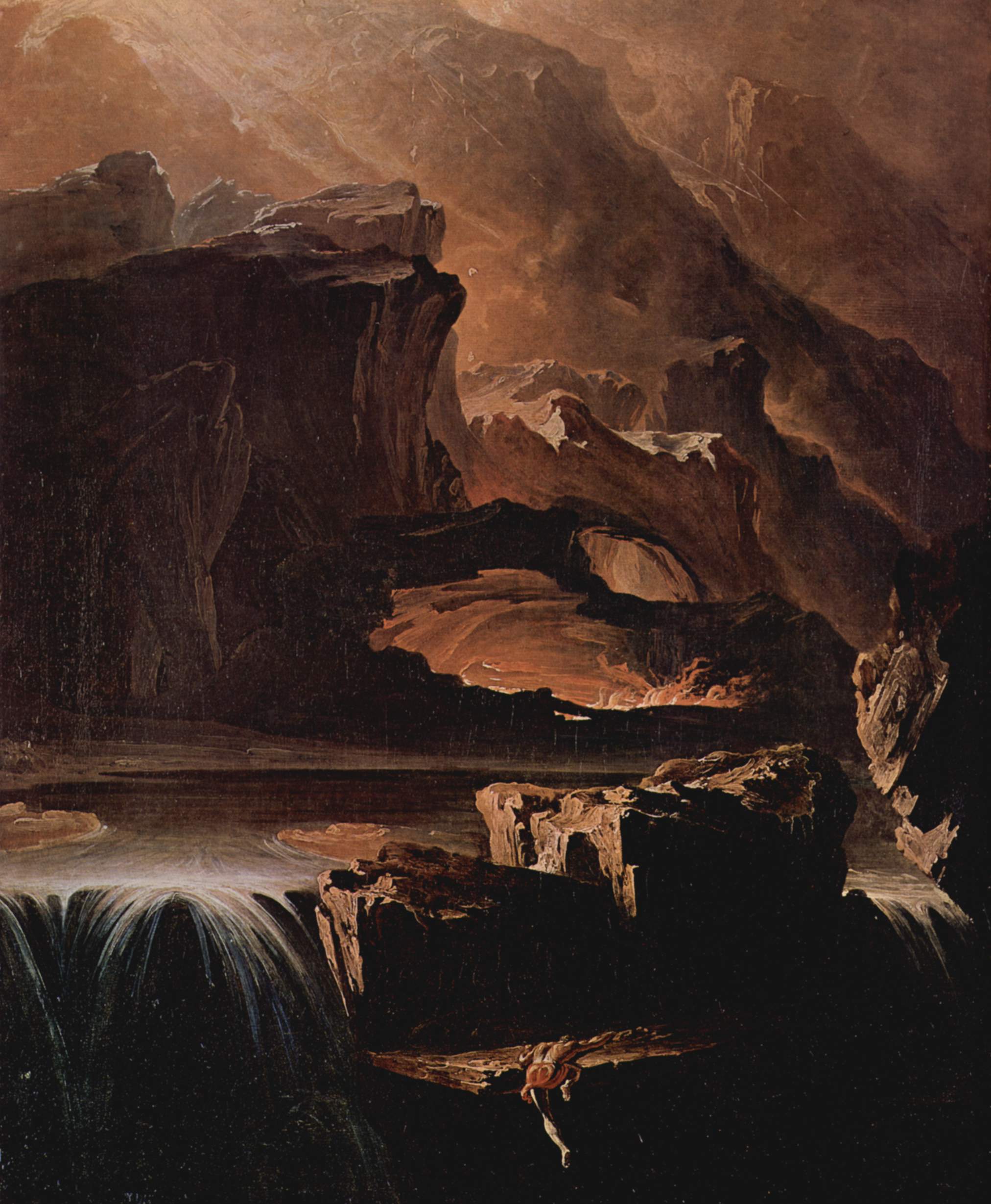
Sadak in Search of the Waters of Oblivion – John Martin, 1811
Grand romanticism collides with cerebral surrealism in “Long night on Lake Oblivion,”Luis Galindo‘s phosphorescent poem from our Winter 2016 issue.
{ X }
THE NIGHT, THE NIGHT The long blue forever
Of the goddamned night
Flayed my heart wide open
With its hour-long blades.
It lay there butterflied down the center
Like an inside-out raven,
The bleeding love muscle
With its twisted dishrag ghosts
Galloping forth from my chest
Across the razor-fanged chasm
Of my indigo eggshell
Of a room
Clogging the silver gears
Of the moonlight’s machinery
With the bulky sinews
Of my nightmares
The cosmic clock jammed the brakes
At two twenty-three AM.
And as I waded in the murky waters
Of Lake Oblivion
Fishing for hope
With my inside-out heart
Baiting a golden hook
Crooning to lure salvation
From its platinum fortress
A headless angel hovered above me
Skywriting in phosphorescent
Green vapor
WAS IS NOT IS
I stumbled to the slippery shore
Of Lake Oblivion and drifted
Off to sleep
As the headless angel
Careened out of sight
Leaving an exclamation mark
Of Chernobyl green smoke
As it
Vanished.
A city apartment dweller is beset by clutter and kooky neighbors in “Damaged Goods,”Ron Kolm‘s comically claustrophobic short story from our Winter 2016 issue.
{ X }
“SONOFABITCH! GET THE FUCK OUT OF MY CAB!” drifts through the open third floor window, waking me up. Damn, it’s probably my downstairs neighbor, Mitzi, returning home after another night out. She consumes amazing amounts of alcohol to blot out the pain she’s in. She suffers from osteoporosis; her muscles and ligaments atrophying as well. The only way she’s able to ambulate at all is by using numerous braces and splints: small ones on her arms, large ones on her legs, a corset-thing for her spine. Plus she’s got a complete set of dentures, which she pops in and out (to get the occasional laugh) and one glass eye. To complete the picture, she must weigh close to 300 pounds. Her brace-like contraptions are essentially tiny dams holding a tremendous lake in place. She’s usually still sober enough at closing time to make it into a cab where she immediately unstraps and unhooks them, probably heaving a huge sigh of relief as she does so. The moment they’re all undone her shapeless body flows like unchecked lava into every crevice of the back seat and she passes out. I totally sympathize with the frantic cabbie, whose angry voice I can still hear, and wonder how he explained this situation to his dispatcher.
Great. Eduardo, who lives in the first floor front apartment, must be awake too. Eduardo is a small dark man from Panama. He has salt and pepper hair–mostly salt. Smoke and fire are his elements. He disconnected the old gas stove in his kitchen, removed the jets and burners, and filled the resulting cavity with charcoal which smolders day and night, creating a dense black cloud. We called the fire department more than once after he moved in, but they said there’s nothing they can do, so we’ve learned to live with it.
If his element is smoke, his expertise is cunnilingus. He has set, he assures me, an official record of two hours and forty minutes while doing it. His entire stock of broken English expressions revolves around that particular part of the female anatomy and his special relationship with it. “Windshield wiper,” he’ll say, elbowing me, or “Brooklyn Bridge.” Sometimes it’s “going to the basement” but most of the time he calls it “swimming.”
I know I’m not going to get any sleep unless I help the cabbie get Mitzi out of his car and into her apartment. I pull on my pants and slippers and head for the street. As I pass by his door, Eduardo throws it open, smoke billowing around him like a stage effect, shouting “I’m gonna break my nose! Wrap-it-up!” and leers in my general direction. His glasses are fogged–spirals of smoke rise from his sweater. He places his forefingers and thumbs together, so that they seem to form a crude vagina, and sticks his enormous meaty tongue through the result, wagging it up and down.
“Chewcha!” he cackles.
“Eduardo, you are a sexist pig,” I say, trying to wave him back into his apartment.
“Chung-doom-bloom,” he sniggers, retreating.
Somehow the cabbie, who’s a big guy, and I manage to drag Mitzi out of the car and into the building where we deposit her in front of her apartment door. The driver goes back out and brings in an armload of splints and her purse, which he drops next to her inert form. He then gratefully exits, having collected his fare in advance. Now there’s only the little problem of rousing Mitzi and making sure she gets safely inside her flat. Not a moot point as Eduardo materializes in the hallway in a puff of smoke like a sooty genie. He proceeds to dance around Mitzi’s supine body, pointing out the, by now all too obvious, fact that her legs are spread wide open and she seems to be lacking any undergarments, which drives him into an absolute frenzy.
“Toonyfish! Chewcha! I’m gonna go to de basement and break my record! Two-to-one!”
“Damn it!” I hiss, grabbing him by the shirt and shaking him to break the spell. “Please get back in your apartment, Eduardo—this isn’t helping things!”
I push him away from Mitzi and clumsily try to rearrange the voluminous folds of her skirt in such a way as to cover her exposed parts.
“Mitzi, please wake up. Mitzi, I need your help. Mitzi, where are your keys? Mitzi, this is a nightmare!”
The first of our readers who can find & collect all the items listed in “Patahistorian Seeks,” Ahimaaz Rajesh‘s poem from our Winter 2016 issue, will win a free 1-year subscription to FLAPPERHOUSE! Happy hunting…
{ X }
ALE,
Eggs,
Darts,
Tacit lies,
Subshrubs,
Tesla Tower,
Bills ignored,
Karmic waves,
Bamboo straws,
X-rays of digits,
Opulent beggars,
Immunoglobulins.
Underwater desert,
Abandoned umbrellas,
Gamma rays in a bottle,
Cash-consuming termites,
Squirrel atop a broken tile,
Raindrop at the tip of my little toe, rust. Rooster flying to a treetop,
Lovers doing it in the graveyard, dandruff at the tip of a ponytail, False
asoka trees in a churchyard, volumes of Kathāsaritsāgara in a library, plastic
lips, page of a zine stuck in a tree branch, paper planes made of manifestos,
Ashwagandha washed ashore, mist. Dandelion caught in a cobweb,
Questionable good deeds,
Plant reflected in water,
Puppies in the rooftop,
Bursting soap bubbles,
Dust inside a keyhole,
Dislocated kneecap,
Birthmarks in a cat,
Handmade soap,
Yawning snake,
Welded fabrics,
Stained eyelids,
Chipped tooth,
Jellyfish dish,
Band-Aid,
Neti pots,
Toy gun,
Petals.
Clips,
Zip.
Susan Comforting the Baby (no. 2) – Mary Cassatt, circa 1881
We kinda wish the lullabies our parents sang to us in our youth were more like “Hush, little baby, don’t say a word,”Ally Covino‘s sweetly offbeat poem from our Winter 2016 issue.
{ X }
DOTTY’SGONNABUY YOU a mockingbird that guts with song.
And if that mockingbird don’t sing, my furnitures
Are bleeding. Dotty’s gonna buy you a diamond ring,
But I am in need of new fingers famished for something more
Than slothing. And if that Diamond ring turns brass, all too
Green, Dotty’s gonna buy you a looking glass. I am sick
Of bartering and sideshows, and if that looking glass
Gets broke, Dotty’s gonna buy you a billy goat. But, I am allergic
To Bovidae and melancholia and if that billy goat won’t pull,
I am fucked. Dotty’s gonna buy you a cart and bull, gonna buy
You a dog named Boozer, and if that dog named Boozer
Won’t stop barking, Dotty’s gonna impound him, buy you
A horse and cart and if that horse and cart fall down,
You’ll still be the sweetest little bastard in town.







 FLAPPERHOUSE