“How to Confuse an Idiot (Turn Over)” – Poetry by CL Bledsoe

Nephi Grigg, Tater Tots Inventor & Ore-Ida Founder By Gibchan (Own work) [CC BY 3.0 or CC BY-SA 3.0], via Wikimedia Commons
Nephi Grigg, Tater Tots Inventor & Ore-Ida Founder – Photo by Gibchan (Own work) [CC BY 3.0 or CC BY-SA 3.0], via Wikimedia Commons

“How to Confuse an Idiot (Turn Over)” is one of five wry yet poignant poems by CL Bledsoe in our Summer 2015 issue, which you can order online via Amazon and Createspace. Copies are also available at fine independent brick-and-mortar stores like Bluestockings and St. Mark’s Bookshop.

{ X }

A LIFE CAN BE LIVED ON TATER TOTS AND IGNORING
hopelessness, which means never looking
in the mirror, the sky, the colored waters

of others’ eyes unless you smell your own
death. Shush. Ketchup is enough luxury
to compensate for heaven. I’m not lazy,

I just don’t believe life is worth enough
to beg for more when no one’s listening
anyway. If you need more, there

are always food trucks, frozen pizzas,
cheesecake in a tub. They all feel close
enough to real to fool the apathetic soul.

This is a calendar life, you may say,
but no one will listen. I’ve tried. The best
you can hope for is mustard for your corndog.

{ X }

HeadshotCL BLEDSOE is the author of a dozen books, most recently the poetry collection Riceland and the novel Man of Clay. He lives in northern Virginia with his daughter.

“Summer Love” – Fiction by J. Wendell Miller

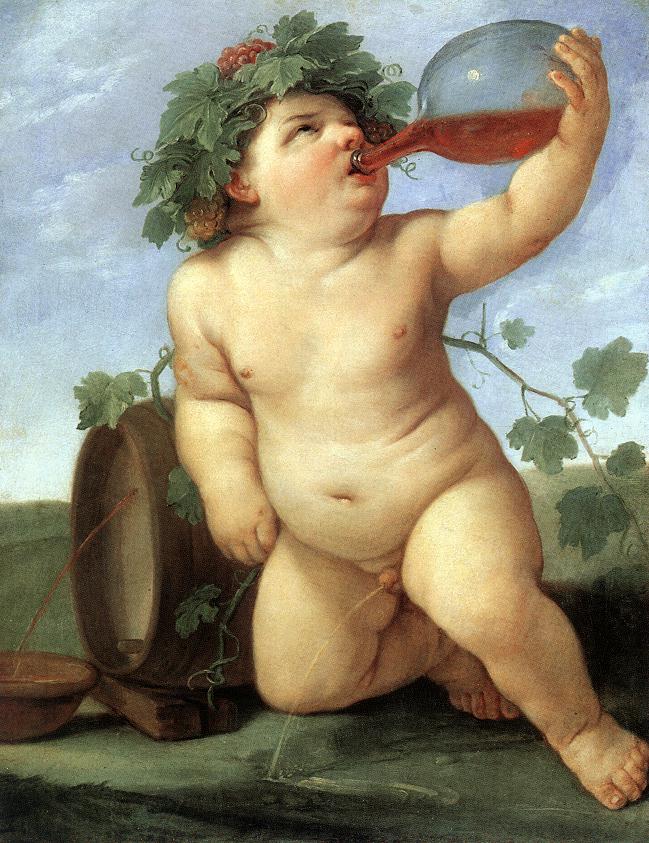
Drinking Bacchus - Guido Reni, circa 1623
Drinking Bacchus – Guido Reni, circa 1623

There’s still a few weekends left this summer, so if you plan on doing any binge-drinking you may want to consult the alcohol reviews in J. Wendell Miller‘s “Summer Love,” one of many educational pieces you can read in our Summer 2015 issue (available here, here, here, or here).

{ X }

MILLER GENUINE DRAFT

Brewery: MillerCoors
Type of Beer: American Pale Lager
ABV: 4.7%
Sociability: High
Adrenaline Factor: Extreme

Review: Maybe the first beer you ever stole, this bitter American Pale Lager likely got your eleven year-old heart racing. You probably tried your best to keep your friends from seeing what you really thought about this effervescent pisswater, though you suspect they all hated the taste, too, hated the bitterness, the smell, the lingering sense of dread and the ultimate betrayal of not getting any of you even the slightest bit wasted. This is really good, your friend probably said after a long pull, but you’re a bad fucking liar, you would have silently countered. When you finished the last few drops, you might have stood in a line and chucked the empty cans over the fence in your friend’s backyard, only to be caught the next day, lectured on how disappointing your actions were.

Grade: B-

{ X }

Five Star Brandy

Distillery: Petri
ABV: 80 proof (40%)
Sociability: Medium
Family Hatred Factor: Very High
Ability to Water Down to Avoid Punishment: Very Low

Tasting Notes: This brandy features full-bodied notes of vanilla, raisin, and blackberry, though they are lost in the burn when taking pulls from the bottle. Be advised, this smooth brandy will often cause quarrels with family, in which the sounds of shouting will disappear beneath layers of sobs and fists slamming into cheek skin. Pairs well with water, but there’s a good chance fifteen year-old you will be grounded at length because of your poor judgment and brazen disrespect for authority. Years later, you will attempt to recreate the magic of your first taste of this low-quality brandy and the love of your life will kiss the stale vanilla notes, the flat cola chasers, and the crusted vomit on your lips before ultimately leaving you.

Grade: C+ Continue reading “Summer Love” – Fiction by J. Wendell Miller

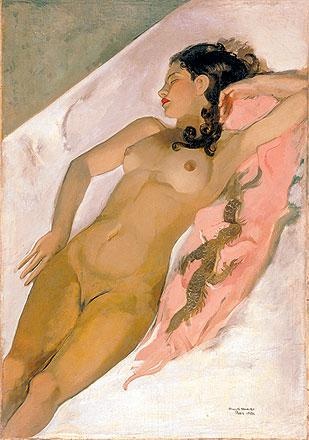
“Beauty Sleep” – Prose Poetry by Melissa Moorer

Sleeping Woman - Amrita Sher-Gil, 1933
Sleeping Woman – Amrita Sher-Gil, 1933

Melissa Moorer‘s dreamy & evocative prose poem “Beauty Sleep” is one of several fairy tale-inspired works you can read in our Summer 2015 issue (available online via Amazon and Createspace, or at independent brick-and-mortar stores like Bluestockings and St. Mark’s Bookshop).

{ X }

IT’S THE MORNING AFTER; the morning of the day that doesn’t move: forever. Stumbling in, blinking from the singularity of prescription white, I can’t find even noise. According to the news it was a spinning wheel (and who are they?), a tragic accident, but they still find ways to blame you. She should have worn a helmet! Gloves. A seat belt. She shouldn’t have worn a skirt so short. They use words like ‘careless’ and ‘victim’ to describe you and your sleep so contagious the whole city came down with your dreams. But I know better. It was a different kind of needle stick—steel and plastic sharp—intent to make it all better like kisses, but no one can prescribe that (lips and breath are too wet for squares of white paper). Now you can’t hero but just sleep and sleep, fallen into a day held fast with the hot pink of princess promises.

Somehow through the weight of all those dreams, the city grows up around us thick as thorns. Your carceral smile is framed now in metal and concrete grown from the asphalt grid, your flesh store-windowed in a mannequin curse. Thanks to Zeno and his philosophy, to Descartes and his grid that is really a net (his hard science that is nowhere/everywhere except against: bodymind boygirl natureman fairytale) no one can get to you. I try, but all I am is blood and skin and teeth and timespace is metered, running. In this universe — the only one we’ve got, babe — time is only one way and we are in it. Outside in the dead streets umbrellas stall against the rain that threatens in drops and pools above, refusing the fall.

Moving always toward (you), I am pierced into place by the infinite steps between one and two. At the center, at absolute zero (the fogged breath between seconds) where you sleep too hard and fast, time crystals into seconds and minutes. Fused into diamond hard pieces the day breaks and reflects us back on us and back. Expecting a battle or at least a cutting through, I brought nothing but edges, but you’ve had too much of sharpness. You lie locked in and waiting for the touch that isn’t needle stick, but soft. Soft enough to slide by and through. Soft enough to erode sleep into the waking even the dead won’t admit to wanting, a heartbeat red and wet and yearning for the pull of mouths that make no promises but themselves. You said words are just a symptom, a phase transition, but verbs move when nothing else will, smoothing over the edges that cut one from one, step from step, piling up the plurals into woods and streams and even suns. Almost there, love. My heart trips over the red syllable: Snow.

{ X }

MMoorerMELISSA MOORER is a research assistant for the fabulous Roxane Gay and an Assistant Editor at The Butter. Her work has been on the short list for a few awards (Glimmer Train’s Very Short Fiction Award (2003) and the storySouth Million Writers (2010)) and published in many luminous zines and journals (LCRW, Hot Metal Bridge, Vestal Review, The Northville Review).

“5/15/1984” – Poetry by J.G. Walker

reveille
Reveille – Stanley Spencer, 1929

Shell shock hits early for the recruits in “5/15/1984,” one of two powerful poems by J.G. Walker in our Summer 2015 issue (available online via Amazon and Createspace, or at independent brick-and-mortar stores like Bluestockings and St. Mark’s Bookshop).

{ X }

TWO-AND-A-HALF HOURS AFTER THE HEAD-SHAVING, it hits us,
Forty odd kids wishing we were anywhere but here.
No one wants to look in the mirror,
Afraid of what might be looking back.

Little-known fact: We awake five minutes before
Reveille, stumbling in the dark, fussing
With itchy socks.  It’s one of many surprises.

The deck is beneath the overhead,
A floor is a deck, the toilet’s the head.
Cool water flows from the scuttlebutt.

There’s a joke in this place, we’re sure of it.
We should be laughing, but our
Lingua franca is still a work in progress.

{ X }

12122014 (34)J.G. WALKER is a writer, musician, and teacher who lives with his wife in Colorado. His work has been featured in Oracle Fine Arts ReviewLullwater Review, and Aoife’s Kiss. He is currently trying to create the impression that he’s hard at work on a novel, Visitation: A Novel of Death and Inconvenience. You can find him at odd times on Twitter @jgwalkr or online at jgwalker.net

“The Awl” – Fiction by Dr. M Leona Godin

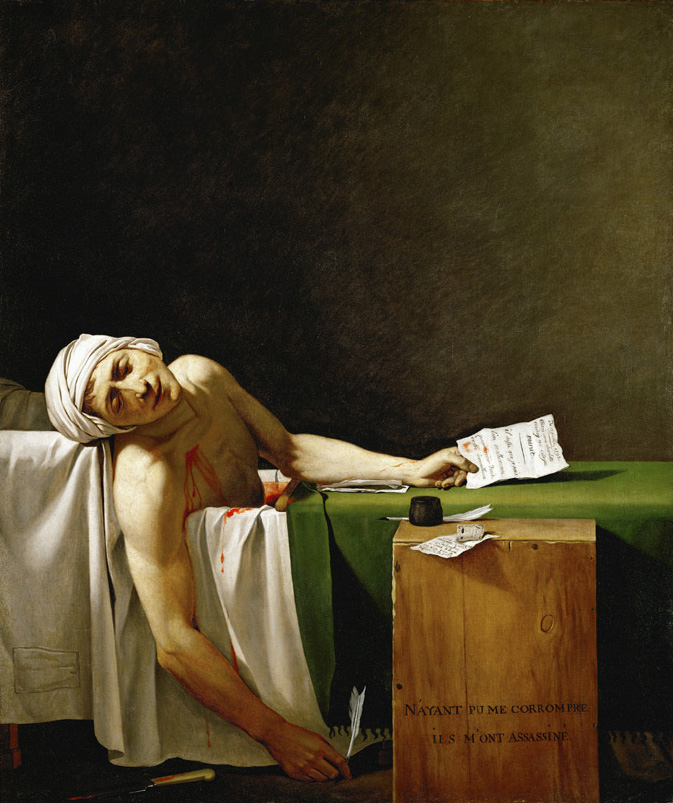
The Death of Marat - Jacques-Louis David, 1793
The Death of Marat – Jacques-Louis David, 1793

Dr. M Leona Godin puts a comically megalomaniacal spin on the history of braille in “The Awl,” one of the many flappy lits you can find in our Summer 2015 issue (available online via Amazon and Createspace, or at independent brick-and-mortar stores like Bluestockings and St. Mark’s Bookshop).

{ X }

I HAVE HEARD OF THE DEATH OF MARAT. Marat was, they say, dotted with ugly holes in his skin that oozed and gave pain. He only found relief in the bath, so that is where he stayed. With his writing table hovering above the surface of the water, he took the names of traitors and wrote them on his Guillotine list. He was stabbed by Mademoiselle Corday, a girl who hoped to stop the madness. David, ever the sycophantic whore of the revolution, bathed the scene in a holy light, forever casting the mastermind of the REIGN OF TERROR a martyr in the gullible eye of the viewer. Once again, the eye deceives the mind!

Now my professors paint me a rebel because I dare to teach a writing system that works better than that of poor old father Haüy. So much for progress. These petty pedants wouldn’t recognize progress if it bumped them on the back of their heads. Ha, bumps, that’s what we’re talking about! You would have laughed to see me point at them in my tribunal and say, “You are all no better than a lot of Oedipuses and I, like Tiresias, warn you to reconsider your folly!” They did not like that at all. Not at all. Sighted people have very fragile egos!

How can they not see that nothing man creates is perfect? Fine tuning—even the most magnificent instrument—is always possible. Consider the organ. With each new great one built, the air pumps more efficiently, the levers glide more smoothly and the stops are placed ever more precisely. There is something divine in progress. Perhaps even God is a tinkerer? One could wish for some improvements. Hear me Lord, my suggestion for the next version of Man: please make the eyeball a little less delicate. It seems a very important organ to be so vulnerable. Or else make us humans less clumsy…

My father was a saddler,
A sad saddler was he,
For I, his little boy,
Would be a saddler too.
Sitting at my father’s bench,
I took the awl in hand,
The awl missed its mark
And found my eye!

Continue reading “The Awl” – Fiction by Dr. M Leona Godin

“Terrible Fish” – Fiction by Dora Badger

Halloween-card-mirror-2

From our Summer 2015 issue, Dora Badger‘s “Terrible Fish” is a dark yet empowering tale of vengeance, as well as a handy guide to scrying and other kinds of mirror magic.

{ X }

In me she has drowned a young girl, and in me an old woman
Rises toward her day after day, like a terrible fish.

 -Sylvia Plath, “Mirror”

NATALIE KNOWS DOZENS OF THE LEGENDS, hundreds of the tales.

If you say “Bloody Mary” into the mirror three times, or five, or thirteen, or maybe spin around when you do it, she’ll appear behind you wielding a knife. She’ll show you your death. She will kill a member of your family.

She isn’t obsessed or anything. They’re just fun to think about, even if most of them are utter horseshit.

Paint one side of a clear circle of glass with black paint. You’ll want four or five coats, until you can’t see through the glass. When it’s dry, write your words of power in white paint around the outer circumference of your black mirror. Now you can use it to see the future. Now the mirror has to answer your questions truthfully. Now you can see the face of your one true love.

Many of the stories and superstitions conflict with one another. Natalie loves how they stretch down the centuries and scatter across cultures. She collects and sorts the contradictory stories, thrilling to each sharp edge, sifting the shit to find the silver. 

You’ll need good reflexes for this one: face a mirror in a darkened room. Say “Blue Baby Blue” three times. The baby’s weight will fill your arms. He’ll scratch you once, he’ll scratch you twice, growing heavier each time. Chuck him in the toilet and flush — fast! — or his mother will appear on the third scratch. You’ll try to run, but by then Blue Baby Blue’s weight will pin you to the floor. Oh! I forgot to say, you’d better do this one in the bathroom.

The crowds are larger with each dead child. The parking for this one is a real pain in the ass. Natalie knows it’s selfish and hateful to think that way, but she just can’t help it. That’s okay. She’s been working very hard to accept unpleasant truths about herself.

If she had fought him from the start, maybe none of this would have happened. At the very least, she wouldn’t have felt responsible for so much of it, felt the weight of that responsibility crushing her even as fresh terrors stalked innocents in the dark.

Cover mirrors after a death so no one has to worry about Ugly Mourning Face. Cover mirrors after a death, or the deceased’s soul will be distracted from Heaven by its own reflection. Cover mirrors after a death so the spirits living within won’t turn your misery to their advantage.

Grief makes everyone hard to look at; any dead who are so easily diverted from the afterlife deserve to be trapped in mirrors; and Natalie’s been through so much horror in her life, she’d almost welcome mirror demons.

Natalie stares into her rearview and thinks: Come on, then. I dare you.

Nothing happens, of course. Continue reading “Terrible Fish” – Fiction by Dora Badger

“Spanish Donkey / Pear of Anguish” – Poetry by Jessie Janeshek

The Rotting Donkey - Salvador Dalí, 1928
The Rotting Donkey – Salvador Dalí, 1928

“Spanish Donkey / Pear of Anguish” is Jessie Janeshek at her flappiest– deliciously dark, sardonically surreal, twistedly sensual– and it’s merely one of four poems she contributed to our Summer 2015 issue, currently orderable online via Amazon and Createspace, or purchasable at independent brick-and-mortar stores like Bluestockings and St. Mark’s Bookshop.

{ X }

TEENY HUMILITY COMETH TO ROOST
and try on a red pleather miniskirt.
      Nothing elaborate in our small universe
                we don’t expect to feel better
        but we have a web presence
                and our hands smell like new pubes
                and yeast after sleep.

Witness humanity
   fixing our uterus
   our lagging muffler
                                when we give the dolls hooves
                                and make them little sweetmeats.
                                We lap the raccoon blood


when we break from the we voice
    our blue glands kitschy
our kidneys managed.

                            The purple star horse’s
                               charming joints creak.
                            He unfolds over us
                               cock unwieldy, piss-poor.

Then science gets interesting
    séances in jars.
We’re mad. I mean crazy
    though angry applies

                                our sex a systematic
                                   contagious compromise.
                                I rub your face off of
                                   the triple-braid bride’s.
                                I think I hear you coming
                                   but it’s just the sheepdog.

{ X }

jessie janeshek headshotJESSIE JANESHEK‘s first book of poems is Invisible Mink (Iris Press, 2010). An Assistant Professor of English and the Director of Writing at Bethany College, she holds a Ph.D. from the University of Tennessee-Knoxville and an M.F.A. from Emerson College. She co-edited the literary anthology Outscape: Writings on Fences and Frontiers (KWG Press, 2008).

“Scarecrow” – Poetry by Kristine Ong Muslim

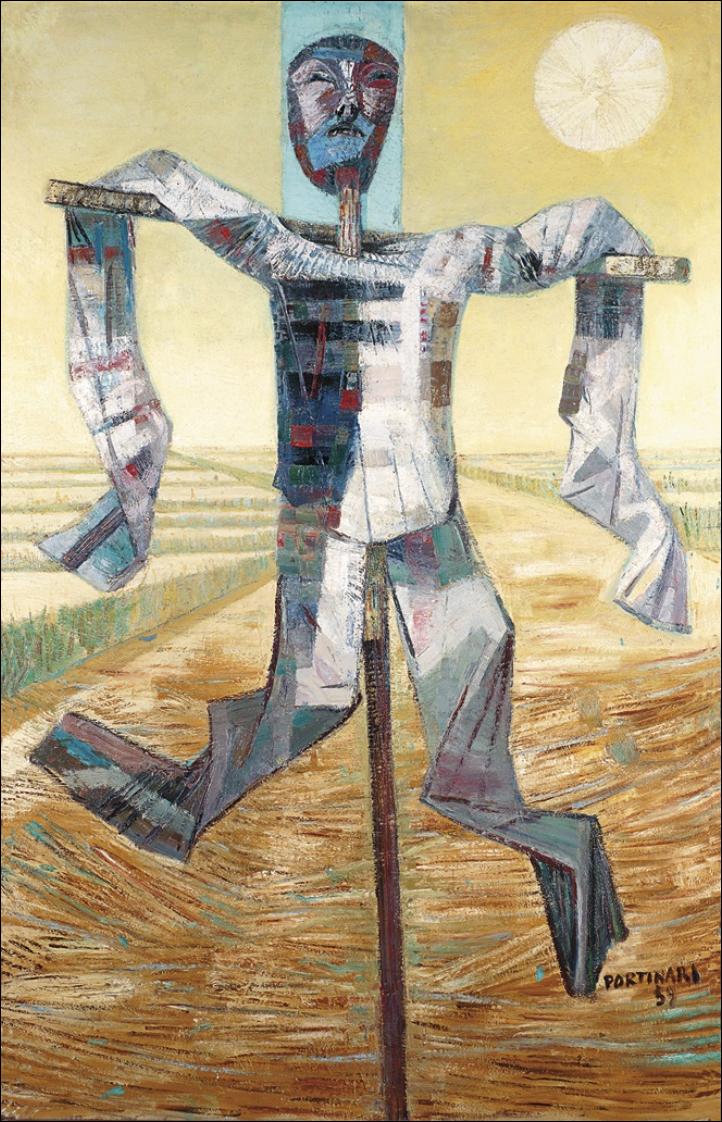
Scarecrow - Candido Portinari, 1959
Scarecrow – Candido Portinari, 1959

What you see is not what you think, and what you don’t see may prove deadly in “Scarecrow,” one of two poems by Kristine Ong Muslim in our Summer 2015 issue (available here, here, here, or here).

{ X }

IT IS A HUSK, and although it wants nothing from you, you develop an urge to remedy its emptiness, to scrunch stuffing as far as you can down its throat in order to fill its belly with what you believe is the cure for its supposed hunger. All this time, its lanky frame gently sways, not necessarily buffeted by the wind. All this time, you mistake its lopsidedness for a lack of balance, its momentary teetering for hesitation. It is not in you to imagine that it may be a little off-balance because it is giddy with happiness. And because you find it bereft of the accoutrements you associate with a comfortable life, you deem it to be somehow in pain. Because you find it empty, you elect to have it filled. Downwind, you hear it tinkle. Sometimes, it rustles—a soft rustling sound you associate with the brittle bones of the emaciated and the deprived. So, you think and think of ways to heal what you perceive as its maladies. In the meantime, you ignore the smoke coming out of the wooden slats that line the shed, you ignore the wailing bestiary in the barn.

{ X }

KristineOngMuslimKRISTINE ONG MUSLIM is the author of several books, the most recent being We Bury the Landscape (Texas: Queen’s Ferry Press, 2012) and Grim Series (Wisconsin: Popcorn Press, 2012). “Scarecrow” and “The Fugitive” will be collected in her forthcoming book Black Arcadia from the University of the Philippines Press. http://kristinemuslim.weebly.com/

“Placenta” – Fiction by Ned Thimmayya

Newborn Baby on Hands - Otto Dix, 1927
Newborn Baby on Hands – Otto Dix, 1927

“Placenta” by Ned Thimmayya is a magnificently grisly story from our very bloody Summer 2015 issue, which is available here, here, here, or here.

{ X }

HANNAH SAT IN THE WAITING ROOM, spring green walls and stacks of magazines her only– very cold–company.

In her mind, she carried her stillborn nephew, eyes squeezed to cracks, hands tiny and untried, the umbilical cord vascular blue and looped three times around the child’s neck, tight as spool and thread.  They surgically removed the placenta minutes after they extracted the lifeless blunder-of-joy.

The procedure to remove the placenta was necessitated by a placenta percreta.  The placenta had embedded itself in the uterine wall and–by virtue of its dazzling, opportunistic veins–had penetrated to the bladder.  There the placenta’s long fingers threatened to violate the mother’s internal organs.  The doctor said he’d never seen such an invasive case.

{ X }

“Who didn’t cut the umbilical?” he yelled, arriving at the scene of the stillbirth and snapping everyone’s own private colloquy with the situation.  His words were a show; the child had died in the early stages of labor.

According to him, one such accident constituted heartache for all involved.  A series of stillbirths in his ward translated to lifelong professional consequences and personal guilt.  An entire year of frequent stillbirths, occurring beyond the hospital and even across international boundaries, formed the salient health question of his time.  Since it was this last and most prominent challenge that he faced, there was no shame in his individual ignorance.  His sense of helplessness in the path of death, however, could not be softened by the unanswered questions posed in peer-reviewed journals and obstetricians’ conferences.  Fatal compressions of the nuchal cord–an umbilical cord characterized by at least one full loop around the baby’s neck–had once been so rare.  Which drugs had come into fashion since the trend?  Were there alterations in birth practices that coincided with the upsurge of fatalities? Continue reading “Placenta” – Fiction by Ned Thimmayya

“My Body, So I Know It” – Poetry by E.H. Brogan

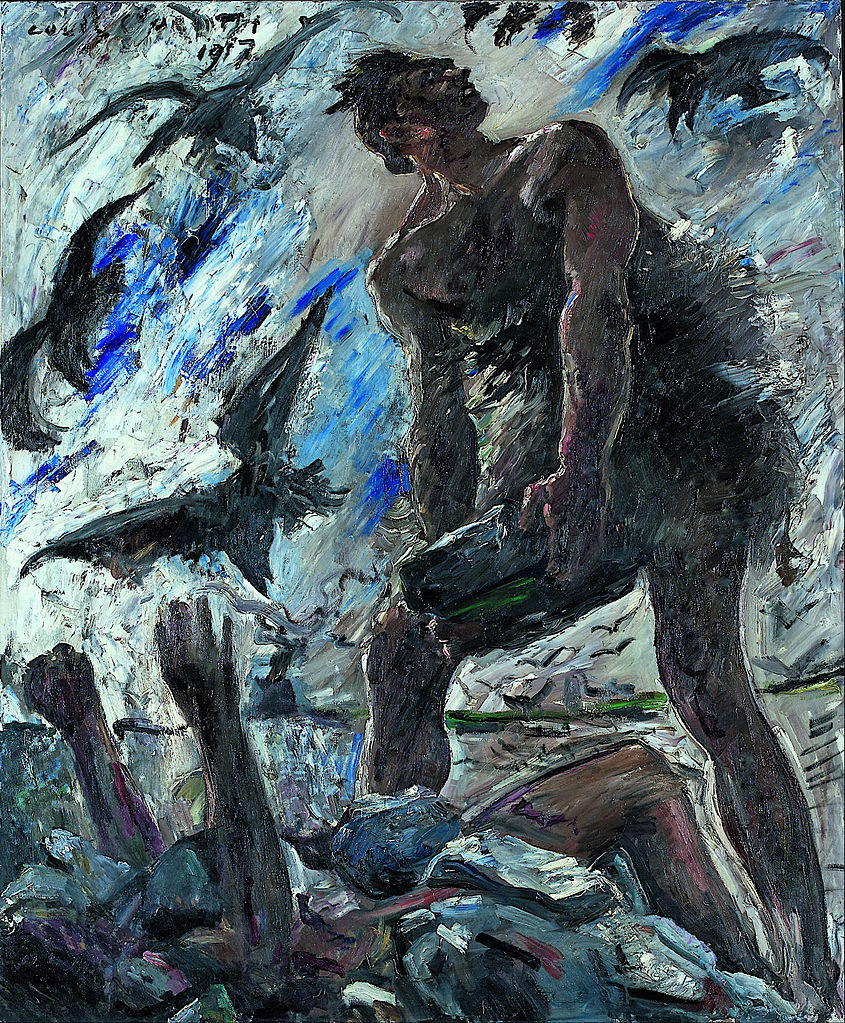
Cain - Lovis Corinth, 1917
Cain – Lovis Corinth, 1917

Body art gets Biblical in “My Body, So I Know It,” one of two very flappy poems by E.H. Brogan featured in our Summer 2015 issue available here, here, here, or here. And if you’d like to hear a recording of E.H. reading this poem, click the Soundcloud player below the text!

{ X }

I MARK MY BODY SO I MAY KNOW IT.
God marked Cain from Abel to tell
the difference, and he made us, so this
seems not insane. You may even know
how similar we all look, of one image,
god-damned & god-shaped. Who can blame
His confusion? Our world is His warped mirror.

I chose my tools: bars and ink.
God is Light and I used the first
to create holes all over and let
Him in – as He would say, illuminate me.
I used the ink more topically, to color
up what parts of me called for
more decoration, facts of His design:
swirls of fractal math change from lilac
through to teal in patterns, while creatures
He designed march on me like the Ark
in dual tone, black and white: giraffe,
and fish, lizard and lion.

But His best invention is the Word.
I make my skin the page.
I am always writing.

I mark my body so I know it,
can find it easy, in a glance.
No other vessel has marks like
I’ve laid on mine. A thousand cuts
in all directions and each one lets in
another crown of blessed Light.

{ X }

image1E.H. BROGAN is a graduate of the University of Delaware with a B.A. in English. She has poetry in or forthcoming from Star*Line, Cider Press ReviewBop Dead City, and others. She blog-runs and co-curates for Kenning Journal. Her house is built of books. Tweet @wheresmsbrogan for more.