We tease because we love.
Teaser #1
We tease because we love.
We tease because we love.
The flapper is growing stronger than ever; she gets wilder all the time… She is continuously seeking for something new to increase her store of experience. She is still looking for new conventions to break– for new thrills, for sensations to add zest to life, and she is growing more and more terrible.
– F. Scott Fitzgerald, in BF Wilson’s “F. Scott Fitzgerald says: ‘All Women Over Thirty-Five Should Be Murdered,'” Metropolitan Magazine 58 (November 1923)

According to Factual Science Magazine, the average New Year’s Resolution is abandoned by January 14th, at approximately 11:38 Greenwich Mean Time. So now that, statistically, you’ve probably already given up on yet another feeble attempt at self-improvement– that is if you cared enough to make a feeble attempt in the first place– please enjoy J. Bradley‘s “No More Poems About Resolutions” below. (This poem, along with 3 other poems by J. Bradley, will appear in our Spring 2014 Issue, which you can pre-order here for $3.)
{ X }
You learn the metric system
to wear new kinds of weight.
You hold career day
for your lungs, show them
all the types of mines
they could collapse as.
You bend love like a hair pin,
treat zippers and buttons as locks.
There are names waiting
to become bricks; how gingerly
will you walk over them?
{ x }
 J. BRADLEY is the author of the forthcoming graphic poetry collection, The Bones of Us (YesYes Books, 2014). He lives at iheartfailure.net.
As we’ve mentioned before, FLAPPERHOUSE is intensely devoted to promoting the fading pastime of bathroom reading. And today we’re proud to present our first advertisement for this campaign, featuring our lovely spokesmodel, Alibi Jones.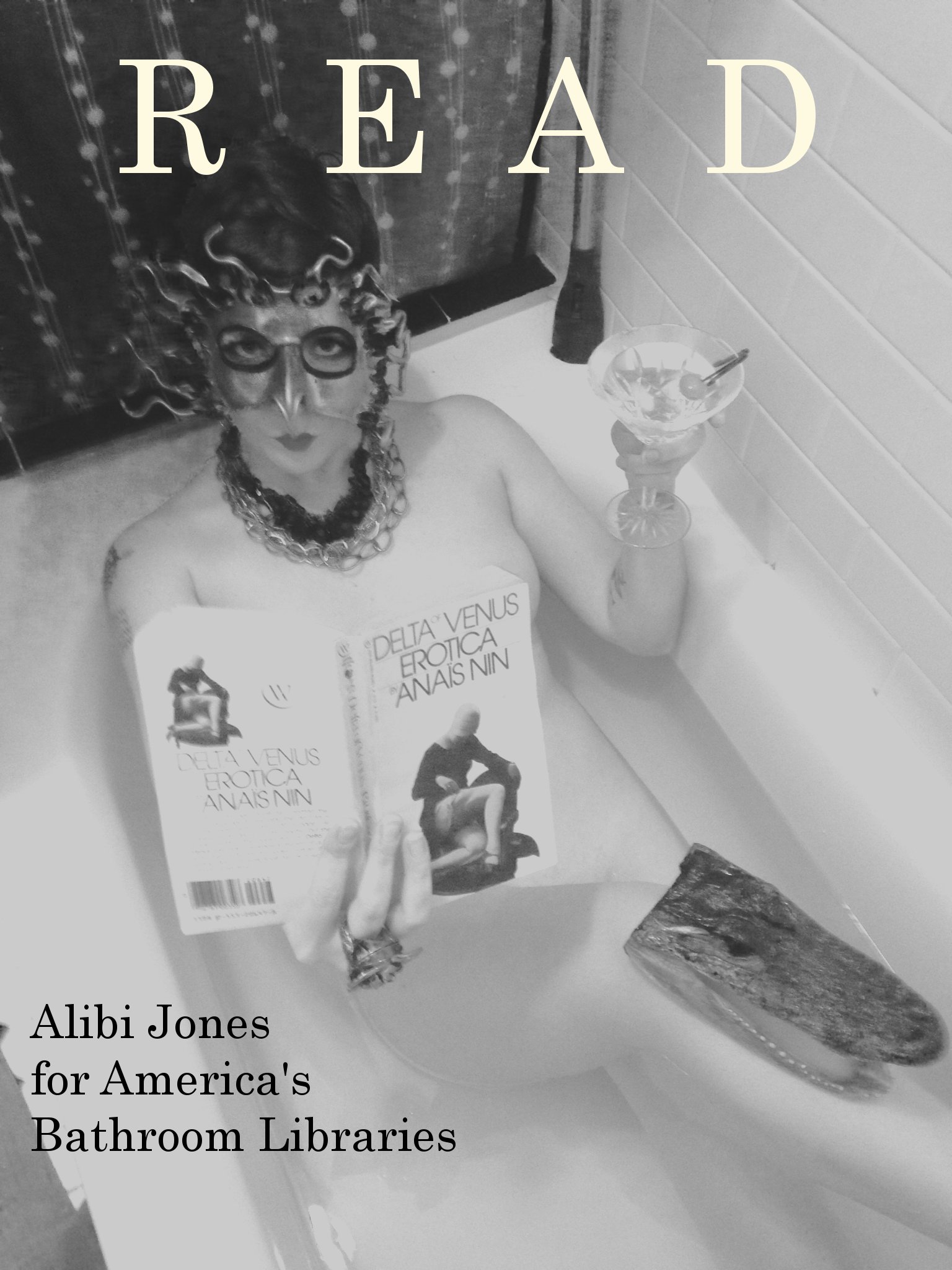
The FLAPPERHOUSE Spotify Playlist: What we listen to when we’re feeling our flappiest. We dream of compiling issues that read the way this sounds.
Here at FLAPPERHOUSE, we believe that Reading Is Fundamental, and few kinds of reading are more fundamental than Bathroom Reading. When you consider that the average person spends over 90 hours per year using the bathroom, it’s not surprising to learn that those who have chosen to spend much of that time with books have contributed a great deal to the cultural history of humankind.
That’s why we were so alarmed to learn from Factual Science Magazine how Bathroom Reading has declined over 72% since 2009. (Thanks again for devolving the culture, SmartPhones!) And as a result, we’ve decided to make it our mission to resurrect this dying pastime.
This mission will, of course, be an ongoing affair, so for now we’d simply like to start by sharing the contents of FLAPPERHOUSE‘s own Bathroom Library:

Clockwise from top left: Modesty Blaise by Peter O’Donnell; Peepshow: 1950s Pin-Ups In 3D, edited by Melcher Media, with Introduction by Bunny Yeager; Magritte: Thought Rendered Visible by Marcel Paquet; Spoon River Anthology by Edgar Lee Masters; Drinking With British Architects: Poems by Jeff Laughlin
So, friends of FLAPPERHOUSE, do any of you have your own Bathroom Libraries at home? Let us know, and help us spread the word that Bathroom Reading Is One Of The Most Fundamental Kinds Of Reading There Is!
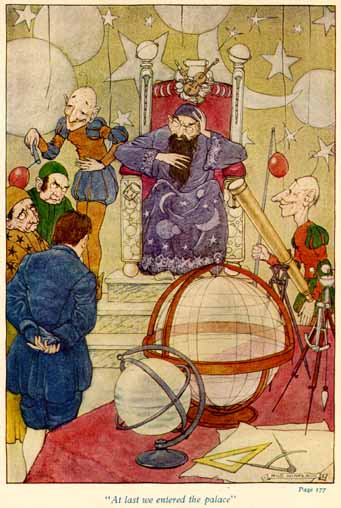
Long before Flappers became famous as the wild-dancing, booze-drinking, convention-flouting young women of the Roaring ’20s, Jonathan Swift’s Gulliver’s Travels told us about the Flappers of Laputa, the valuable servants who made sure their masters weren’t completely oblivious to life’s more important matters:
I observed, here and there, many in the habit of servants, with a blown bladder, fastened like a flail to the end of a stick, which they carried in their hands. In each bladder was a small quantity of dried peas, or little pebbles, as I was afterwards informed. With these bladders, they now and then flapped the mouths and ears of those who stood near them, of which practice I could not then conceive the meaning. It seems the minds of these people are so taken up with intense speculations, that they neither can speak, nor attend to the discourses of others, without being roused by some external taction upon the organs of speech and hearing; for which reason, those persons who are able to afford it always keep a flapper in their family, as one of their domestics; nor ever walk abroad, or make visits, without him. And the business of this officer is, when two, three, or more persons are in company, gently to strike with his bladder the mouth of him who is to speak, and the right ear of him or them to whom the speaker addresses himself. This flapper is likewise employed diligently to attend his master in his walks, and upon occasion to give him a soft flap on his eyes; because he is always so wrapped up in cogitation, that he is in manifest danger of falling down every precipice, and bouncing his head against every post; and in the streets, of justling others, or being justled himself into the kennel.
 Interviewer: FLAPPERHOUSE has described itself as “Dragging the future back through the past, like a rotting donkey on a grand piano.”
FLAPPERHOUSE: Chien! Andalusia! We are un!
Interviewer: Precisely. And by “the past,” more specifically you mean circa the 1920’s?
FLAPPERHOUSE: Yes and no. Mostly yes. We do think the future should have much more futurism. But with much less fascism. We’d also like to see more surrealism, expressionism, dadaism, psychological horror, and, of course, modernism.
Interviewer: Post-modernism?
FLAPPERHOUSE: Is punk rock post-modern?
Interviewer: Is that a rhetorical question?
FLAPPERHOUSE: It wasn’t meant to be, but we’ll answer it anyway. Punk rock is kind of post-modern, right?
Interviewer: …
FLAPPERHOUSE: Right. So we want to see post-modernism as long as it’s punk rock.
Interviewer: Punk rock is more of a 1970’s thing.
FLAPPERHOUSE: Technically, yes. But the 20’s were punk rock too.
Interviewer: I see. So who are some of the writers in the FLAPPERHOUSE family?
FLAPPERHOUSE: They’re writers you should know, but probably don’t yet. They’re very good.
Interviewer: Like George Saunders?
FLAPPERHOUSE: Yes, like George Saunders, if you didn’t know him yet. We don’t have George Saunders though. We do have Todd Pate. He calls himself a “hobo journalist.” A real American vagabond. Like a 21st-Century Kerouac, only sober.
Interviewer: Kerouac was more of a 50’s guy than a 20’s guy.
FLAPPERHOUSE: Yes but he was born in the ’20s.
Interviewer: Touché.
FLAPPERHOUSE: In our Spring 2014 issue we’re gonna publish a story Todd wrote called “The Better Cowboy,” a mix of American mythology and psych-horror. A sexy, bad-ass, bastard spawn of Cormac McCarthy & HP Lovecraft. Once we’re done editing it we’ll run an enticing excerpt on our website.
Interviewer: My blood’s tingling already. Who else you got?
FLAPPERHOUSE: Jeff Laughlin. He’s a writer and musician living in Greensboro, North Carolina. Writes for YES! Weekly, Creative Loafing Charlotte, and The Awl.
Interviewer: I know The Awl!
FLAPPERHOUSE: Jeff wrote their obituaries for Leslie Nielsen and David Markson, among other things.
Interviewer: I remember those obituaries! Two of the best obituaries I ever read.
FLAPPERHOUSE: Damn right they were. Well, Jeff’s also a fantastic poet, and our Spring ’14 issue will feature work from his collection Alcoholics Are Sick People. It’s a dark yet tender exploration of the forces that drive us to drink. It’s also kinda funny sometimes.
Interviewer: Sounds poignant.
FLAPPERHOUSE: It is. Touching, even.
Interviewer: Indeed. Any more FLAPPERHOUSE writers you can tell us about?
FLAPPERHOUSE: We’ve heard rumors that we may publish a brand new tale by Cameron Suey, a rising star in horror and dark fantasy fiction.
Interviewer: Rising where?
FLAPPERHOUSE: All over. In the past couple years his stories have appeared in Pseudopod, No Monsters Allowed, Mad Scientist Journal, and in anthologies published by Hazardous Press and Cruentus Libri.
Interviewer: My, how prolific.
FLAPPERHOUSE: Dude’s like the next Stephen King, but with much tighter prose.
Interviewer: And that’s all?
FLAPPERHOUSE: What do you mean, “That’s all?” That was intended as very high praise.
Interviewer: I meant, is that all the writers you can tell us about for now?
FLAPPERHOUSE: Oh yes, that’s correct.
Interviewer: You know for a magazine called FLAPPERHOUSE you don’t seem to have a lot of women on board. Or any.
FLAPPERHOUSE: Yeah we know. We’re working on it.
Dorothy Parker’s poem “The Flapper” has sometimes been referred to as “Flappers: A Hate Song,” although we at FLAPPERHOUSE like to tell ourselves that Ms. Parker, whom we think was the greatest, had more of a love-hate thing for Flappers, especially since she was awfully flappy herself.
 The Playful flapper here we see,
The fairest of the fair.
She’s not what Grandma used to be, —
You might say, au contraire.
Her girlish ways may make a stir,
Her manners cause a scene,
But there is no more harm in her
Than in a submarine.
She nightly knocks for many a goal
The usual dancing men.
Her speed is great, but her control
Is something else again.
All spotlights focus on her pranks.
All tongues her prowess herald.
For which she well may render thanks
To God and Scott Fitzgerald.
Her golden rule is plain enough –
Just get them young and treat them
Rough.


 FLAPPERHOUSE