Category Archives: Fiction

“Alone with All You Can’t Hear” – Fiction by Jason Namey

The Twin Stars - Luis Ricardo Falero, circa 1890
The Twin Stars – Luis Ricardo Falero, circa 1890

From our Fall 2016 issue, “Alone with All You Can’t Hear” is Jason Namey‘s twisted tale of a troubled twin & an eccentric assassin.

{ X }

THE CORK BOARD FLYER SAID I CAN KILL YOUR HUSBAND in discreet serif; I laughed at how funny it would be to call the listed number, but I wasn’t married. I called anyway.

I had sweated two coffees past midnight, time spent necking bare toes beneath a cafe table, avoiding the graphic design jobs my sister had been sweeping my way.

“Just find the shape for the puzzle pieces of your life,” she had said as we shared a glass of wine in bed a few weeks earlier. “Like take for instance me and Paul.” Every time Paul looked at me, I could feel him thank his luck for finding the fairer half of that zygote. Except when it was Christmas at their house and we sat next to each other on the couch and he pretended to need the remote control but really just wanted to reach over my legs and let his elbow brush my knee.

“What am I supposed to take for instance from you and Paul?” I asked.

“Well for one we don’t ask so many questions.”

My sister did not like questions. Not normal ones, not rhetorical ones, not moral ones.

I liked questions.

Like for instance: If Paul wasn’t around, would me wanting to move into their guest room still be considered “needy and pathetic”?

I flattened the flyer with my hand, while the ringing phone gave birth to blank space.

“Hello,” a tired, female voice said.

“I’m looking at your flyer outside Coffee Hut.”

“And you’re interested.”

“Give me the scoop, kid.”

“Be patient, lady. I need to be up soon to feed four kids eating their way to JV. We’ll meet in twelve hours, fifteen feet to your right.”

I tiptoed home over the cyanide white sidewalk, leaping cracks, not letting the palms of my feet touch. Each streetlight I legged under was the sun of some legendary world. I danced across galaxies.

I want to make love with everyone; I don’t want to make love with anyone.

I want to make love with my sister.

At home, I crawled onto the couch, a ball of caffeine flesh. I put in headphones and played Beck and dreamed about chewy toast on Sunday mornings.

{ X }

Continue reading “Alone with All You Can’t Hear” – Fiction by Jason Namey
“Elementals” – Fiction by Ilana Masad

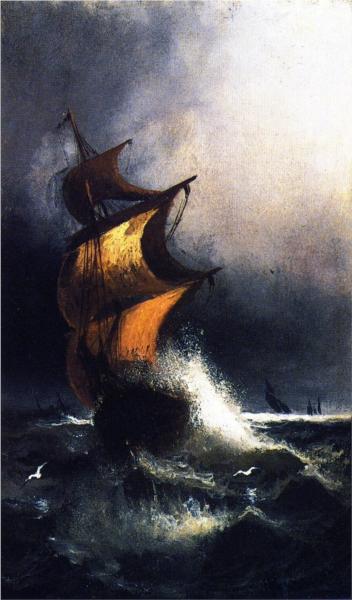
Ship in a Storm - Henry Ossawa Tanner, 1879
Ship in a Storm – Henry Ossawa Tanner, 1879

“Elementals” is Ilana Masad‘s fantastically turbulent short fiction from our Fall 2016 issue.

{ X }

DO YOU HAVE A CHILD? How about a niece or nephew? Well then, what about an old mother, knitting a sweater for you that is always too small when you return ashore? Hm. No siblings either? A father? No, of course not, none of you have fathers. Right, well, hear me out. I’m sure, and don’t deny this now, you have a lovely lady waiting onshore for you somewhere, maybe she’s a redhead, maybe a brunette, maybe her tresses are silky black and Oriental. I don’t judge. It’s not my business to judge, you see. So this lady – no, don’t try to sit up now – this lady, she’ll be wondering what has become of you. She’ll be walking along the docks day after day, holding her rosary beads, because let me tell you, all women turn religious when they fret and if you haven’t learned that yet, you’re in for a shock, oh my yes you are. So she, this daughter of God, is saying her Hail Marys and her Our Fathers and she is atoning, you see, for all her sins. And what’ll happen when she hears about you? We’ll dock eventually, my boy, and then what? Then the news will get out and she’ll hear about the noble way you went, yes, they’ll tell brave stories about you I’m sure, but will she be comforted? After all, you’ll get the sailors’ burial, much as I wish I could spare you that, and she won’t get so much as a casket to kiss for the last time before it’s put into the damp earth of our Lord. What? No lady even?


Tossed like toys by rambunctious oceanic whims, still they sail. Wind whipping flagellations and rain coming down in icy spears, the men feel a thousand sewing needles falling on their every exposed bit of skin, not just the familiar thumb and forefinger accustomed to the sensation. Their faces do not reflect light any longer. The sun has been gone far too long.


Again? Yes, here’s the bucket. Good, good, get it all out. Amazing, what the body can do, isn’t it? Going of unrelated causes and still able to get sick as a landlubber from a bit of a storm. All thanks to our Creator, you know. It’s small miracles like this, really, that make every day a fresh, bright, and new one, you know. Where were we, you stubborn dog? Ah, yes, you said there’s no lady. You’re sure? None? No special friend? Well, now, we don’t normally condone this sort of thing, but in this case, I will understand and absolve you… perhaps a gentleman? Don’t look at me like that, I wasn’t born yesterday, young man, I know well what happens above and below me on these decks. Sometimes, I hear it extends to shore, to marriage-like relationships. Un-Godly, but then the whole group of you are, and that’s what I’m here for. Hm? No? No gentleman either? Well.


Crooked shafts of lightning hurled by the gods of Greece and Rome and pagan storymongers seal the skies with a kiss. Thunder rolls its dice over and over again, waiting for the weighted one to fall right above the ship with a heavy and satisfying rumble-thump. Roiling water gushes over the sides of the wooden dinghy that hubristically calls itself by more respectable names and the sea attempts to swallow it whole. Men are not at stake here; it is only a tug of war between the sky and the sea. Which will get the toy? Which will win this round?

Continue reading “Elementals” – Fiction by Ilana Masad

“The Last War” – Fiction by Stu Watson

The Critic - Arthur Dove, 1925
The Critic – Arthur Dove, 1925

Pride and pettiness spiral into catastrophe in “The Last War,” Stu Watson‘s exquisitely  twisted short story from our Fall 2016 issue.

{ X }

LIKE MOST THINGS, THE LAST WAR BEGAN AS A DISPUTE BETWEEN A POET AND A CRITIC, one that, in its unfolding, ultimately tells us little about the nature of art but reveals volumes about the pettiness and stupidity of human beings.

You see, at a fashionable party in the most fashionable part of the city with all of the correct people in attendance, the preeminent literary critic of his generation, at least by his own estimation and by the stature of the publications for which he wrote, overheard, while discreetly positioned behind a large antique computer monitor, the following conversation.

“So, it seems ———— was not too keen on your latest book of odes…”

“No. But then, who cares for that self-infatuated gas bag’s opinions outside of the media itself? He’s like the ultimate ‘insider’s insider,’ so far inside as to be completely up his own ass! And what’s more, I have it on good report his children aren’t even his.”

It took all of his strength for the critic not to reveal himself on hearing this last remark, for it hit him immediately with the full force of truth. It explained so much, was in fact obvious, but somehow, in over twenty years of marriage, it had never occurred to him as even the remotest possibility. For a moment he felt freed, gifted with the grace of one newly converted, but almost immediately this faded, twisted, and he began to wonder: “How can this poet be so secure in his knowledge to say such a thing, and so casually? What special access to truth does this man have that I do not?” And so his mind began to turn about the possibilities, fixating as each minute passed more and more completely on the poet who had uttered this remark.

He left the party having given no inkling of his new knowledge to any of his literary associates. He almost marveled at himself, keeping quiet about such a juicy piece of gossip, until he recalled that, as he was the object of this particular bit of gossip, it was, in fact, quite likely that everyone else at that particular literary gathering was already all-too-aware of this information that was to him so marvelously new and surprising. That this only occurred to him as he was getting into the taxi outside of the building, having already wordlessly given the driver his address, struck him as fortunate.

On reaching his apartment he stood for a long time looking at the door, thinking, before turning around and walking several blocks to a hotel where he booked himself a room for the week. The next morning he sent a note over to his home via courier informing his wife that he was leaving her, that she likely knew why, and that he expected her to cooperate with his desire for a divorce. By the same courier she sent back a note saying that she was sorry, and that she understood. At the end of his week at the hotel, having brought a few pending affairs to a close, the critic went to the airport and booked a flight for Berlin that departed that evening. Thus it was that one of the most public careers in the world of literary arts journalism came to a sudden and abrupt conclusion, and though there were rumblings as to what might have caused his absconding from the scene so precipitously, the story of his wife’s infidelity was so old, so well-known, that few suspected it might have played any role at all in his vanishing.

But of course the critic did not vanish, was in fact very much present in beginning, in middle age, a radically new life. In Berlin he lived frugally, as was still possible in those days in some of the city’s redeveloping eastern regions. His reputation as a prominent man of letters made it so that he had had few difficulties in procuring status as a permanent resident in Germany, and so, safely established in his new home, he got to working his revenge.

Continue reading “The Last War” – Fiction by Stu Watson

“Charlotte” – Fiction by Nancy Hightower

A Girl Head Behind Spider Web - Toyen, 1934
A Girl Head Behind Spider Web – Toyen, 1934

From our Fall 2016 issue, Nancy Hightower‘s powerful flash fiction “Charlotte” is a dark spin on a classic children’s story. 

{ X }

THERE COULD HAVE BEEN A BARN THAT DAY, with giant haystacks and a pitchfork that somehow always got lost. It could have been a one bedroom apartment in Jersey City. There could have been a baby pig so small the mama pig forgot all about it. Or an old pit bull that pissed on the carpet because it couldn’t make it outside in time.

Either way, the dad wanted to kill it.

There was probably a little girl who wanted to save the pig or the pit bull. That kid had street smarts, could work the county fair or Atlantic City and bought her adopted pet a few extra months of life with the dad. The Jersey father might have worked seventy hours a week and had no patience for an invalid pet and headstrong child. They both knew how to hide in a corner, blend into the shadows so the father might not see them. The farmer probably had his own concerns, but daily he eyed the scrawny runt who ate the scraps and yet never grew fast enough. And the daughter saw it. She saw many things, that girl. Some real, some imagined. Who’s to say the spider in the old barn didn’t spin glorious webs into words illuminated by the morning dew? Or it could have been a brown recluse whose ragged weavings she imagined would save her pig from her father’s ax.

Either way, there was a spider.

Continue reading “Charlotte” – Fiction by Nancy Hightower

“Mediocre Company” – Fiction by Michael Seymour Blake

Eggs in an Egg Crate - Mary Pratt, 1975
Eggs in an Egg Crate – Mary Pratt, 1975

In the spirit of the Halloween season, we present “Mediocre Company,” Michael Seymour Blake‘s uniquely disturbing haunted house story from our Fall 2016 issue.

{ X }

IT STARTS WITH EGGS.

A few weeks after buying the house, a little two bedroom in suburban Long Island, my husband Marc and I feel like we’re starting to take control of our lives. We spend most of our time setting the place up, settling in, dealing with all the inconveniences of owning an older home. Our savings deplete faster than we’d planned, but we find a way to stay afloat.

Then, there’s the eggs.

Marc has always been in charge of cooking eggs because I can never get them quite right. Eggs are trickier than you’d think. Weekday mornings, he scrambles us some for breakfast, then we go about our business.

One morning, Marc’s eggs come out hard and rubbery. “Sorry, hon,” he says. I tell him he’s losing his touch and he fakes getting angry with me.

But the next morning, it happens again.

Marc says it could be the stove. The stove came with the house so who knows how old it is or how it’s been treated. He opens it up and looks around as if he knows how to fix a stove or even tell if it needs fixing. “Weird,” he says, “everything looks fine.”

The following day, Marc wakes up early and starts preparing breakfast. By the time I get to the table, there’s a mountain of eggs stacked on one of our biggest plates. Marc tells me they’re all bad. We eat the next batch he prepares. Rubbery eggs. Tasteless eggs. Not Marc-made eggs. We load them down with salt, but it doesn’t help much.

That night, I prepare some pasta for dinner. The noodles come out sticky, stiff and undercooked. If anything, I left the noodles boiling for too long. I forget about things like that. But no, they’re undercooked.

“Goddamn stove,” Marc says, throwing a crumpled napkin at it.

We have Marc’s dad’s pal, Ted, over to check it out. Ted knows about things like fixing stoves. He unscrews stuff, opens other stuff, nods.

“Seems perfectly fine,” he says, turning the burner on and off.

We make some small talk. He asks me how my yoga classes are going.

“I almost had a full class last week, seven people. If that keeps up, one day I’ll be able to make it a full-time job.”

Ted says, “Wouldn’t that be great.”

“And my YouTube channel is starting to take off,” Marc says.

Marc had been uploading videos of himself singing popular TV theme songs on YouTube. His last one received 150 likes. He wants to go pro someday.

“Lots of people get their start on the internet these days,” Ted says, washing his pudgy hands, “you guys are too cool.”

The stove continues to under/overcook things, but other little problems begin to arise and distract us. One morning, I can’t find my left shoe. I thought I’d left them under the bed because I wanted to wear them for work. Black velvet pumps that are crisscrossed at the vamp. Love those pumps. I ask Marc, but he’s busy trying to figure out how one end of his work pants suddenly became slightly higher than the other.

I look under the bed, in the closet, under the sofa. I look in cabinets, trash bins, the front porch.

The shoe is gone.

“Aren’t you gonna be late,” Marc asks, fishing a tape measure out of the junk drawer.

I grunt in response, checking the refrigerator and freezer.

Continue reading “Mediocre Company” – Fiction by Michael Seymour Blake

Our 2016 Best of the Net Nominees Are…

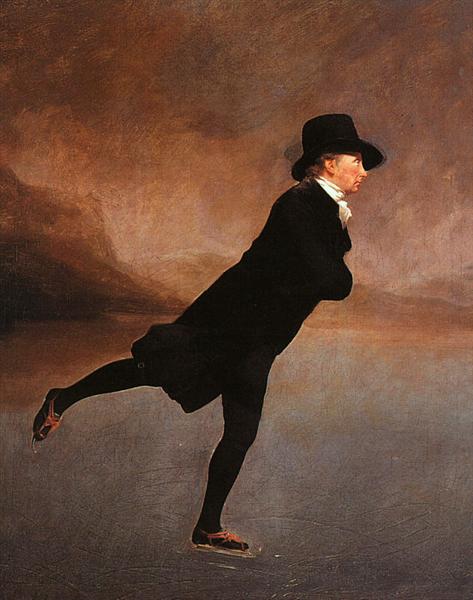
The Skating Minister - Henry Raeburn, 1784
The Skating Minister – Henry Raeburn, 1784

Our nominations for the 2016 Best of the Net anthology, which honors literary work that originally appeared on the internet between 7/1/2015 & 6/30/2016, are:

“CREATURE  FEATURE : CALIGYNACHTMARE : DREAD  the  BEAUTY” – poetry by Shannon  Moore  Shepherd

“CHAPEL  of  SACRED  MIRRORS” – poetry  by  Joanna  C.  Valente

“The  WITCH  THESE  DAYS” – poetry  by  E. H.  Brogan

“HOW  to  be  a  SMALL  PRESS  SUCCESS” – poetry  by  Catfish  McDaris

“HELPFUL  NOTES  REGARDING  YOUR PURCHASE” – short  fiction  by  Brandon  Barrett

Congratulations & best of luck to all our nominees, as well as our eternal gratitude for contributing their amazing work to our weird little zine.

“Finnegan Joyce” – Fiction by Ron Kolm

James Joyce - Djuna Barnes, 1922
James Joyce – Djuna Barnes, 1922

From our Summer 2016 issue, “Finnegan Joyce” is Ron Kolm‘s funny & raunchy riff on the late great James Joyce.

{ X }

HELLO, HELLO, JAMES JOYCE HERE, but briefly, yes, the voice, yes, I know it doesn’t sound so very good, no, the voice does not fare well here in the dead zone — 0, and I used to be a tenor, such a beautiful tenor that they told me, more than once, yes, that I could have been a contender but don’t take my word for it, listen to the record, do they still have records?– it was a Finnegans Wake rap sort of thing, yes, as you can see I try to keep up — should have used more bass, a little sampling, be ok on the boombox then — but I’m pulling your leg, as if a shade could pull anything — because, now that I’m dead, I don’t have to protect the image I worked so hard to create — I’m finally free, I tell you — though I still rejoice at the number of academics who toil in its shadow — who till the field I manured so well — the me they think they know is a construct, only part of the story — James Joyce as Jesuit — James Joyce the aesthete — going slowly blind — grinding out the great creations in the face of insurmountable odds; misunderstanding, penury, censorship, the lovely chains of Ireland past and always present but, shit, what else could I do? — I was as trapped by the iron logic of my own work as any Joycean scholar — forget modernism, the fetter that bound me and, yes, broke me, was the notion of progress — I started small, a few poems, then moved on to short stories, well-crafted they were, too, and finally graduated, with my Portrait, to the novel — all well and good – I was on an upwards trending line on the graph of life, steadily ascending, and seeing the sense and shape of my literary output I made the big jump, the quantum leap, to ur-novel, the novel as encyclopedia, and the result was, of course, Ulysses — but that particular jump from the novel we all know and love to the thinner atmosphere of ‘Great Book’ is a tricky one, because where do you go from there?

Continue reading “Finnegan Joyce” – Fiction by Ron Kolm

“From the Master’s Table” – Fiction by Christine Ma-Kellams

The Woman of Canaan at the Feet of Christ - Jean Germain Drouais, 1784
The Woman of Canaan at the Feet of Christ – Jean Germain Drouais, 1784

“From the Master’s Table” is Christine Ma-Kellams‘ sardonic yet plaintive story of mental illness & loss from our Summer 2016 issue. (To hear Christine read the story, and discuss it with fellow FLAPPERHOUSE contributor Ilana Masad, check out episode 89 of The Other Stories podcast~)

{ X }

MR. P WAS NEVER ONE TO VOUCH FOR HEAVEN but considered God a useful trope for making conversations with people he wanted to keep at bay. He has always been attracted to the idea of being alone, and that’s why being a history teacher seemed like a good idea.

History always seemed to him like a useful way of rewarding and punishing the good and the bad (and sometimes the bad and the good). For this reason he could never take heaven seriously, because waiting until someone was dead to dole out the true consequences of their actions appeared counterproductive at best. He preferred to pay people back while they could still bleed.

He is one of the few functional schizophrenics that I know. I say functional because he is not homeless and owns a Craftsman-style grey house on the West side of San Pedro, in a neighborhood made up of right angles, seven minutes from the ports where he unloaded boats carrying precious Chinese cargo or the occasional carcass, and where celebrity-themed cruise ships now forage for travelers afraid to fly.

When he was in his first year of teaching at West High, several seasons before he was shamed into renouncing vagabondage for a more stable routine of the conjugal kind, Mr. P would spend entire nights at the Coffee Cartel, rambling on the backs of 5-page papers on the necessary prerequisites of civil society, the threat of a perpetual police state thinly veiled by democracy and terrorism, the disappearance of childhood, NPR, the Big Sort into like-minded communities, credit cards, the problem of consciousness, and beauty—usually of the agonizing, thoughtful, forbidden kind. He loved talking to strangers and his students were no exception, though he did not like hugging, which some of them found out the awkward way.

The madness peeked out rarely in those days: an offhand, ostensibly preternatural comment about the NSA, an insistence on sitting in the chair facing the exit at El Burrito Jr.

These days the episodes come on like waterboarding, a deluge of invisible visitors dressed in vapor, narrating every interpretational version of an ever-slippery reality. Mr. P obliges his ghosts, force-feeds them his insides as he tries to disentangle facts from evidence.

Continue reading “From the Master’s Table” – Fiction by Christine Ma-Kellams

“First Souls” – Fiction by Cameron Suey

Head of a Sick Man - Ernst Ludwig Kirchner, 1917
Head of a Sick Man – Ernst Ludwig Kirchner, 1917

From our Summer 2016 issue, “First Souls” is Cameron Suey‘s tantalizingly twisted tale of pandemics, gut flora, and folie à deux.
(And hear Cameron read the story & discuss it with Ilana Masad, check out episode 91 of The Other Stories podcast!)

{ X }

THE WAITRESS BRINGS US OUR COFFEE, dishwater pale murk in cracked porcelain cups. Behind the thin surgical mask, her face is unreadable, but her gaze flicks from me to my companion and back again before she leaves without a word. Mickey watches her go and then fixes his eyes on me. For a long moment, the silence continues, as our eyes confirm what our hearts seemed to know the instant we passed on the street.

“Okay, Dale,” he says, his voice hoarse and still raw, like my own. There is an accent I can’t place – perhaps a district on the other side of the city. “I’m going to ask you a couple of questions, but I think I already know the answers.”

I pick up the coffee, finding it smells as weak and thin as it looks, and contemplate taking an exploratory swig. Around us the few lunchtime patrons of the dingy coffee shop are listlessly eating, lifting up paper masks to shovel in crumbling and greasy burgers, backsides squeaking on red vinyl seats. Those that aren’t eating are staring at us, at our uncovered faces.

“Okay,” I say, “Shoot.”

“You had the sick. But you didn’t report it, or go to quarantine like you were supposed to. Didn’t tell anyone.”

I nod, scared to say out loud that I’d broken the law, and willing him to lower his voice. He smiles a little, showing one blackened and rotting canine.

“Yeah. Me too, I mean, obviously. Look at us. We still look like shit. But, you got better. They say 1 in 10 do, and you took the chance. No family, no close friends, you weren’t worrying about passing the sick along. Or maybe too scared to let that stop you.”

I nod again, excitement and night terror churning in my gut. I knew all this when we first saw each other this morning, that he and I were the same.

I came out of my office building, fighting the paranoia and nausea that had plagued me since my recovery, pulling my necktie loose. I couldn’t be around my coworkers, couldn’t look anyone in the eye. Guilt from ignoring the quarantine, from lying, but something else. Something wrong in every pair of eyes. Ever since the fever broke, and I lay awake and sweating in my bed, the sheets clinging to me, I knew something had changed. That feeling is worse than the sick ever was.

Mickey was just outside my office building, crouched on the edge of a planter box. He was sucking a cigarette down to an ashen nub, and dressed in torn jeans and a stained green nylon jacket, worn thin by time. Our eyes met and I froze, held in place like two sparking nodes of an electric arc.

“We should talk,” was all he’d said, and he led me here, to this grim and filthy diner.

“So,” he continues, “We were sick, we hid it, we got better. But it’s not really better is it? There’s something wrong.”

“Yeah…” I croak, and take another mouthful of bitter coffee. “Something’s wrong. But… I don’t think… it’s not with us.”

“No,” he smiles in agreement, the black tooth sliding into view, “Not us.”

Two hours ago I was convinced I was going mad. Now, I am not alone. I could cry, the relief is so great.

Continue reading “First Souls” – Fiction by Cameron Suey

“Polaroid of a Man in Love” – Fiction by Darley Stewart

Reclining Nude - Paul Cezanne, 1887
Reclining Nude – Paul Cezanne, 1877

Sensuality & brutality collide in “Polaroid of a Man in Love,” Darley Stewart‘s powerful & disturbing shard of impressionistic flash fiction from our Summer 2016 issue.

{ X }

{ 1 }

AS MUCH AS I WANT TO STAY IN THIS SEMI-DOMESTIC SCENE, the pink of the sun rises and infects the clouds. And I am afraid to be alone and stuck in one scene for too long. My mind wanders — often. It runs against good reason. I am afraid more than anything to be alone with my own mind. I know enough to know that I need a woman around, it can even be a girl, she can pick up and fold my socks, or she can suck me until I go blind, she can do mostly whatever she wants unless I am in a very dominant mood, but mostly, mostly, I am gone.

{ 2 }

I believe this is what has made my paintings successful. I watched her slow murder unfold. It was slower than I ever thought murder could be. I can take a polaroid of it for you. Polaroids were popular in the summer of the year she was murdered. The polaroid version is that I was fourteen years old. My mother had died from cancer, leaving me with my tyrannical father and tall, angry brother who excelled at everything he touched, athletics, women, whatever he wanted. I won a scholarship to paint, and I went off to Italy. My father grudgingly acknowledged the genius in me — said to me, quietly one night, you’re a talented fag aren’t you. I painted but I was also lured off to a part of Italy that had nothing to do with the scholarship or the program or the students. A part of Italy that had to do with a girl set against a coastal landscape. I had my first taste of coffee, good bread, and I went to the sea every morning to see her, at first from a distance. She was my age, and she liked to greet the morning without her shirt on. Her breasts were the first I had seen and touched. They were small, perfect. Her deeply tanned skin melted into the palm of my hand. Later in the day she showed me how to catch fish with wide nets. It was unfortunate but the coast was rocky, and by sunset her head was crushed against the rocks by two strong older men. They took turns with her dead body. They forced me to watch. Then I ran away. I never saw them again.

{ 3 } 

I watch her — she is sleeping. She has her dramas, as all young women do, and she is twenty, so she is expected to have them, but what is especially boring about hers — aside from the fact that she is compelled to share them — is that she attempts, in all her dramas, to be the mature one who waits things out. I find it boring that she is as middle-aged as I am. She is very tall — her name is Mildred. Mildred, a name that brings to mind both mildew and dread. Mildred grew up in Ohio before she claims to have grown up in Tribeca and was coaxed into modeling at the age of seventeen. Since then she has earned her spot this winter season as fashion’s “it” girl and she has been parading in white cable knit sweaters and see-through panties, her pubis glittering distantly behind meshed fabric, on billboards in Soho and Times Square. Continue reading “Polaroid of a Man in Love” – Fiction by Darley Stewart