Category Archives: Fiction

“The Story of Essa” – Fiction by Alison McBain

Enchanted Beach - Boris Mago, 1938
Enchanted Beach – Boris Mago, 1938

Alison McBain‘s “The Story of Essa” is a stirring, dream-like tale of transformation from our Summer 2015 issue, which you can order online via Amazon and Createspace. Copies are also available at fine independent brick-and-mortar stores like Bluestockings and St. Mark’s Bookshop.

{ X }

I. SAND

BEFORE HE BROUGHT THE KEY, Essa had been chained to the basement door her whole life–locked within the confines of her own ten fingers and the ability to work small magicks when on call. Before she sunk her feet into the sand, before the rough-hued grains cascaded over her toes, she had never known how to move with any sort of rhythm.

The seagulls sang, and the wind came down to partner her, and she danced and she danced and she danced.

II. SILENCE

Words had never been required. She saw herself as a newborn, the thin loops of the basement chains cascading around chubby wrists and baby cankles, and the admonishment of angels telling her to hush. When he came before her, he didn’t ask questions–he gave her fully-formed sentences, directives for training and the execution of purpose. He taught her how to summon her will and focus it to the desires of the mind; he taught her how to name, silently, all the colors held inside.

But her words were not noticed when she tried them out. Her mouth fell idle in the absence of encouragement. Her tongue dwindled down until it became a tube and split at the end. Sometimes, she cast her tongue out like a net to scent the air, little lizard-girl pining for the day. Continue reading “The Story of Essa” – Fiction by Alison McBain
“Workplace Violence” – Fiction by Leland Neville

desk-murder
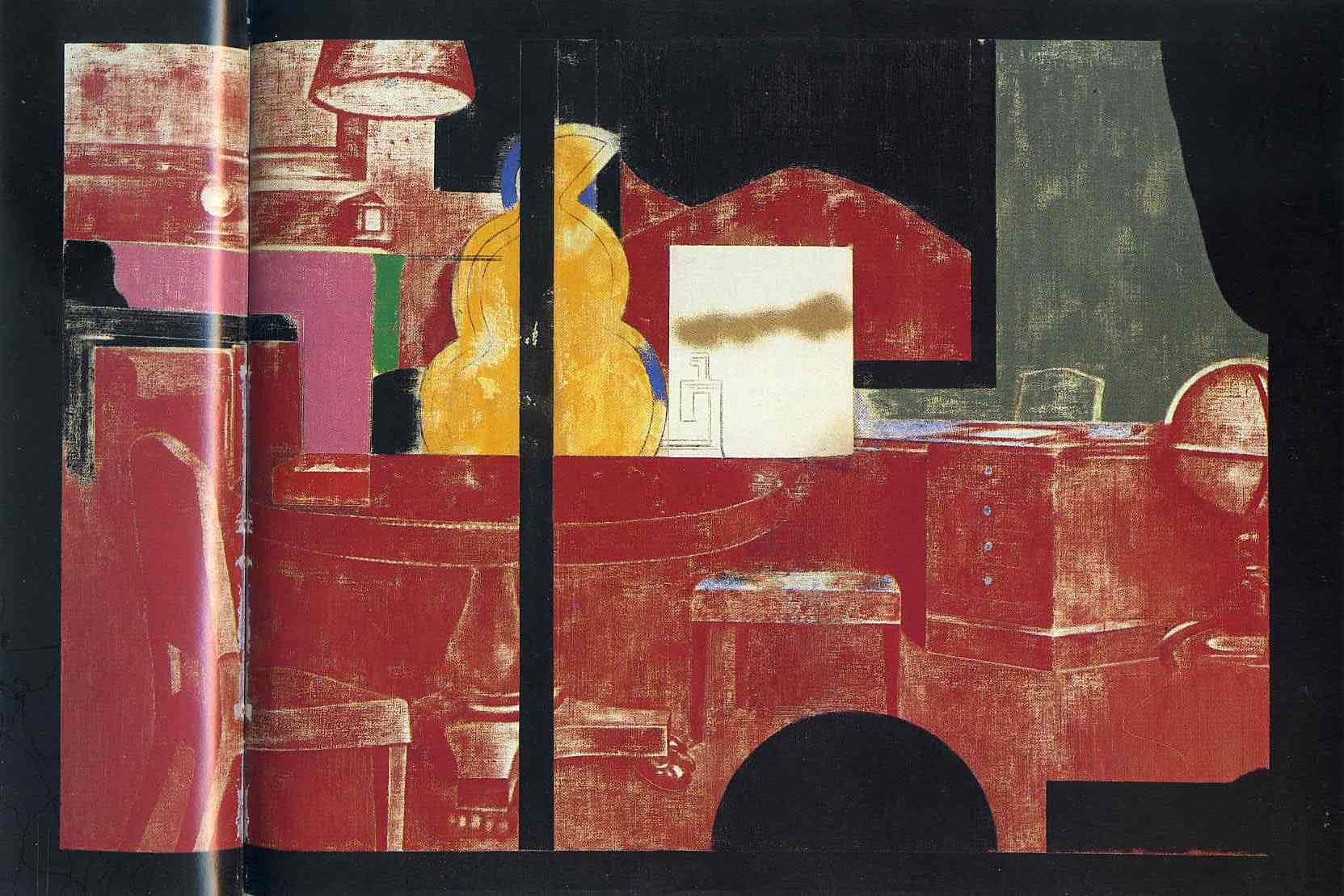
Desk Murder – R.B. Kitaj, 1970 – 1984

Let’s ease back into the work week with a bit of the old “Workplace Violence,” Leland Neville‘s diabolical short story from our Summer 2015 issue (available here, here,here, or here).

{ X }

IT WAS WORKPLACE VIOLENCE, possibly premeditated. The approaching sirens announced my crime. I didn’t have a lawyer. My iPhone was back at my desk. Rudy’s laptop was opened, but I didn’t want to trespass. I remembered the names of those law firms whose ads are impossible to avoid. Their phone numbers all contain seven identical numerals.

One of Rudy’s responsibilities involves escorting terminated employees from the premises of the National Data Archives. That usually happens once a day, always after lunch. Rudy doesn’t carry a gun. (I never witnessed a fired worker refusing to leave or even offering a mild verbal protest.) Our division of the National Data Archives (nine hundred associates and growing) is strictly an information call center. Other departments of the NDA answer letter and email queries.

I had delivered one vicious punch to Doug’s head in exchange for an instant of mindless pleasure. I definitely wanted him to die. Doug collapsed on his ass. My right hand burned. A woman screamed and a man yelled, “Shit!” I think I smiled.

Doug’s round shiny bald head trembled and white foam poured from his surprised mouth. A muscular, six-foot man, one of my coworkers, restrained me. “What got into you?” he asked.

“Does anyone know first aid?” asked a female coworker. “I think he’s dying,”

“I think he’s choking on his tongue,” said another female coworker. “Someone should place a pencil between his teeth.”

Doug rolled onto his belly and extended his arms. He began a steady swim kick. I focused on his Kanji neck tattoo and single black stud earring.

That’s when Rudy from security arrived. He ignored Doug.

“You’d better come with me,” he said.

Continue reading “Workplace Violence” – Fiction by Leland Neville

“Summer Love” – Fiction by J. Wendell Miller

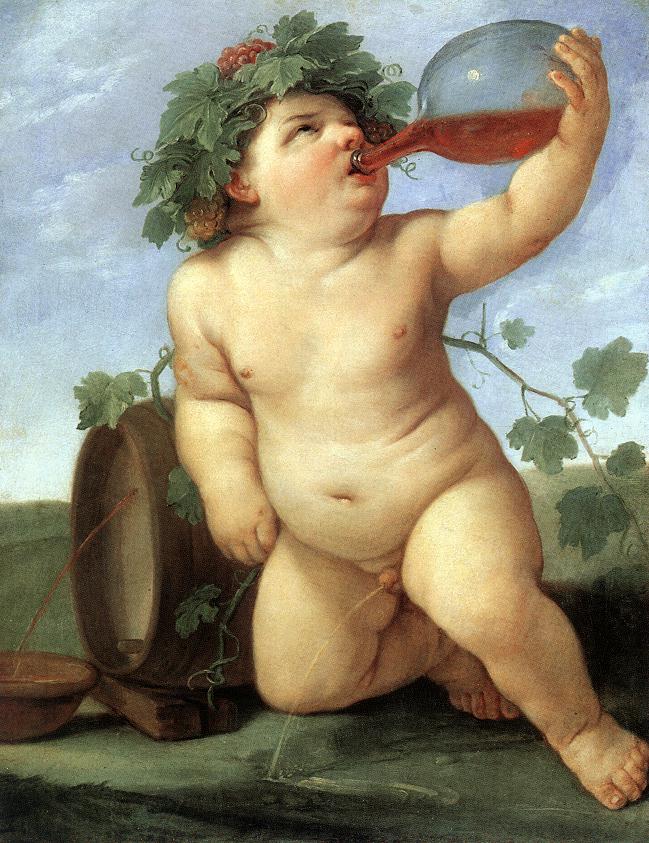
Drinking Bacchus - Guido Reni, circa 1623
Drinking Bacchus – Guido Reni, circa 1623

There’s still a few weekends left this summer, so if you plan on doing any binge-drinking you may want to consult the alcohol reviews in J. Wendell Miller‘s “Summer Love,” one of many educational pieces you can read in our Summer 2015 issue (available here, here, here, or here).

{ X }

MILLER GENUINE DRAFT

Brewery: MillerCoors
Type of Beer: American Pale Lager
ABV: 4.7%
Sociability: High
Adrenaline Factor: Extreme

Review: Maybe the first beer you ever stole, this bitter American Pale Lager likely got your eleven year-old heart racing. You probably tried your best to keep your friends from seeing what you really thought about this effervescent pisswater, though you suspect they all hated the taste, too, hated the bitterness, the smell, the lingering sense of dread and the ultimate betrayal of not getting any of you even the slightest bit wasted. This is really good, your friend probably said after a long pull, but you’re a bad fucking liar, you would have silently countered. When you finished the last few drops, you might have stood in a line and chucked the empty cans over the fence in your friend’s backyard, only to be caught the next day, lectured on how disappointing your actions were.

Grade: B-

{ X }

Five Star Brandy

Distillery: Petri
ABV: 80 proof (40%)
Sociability: Medium
Family Hatred Factor: Very High
Ability to Water Down to Avoid Punishment: Very Low

Tasting Notes: This brandy features full-bodied notes of vanilla, raisin, and blackberry, though they are lost in the burn when taking pulls from the bottle. Be advised, this smooth brandy will often cause quarrels with family, in which the sounds of shouting will disappear beneath layers of sobs and fists slamming into cheek skin. Pairs well with water, but there’s a good chance fifteen year-old you will be grounded at length because of your poor judgment and brazen disrespect for authority. Years later, you will attempt to recreate the magic of your first taste of this low-quality brandy and the love of your life will kiss the stale vanilla notes, the flat cola chasers, and the crusted vomit on your lips before ultimately leaving you.

Grade: C+ Continue reading “Summer Love” – Fiction by J. Wendell Miller

“The Awl” – Fiction by Dr. M Leona Godin

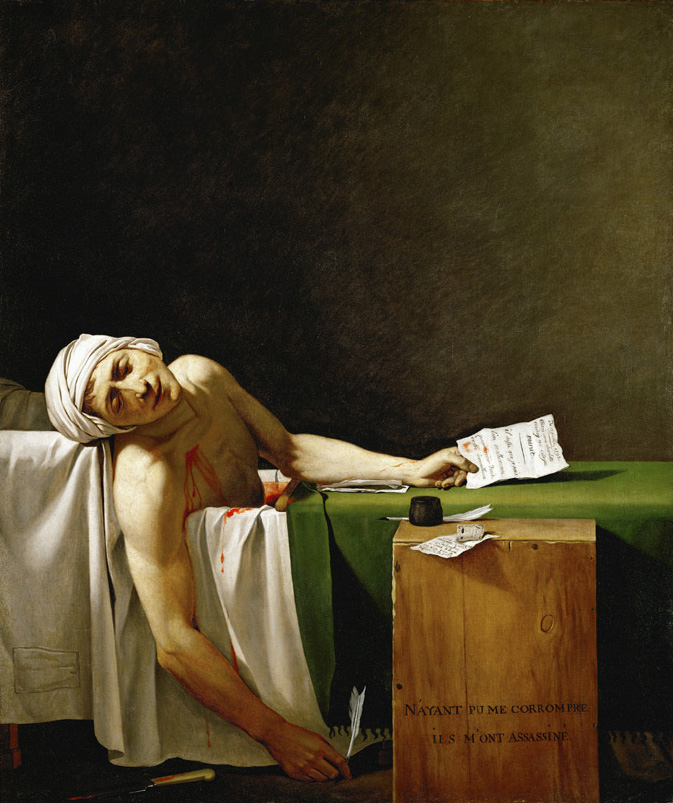
The Death of Marat - Jacques-Louis David, 1793
The Death of Marat – Jacques-Louis David, 1793

Dr. M Leona Godin puts a comically megalomaniacal spin on the history of braille in “The Awl,” one of the many flappy lits you can find in our Summer 2015 issue (available online via Amazon and Createspace, or at independent brick-and-mortar stores like Bluestockings and St. Mark’s Bookshop).

{ X }

I HAVE HEARD OF THE DEATH OF MARAT. Marat was, they say, dotted with ugly holes in his skin that oozed and gave pain. He only found relief in the bath, so that is where he stayed. With his writing table hovering above the surface of the water, he took the names of traitors and wrote them on his Guillotine list. He was stabbed by Mademoiselle Corday, a girl who hoped to stop the madness. David, ever the sycophantic whore of the revolution, bathed the scene in a holy light, forever casting the mastermind of the REIGN OF TERROR a martyr in the gullible eye of the viewer. Once again, the eye deceives the mind!

Now my professors paint me a rebel because I dare to teach a writing system that works better than that of poor old father Haüy. So much for progress. These petty pedants wouldn’t recognize progress if it bumped them on the back of their heads. Ha, bumps, that’s what we’re talking about! You would have laughed to see me point at them in my tribunal and say, “You are all no better than a lot of Oedipuses and I, like Tiresias, warn you to reconsider your folly!” They did not like that at all. Not at all. Sighted people have very fragile egos!

How can they not see that nothing man creates is perfect? Fine tuning—even the most magnificent instrument—is always possible. Consider the organ. With each new great one built, the air pumps more efficiently, the levers glide more smoothly and the stops are placed ever more precisely. There is something divine in progress. Perhaps even God is a tinkerer? One could wish for some improvements. Hear me Lord, my suggestion for the next version of Man: please make the eyeball a little less delicate. It seems a very important organ to be so vulnerable. Or else make us humans less clumsy…

My father was a saddler,
A sad saddler was he,
For I, his little boy,
Would be a saddler too.
Sitting at my father’s bench,
I took the awl in hand,
The awl missed its mark
And found my eye!

Continue reading “The Awl” – Fiction by Dr. M Leona Godin

“Terrible Fish” – Fiction by Dora Badger

Halloween-card-mirror-2

From our Summer 2015 issue, Dora Badger‘s “Terrible Fish” is a dark yet empowering tale of vengeance, as well as a handy guide to scrying and other kinds of mirror magic.

{ X }

In me she has drowned a young girl, and in me an old woman
Rises toward her day after day, like a terrible fish.

 -Sylvia Plath, “Mirror”

NATALIE KNOWS DOZENS OF THE LEGENDS, hundreds of the tales.

If you say “Bloody Mary” into the mirror three times, or five, or thirteen, or maybe spin around when you do it, she’ll appear behind you wielding a knife. She’ll show you your death. She will kill a member of your family.

She isn’t obsessed or anything. They’re just fun to think about, even if most of them are utter horseshit.

Paint one side of a clear circle of glass with black paint. You’ll want four or five coats, until you can’t see through the glass. When it’s dry, write your words of power in white paint around the outer circumference of your black mirror. Now you can use it to see the future. Now the mirror has to answer your questions truthfully. Now you can see the face of your one true love.

Many of the stories and superstitions conflict with one another. Natalie loves how they stretch down the centuries and scatter across cultures. She collects and sorts the contradictory stories, thrilling to each sharp edge, sifting the shit to find the silver. 

You’ll need good reflexes for this one: face a mirror in a darkened room. Say “Blue Baby Blue” three times. The baby’s weight will fill your arms. He’ll scratch you once, he’ll scratch you twice, growing heavier each time. Chuck him in the toilet and flush — fast! — or his mother will appear on the third scratch. You’ll try to run, but by then Blue Baby Blue’s weight will pin you to the floor. Oh! I forgot to say, you’d better do this one in the bathroom.

The crowds are larger with each dead child. The parking for this one is a real pain in the ass. Natalie knows it’s selfish and hateful to think that way, but she just can’t help it. That’s okay. She’s been working very hard to accept unpleasant truths about herself.

If she had fought him from the start, maybe none of this would have happened. At the very least, she wouldn’t have felt responsible for so much of it, felt the weight of that responsibility crushing her even as fresh terrors stalked innocents in the dark.

Cover mirrors after a death so no one has to worry about Ugly Mourning Face. Cover mirrors after a death, or the deceased’s soul will be distracted from Heaven by its own reflection. Cover mirrors after a death so the spirits living within won’t turn your misery to their advantage.

Grief makes everyone hard to look at; any dead who are so easily diverted from the afterlife deserve to be trapped in mirrors; and Natalie’s been through so much horror in her life, she’d almost welcome mirror demons.

Natalie stares into her rearview and thinks: Come on, then. I dare you.

Nothing happens, of course. Continue reading “Terrible Fish” – Fiction by Dora Badger

“Placenta” – Fiction by Ned Thimmayya

Newborn Baby on Hands - Otto Dix, 1927
Newborn Baby on Hands – Otto Dix, 1927

“Placenta” by Ned Thimmayya is a magnificently grisly story from our very bloody Summer 2015 issue, which is available here, here, here, or here.

{ X }

HANNAH SAT IN THE WAITING ROOM, spring green walls and stacks of magazines her only– very cold–company.

In her mind, she carried her stillborn nephew, eyes squeezed to cracks, hands tiny and untried, the umbilical cord vascular blue and looped three times around the child’s neck, tight as spool and thread.  They surgically removed the placenta minutes after they extracted the lifeless blunder-of-joy.

The procedure to remove the placenta was necessitated by a placenta percreta.  The placenta had embedded itself in the uterine wall and–by virtue of its dazzling, opportunistic veins–had penetrated to the bladder.  There the placenta’s long fingers threatened to violate the mother’s internal organs.  The doctor said he’d never seen such an invasive case.

{ X }

“Who didn’t cut the umbilical?” he yelled, arriving at the scene of the stillbirth and snapping everyone’s own private colloquy with the situation.  His words were a show; the child had died in the early stages of labor.

According to him, one such accident constituted heartache for all involved.  A series of stillbirths in his ward translated to lifelong professional consequences and personal guilt.  An entire year of frequent stillbirths, occurring beyond the hospital and even across international boundaries, formed the salient health question of his time.  Since it was this last and most prominent challenge that he faced, there was no shame in his individual ignorance.  His sense of helplessness in the path of death, however, could not be softened by the unanswered questions posed in peer-reviewed journals and obstetricians’ conferences.  Fatal compressions of the nuchal cord–an umbilical cord characterized by at least one full loop around the baby’s neck–had once been so rare.  Which drugs had come into fashion since the trend?  Were there alterations in birth practices that coincided with the upsurge of fatalities? Continue reading “Placenta” – Fiction by Ned Thimmayya

“Difficult Questions” – Fiction by Zain Saeed

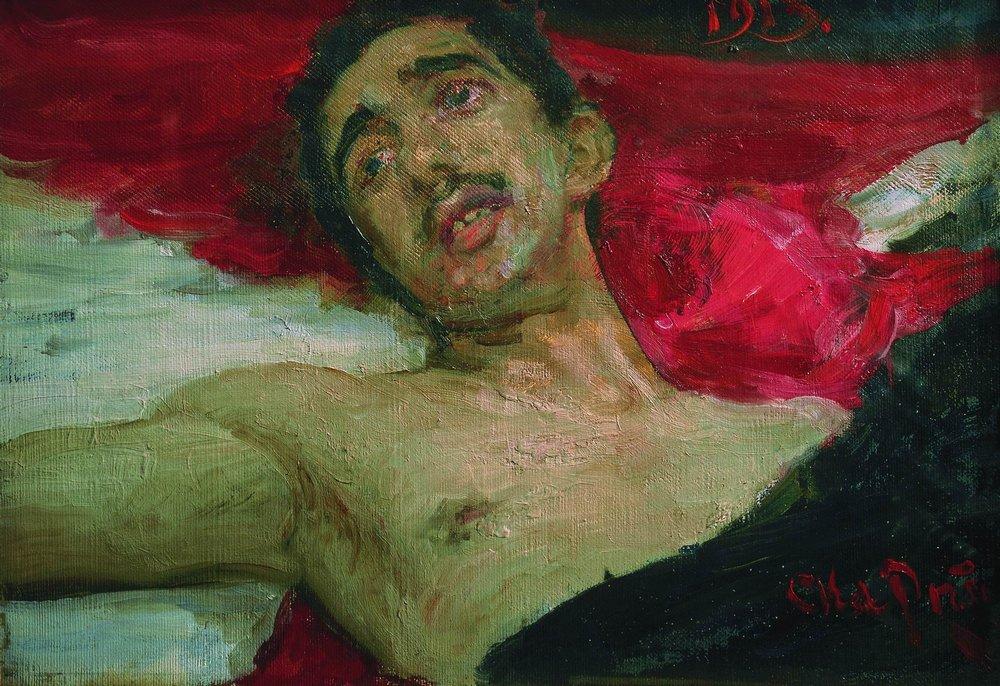
Wounded Man - Ilya Repin, 1913
Wounded Man – Ilya Repin, 1913

When a man jumps into your car pointing a gun at your head and asks how much your life is worth, what’s the correct answer? Find out by reading “Difficult Questions,” Zain Saeed‘s short story from our Summer 2015 issue.

{ X }

WHEN HE SAID HE DIDN’T WANT MY PHONE I WAS DISAPPOINTED, not because I’d kept an extra phone in the car just for days like this and men like him, but because I realized this was going to be one of those days. I was going to remain stuck here on this little street with a gun pointed at me while I pled theatrically for my life and probably be about two or maybe three hours late in getting to the stock exchange depending on this man’s experience and current life situation. I was especially annoyed because I’d already used two out of my three monthly “I got mugged by a man on Tariq Road” excuses and was saving one for the day after Ahmed’s birthday. And now this stupid man had gone and ruined everything.

“Please don’t kill me, please don’t! I’ll do anything,” I said through the still rolled-up window.

“Unlock the doors gaandu.

Fuck me. He was a Clinger and a Swearer. Three hours easy. I made a mental note to apologize to Ahmed. I then unlocked the door and he came and sat in the back, gun pointing at my head.

“Now drive!”

“Of course of course, sir. Where to?”

“Just drive.”

Fucking aimless person.

I began to drive. He took his mask off and lowered the gun, pointing it at my butt so as not to be visible to the people that would get to work on time, lucky bastards. He looked about 19. Clean-shaven, puffy eyes, probably six feet tall, wore camouflage trousers. I wanted to ask him what war was on, but I felt he wouldn’t get the joke. Or maybe he was caught up in too many to tell me which.

Continue reading “Difficult Questions” – Fiction by Zain Saeed

“Who Else Would Make a World Like This” – Fiction by Stephen S. Power

detail from The Garden of Earthly Delights - Hieronymus Bosch, 1510 - 1515
detail from The Garden of Earthly Delights – Hieronymus Bosch, 1510 – 1515

SPOILER ALERT: Stephen S. Power‘s “Who Else Would Make a World Like This” (the first piece from our forthcoming Summer 2015 issue) takes place in a not-too-distant future during GAME OF THRONES’ series finale. Any similarities between this work of flash fiction and the show’s actual finale are purely coincidental. Any similarity between this story’s vision of our future and our actual future, however, is another matter entirely.

{ X }

ADAM AND HIS FRIENDS ERUPT IN CHEERS when, during the Game of Thrones finale, Jon Snow steps over Jaime’s body. Shots all around.

“Who’s got Jaime in the pool?” Adam says.

“I do,” Michael says. “Oh, wait. Damn.”

Bea laughs. “I can’t believe I’m still in it with Gendry.”

“Ssh!” Luce says.

Jon Snow picks up Oathkeeper and charges Aegon. Adam refills everyone’s glasses with Kilmagoon. He gives Bea hers. She kisses his hand. He kisses her neck.

The TV goes black.

“What the hell?” Michael says.

Adam waves. He snaps. Everyone claps. “Stop!” Adam says. He claps again. “TV, turn on,” he says. The TV doesn’t.

Adam’s phone buzzes. Luce looks over his arm. “You hit your viewing cap? It’s only the 13th.”

“I told you I binged the whole series.”

“Just pay for overage time,” Michael says. “Don’t you have escrow?”

“I blew it on the series,” Adam says.

“I’ll pay,” Bea says. She jabs the screen of her phone, entering the TV’s serial number.

The TV turns on. “Goddamn Samsung,” Adam says.

“Tell me your cable bill’s paid,” Michael says.

“Ssh!” Luce says.

Adam whispers to Bea, “Thank you.”

“Just watch,” she says, staring straight ahead.

Gendry’s Armies of the North, surprised after taking Duskendale, are being blasted by Dany’s dragons.

“And his dreams of spring die,” Luce says.

“I can’t believe I just paid to see that,” Bea says.

“You know, in the book–”

“Shut up, Michael,” Bea says.

The Brotherhood appears, it fires crossbows at Dany’s back, and the power in Adam’s apartment goes out.

“You cannot be serious,” Michael says.

Bea pulls away. “Should I break up with you now, Adam, or after I kill you?”

“I don’t know what the problem is,” Adam says. The city glows through the curtains. He goes to the door and cracks it because the peepscreen’s dead. “The hallway’s lit.”

His phone buzzes. “Unbelievable.” He turns it around.

“You hit your power cap too?” Luce says.

“Someone must be hacking my line again.”

“Now that you and Bea are done,” Luce says, “could we go out so I can dump you too?”

“I’m so sorry, guys.”

“Screw it,” Michael says, “I’ll use the app. Nothing like fifty-foot dragons on a 5-inch screen.” He taps his phone. Bea slides over to snuggle against Michael. He shakes her off. “This is crazy. ‘Due to reciprocal contracts with Consolidated Edison, CoxWarner cannot provide service to your location at this time.’”

Continue reading “Who Else Would Make a World Like This” – Fiction by Stephen S. Power

“Many Worlds Away” – Fiction by Damien Krsteski

By NASA/JPL-Caltech/Univ. of Ariz. (NASA - Comets Kick up Dust in Helix Nebula) [Public domain], via Wikimedia Commons
Comets Kick Up Dust in Helix Nebula – NASA/JPL-Caltech/Univ. of Ariz., 2007

The grand finale of our Spring 2015 issue is Damien Krsteski‘s “Many Worlds Away,” a cosmic odyssey through death and what comes next.

{ X }

TO DIE IS TO JUMP. Small pounce, huge leap, big skip or tiny hop, you end up doing it anyhow. (If you want to be all philosophical about it, you could ask whether it’s you that moves or the entire universe that changes lanes—swerving, not a single pop nor screech to warn you—while you remain immobile, believing to have taken flight.)

My first such movement happened at thirteen, in my Grandpa’s library, balancing on two stacked chairs to reach the thick tomes behind which he kept his pistol; I hoped to brandish it before the school jocks whose hands had begun straying toward my developing girl-parts. Just as I started to climb down, the bottom chair cracked, wobbled, gave in, and I tumbled down, revolver in hand, hit the ground with a thud and the distinct click of a pulled trigger. Panting, blinking tears, the clutched gun pointing toward my chest. Unloaded.

Years later I decided that was the precise moment when I began living in Everett-2.

Switching to Everett-3 also happened unknowingly, four years later, when distressed, angry and depressed I ate half the pills from my parents’ medicine cabinet—goddamn Vincent and his goddamn jealousy fit cause I’d dared to like somebody else, calling me a dirty dyke, and whatnot—with cognac to wash it down. I woke up in a hospital to many concerned expressions, in a whole other World.

It was in Everett-7 that I met them—

“Hey, you,” she hollered at me, holding up a cardboard sign at an intersection corner, “how many times have you died already?”

Hurry on. Ignore the freaks. Sip your coffee. But I glanced back; in a fraction of a second my eyes absorbed her whole, and my brain decided to like her. Close-knit wool hat, spotted gloves matching her scarf, blue eyes, pale skin, sophisticated, pretty; she didn’t resemble a crazy street hustler.

“Zero, unfortunately,” I shrugged, taking a sip of the scalding take-away latte to my immediate regret.

She took a step in my direction. Sharpied on the cardboard, the words, Too important to disappear.

“You’ve traveled, girl,” she said after a prolonged look into my eyes, then handed me a business card. Coated paper, slick, only a street address printed on it.

I went to see them that night. Maybe it was my conservative upbringing, my paranoid, prepper brothers, or just too much TV, but I expected robes, candles, pentagrams, goth music. Instead I walked in on a party—crab cakes and white wine, folding chairs and people in T-shirts tucked into jeans talking passionately about politics and science and what have you.

Klara looked nicer without the winter garments, her hair draped over her shoulders. She introduced me to Peter, their leader.

Continue reading “Many Worlds Away” – Fiction by Damien Krsteski

“A Magician and a Marriage” – Fiction by Sagnik Datta

Girl With the Broken Doll - Paritosh Sen, 2005
Girl With the Broken Doll – Paritosh Sen, 2005

Magic and marriage are major themes in our Spring 2015 issue— especially in Sagnik Datta‘s aptly-titled “A Magician and a Marriage.”

{ X }

AFTER LEARNING MAGIC FROM THE SADHU ON THE BANKS OF THE GANGES, Narayan came back to his village incognito, in a long beard and a long dark robe that reached his knees, a jute bag on his shoulder, and with a stick, almost two feet long with knots in two places. He introduced himself as ‘Naran Jadugar’, the greatest magician that Sindoor has ever seen, and spent the first weeks under the peepal tree in the bank of the Mohini River.

He attracted a good crowd on the first two days with little more than a beggar’s provisions, showing them tricks he had learnt from the sadhu, and a small number of tricks he devised on his own; but the audience soon thinned due to the repetition and monotony of the tricks. Once, a stooge was caught, and it caused Narayan much embarrassment, and there was one day when he had to show his magic in front of only a dog which wagged its tail whenever Naran Jadugar uttered a paranormal word.

Narayan’s father, who five years earlier forced his son out of his house for failing in Mathematics, heard of the magician, but did not feel the urge to go and see for himself. When a friend of his pointed out the similarities in the facial characteristics of Naran Jadugar and Narayan, Narayan’s father spit out a jet of betel-red from his mouth.

“No,” he said after heavy contemplation, “my son did not know magic, and he is not talented enough to learn anything.”

But over the next few days, more and more people came to him and spoke to him of the same thing.

“Hmm, seems like the idiot is back,” he said, spitting out the betel-red and wiping his mouth.

The reunion of father and son brought out tears in the eyes of both. Narayan left his shade, and a pigeon flew out of his back, unhindered and to the claps of the children who watched it for free. He hugged his father, his father hugged him back.

“Come home, son.”

But Narayan didn’t. His lips trembled while saying no.

He was unrelenting and showed the signs of the stubbornness that characterized his father, not even bending under the threat of a slap. Their arguments flowed till sunset, and a crowd gathered around them, periodically varying their opinions as they listened to the speakers.

Defeated, Narayan’s father returned home, reeking of the breaths of failure.

Narayan’s mother, Shashibala, heard it all. She came out of the house at night, proceeded to the peepal tree alone, with her searching owlish glances probing the darkness. She returned with her son within a quarter of an hour.

Narayan stayed in the house at night, but in the balmy mornings he would be back under the peepal tree with his magical belongings, and would sometimes show his tricks to nonexistent spectators and bask in vanity at their claps and hoots. On certain clear days, he would also venture out to the neighbouring village of Nandangram where, just like Sindoor, he attracted good crowds on the first days, but then they thinned, and one person had even thrown a ripened tomato at him once but had thankfully missed.

Yet a certain little girl, aged fourteen, with large wide kohl-lined eyes and a single ponytail hanging from the back of her head, was a regular at the show. Even after she had seen all the tricks and knew what would happen next, she would still sit and watch in admiration and silence, with her glass doll in her lap. Her name was Uma.

{ X } Continue reading “A Magician and a Marriage” – Fiction by Sagnik Datta