21THE MOST BEAUTIFULEST SHIT in the whole world can
be the ugliest shit at the
same time/ like toilet paper
& black plastic bags
hanging from a cherry blossom
in the spring/
or the smile of a wretch as you
put the dollar in his cup &
he says god bless you & you walk away/
or the wrath of a mother’s
love/ beaten into her
through generations/
or the son’s tears as he chokes
the doctor who cannot
save her/
22 when was the last time we
dreamed? what did
we dream of?
23 it gets hard to think with
all that laughing in
the background/
24 it gets hard & you think
that shit will never
change/ & the desire
to pass through
life like a shadow becomes
greater than the desire
to raise your voice in vain/
25 plus all everybody do is talk & take
pictures of themselves/
so you can see why folks might
just save their breath
when you see everybody
huddled up crying on
the news/ asking why/
& you see so much beauty in the world
& you wonder how much
of beauty is really real
From our Winter 2018 issue, “Sycorax Martinez is a witch from Corpus Christi, Texas” is a spellbindingly brilliant poem by longtime contributor Luis Galindo.
{ X }
TELL ME, SYCORAX, of the time your heart was broken.
How it almost killed you.
How love itself decayed overnight like filet mignon
Left out on your kitchen table.
How flies gathered to buzz your rotting meat
Your heart meat
Your love offal.
Tell me of the bottomless pain in your chest
The razor sharp scissors of reality to your center.
How you turned to magick and witchcraft
To transform you out of your misery
To exact your revenge
How you sat for months in the botanica backrooms
With more seasoned Latinx brujas
learning, honing your abilities
Your plans for revenge.
Tell me of the spells you wrought
The hexes you spawned
How you drew your own blood with a flea market switchblade
The crimson rivulets that flowed from wrist to chalice
On those Mariachi midnights.
The thick burn of mezcal on your wounds,
Your tongue fat with chanting and prayer
With Marlboros and songs.
How it singed your innards
On those Summer nights in Texas.
Your body and soul engulfed
By the melancholy flames of forever.
Creating sigils, mixing tinctures
Conjuring saints, spirits,
anyone and anything to help ease the pain.
Tell me, Sycorax, how you conjured
The ghosts of Selena and Ophelia
How Selena, with electric wings and voice
attempted to ease your sorrow with songs
and held you, her broken sister
And sang, “bidi bidi bom bom” in your ear.
How Ophelia (who was taller and more powerfully built
than you imagined) appeared
In her diaphanous gown
drenched from her descent from that willow branch
How you said to her, “I thought you were fiction?”
How she replied, “I thought the same of you.”
Tell me, Sycorax, of your bruised heart
swollen and bleeding, nailed above the blue door
Of your consciousness
Like some throbbing crucifix
Your whole impossible existence hanging from a rusty nail
Tell me of your attempted suicide
How you drove to Matamoros and jumped in El Rio Bravo
How you wetbacked your spirit into damnation
On the banks of despair.
How your Americanized pig-sty soul
Was drenched by the river your grandmother crossed
that eventually led to you, wailing and crying
In the gringa nurses’ arms to here
now, wailing and crying again
The Mexicana- Americana tears of lost and unrequited love
congregating, flowing, dividing two countries
dividing your will to live and your longing for an end.
Tell me, Sycorax, how Selena and Ophelia
Cried and pleaded with you from either shore
Watching as you bobbed in the water like a cinnamon stick
until they sensed your will to live had won
how they pulled you to the Mexican side
and held you, wept, howled, laughed and chanted with you;
a triumfeminate coven of tragically wounded witches.
How they whispered and sang in your waterlogged ears
“Bidi bidi bom bom bidi bidi bom bom
And I of ladies most deject and wretched
That sucked the honey of his music vows
Blasted with ecstasy, oh, woe is me
T’have seen what I have seen, see what I see,
Cada vez, cada vez que lo veo pasar
Bidi bidi bom bom.”
Tell me, Sycorax, how you woke at your altar
wet and muddy, dazed and mumbling
how you opened your book of shadows and wrote,
“We are the dreams of the All, falling in love
with one another’s magnificence in spite of
our limitless capacity for avarice, violence and cruelty
and that, my sisters, is the real miracle of life.”
How you tore the page from your book
and set it aflame atop your black candle
and began writing again,
“Ovum, sanguis, cerebrum, aenima
Behold the girl, the woman
Being born again and again.”
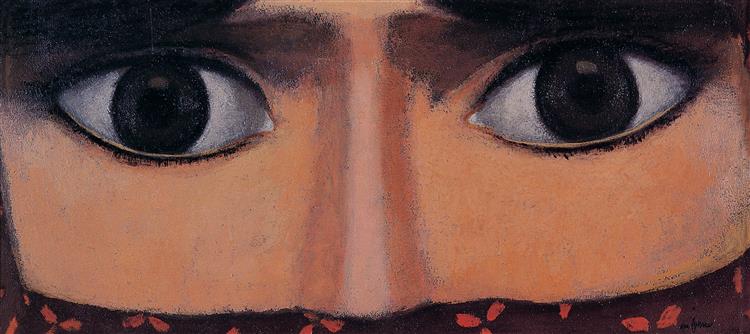
WHEN THE STEREO BEGAN TO BUZZ AND DISTORT I knew it was time and my heart leapt up to take its place in my mouth his voice was garbled and faraway as if speaking into the phone through a glass his profile picture was a close up of his EYE the picture had an effect added to it the name of the effect might have been X-Ray it turned light colours dark and vice versa giving the picture an unnerving quality inverted colours everything a variation of green I saw the EYE when I closed my own it followed me into my dreams I had the feeling of my organs clasped in an icy grip I stopped breathing out I passed the time waiting for Messages and Signs the relationship seemed to be taking place on another planet he had to be the one to contact me if I tried to initiate he would not respond there were rules that were never said out loud some of them I might have imagined whether imagined or not I devoted all my energy to following them I needed to keep the EYE on me without it I knew I would become hopelessly depressed
finally we met in real life I knew him by the way he crept towards me his lips did not move when he spoke he immediately placed his hands on my breasts and put his mouth over mine I was sure I could hear something inside him I imagined that it was his heart the details of him I can remember his clothes made a great deal of noise squeaking leather I could hear his steel toed boots walking a street away he wore a lot of glinting silver attracting attention from local birds his flesh was cool to the touch turning blue in some places today I search for him on the internet I find him commenting on message boards for a television programme that has been off the air for ten years I feel the EYE urging me to do the things I did in my youth the undoing of my shirt and jeans the slow pulling of a sock from the end of my foot the teeth of his zip raking along my cheek on the mattress on his floor he said I was sexy enough to be a glamour model now the skin of my breasts is growing slack a cluster of spidery veins has appeared on my left calf I would be ashamed for him to see me still I yearn to be watched I find myself scanning the blank faces of people in the vicinity customers I’m serving passersby I realise I am taking stock of their EYES as I do this I recite a minor prayer waiting for my breath to catch then hold and hold.
This can refer to swiftly unfolding events whether unintentional or intentional (tarot.com). Just see
those staffs through the kitchen sink
or a little bit of
coffee. Things are not okay,
but it’s not too much
for you to eat.
III. iOS X Predictive:
Lizzie Borden hurt my face and now I feel better.
I think it’s a bad thing but that’s what happened last night
so I’m going to call her tomorrow.
Face the way of your life and then I’ll be there.
{ X }
KAILEY TEDESCO‘s debut collection of poetry, She Used to be on a Milk Carton(April Gloaming Publishing) will be available this winter. She is the editor-in-chief of Rag Queen Periodical and a staff writer for Luna Luna Magazine. She also performs with the Poetry Brothel. Her work has been featured in or is forthcoming from Prelude, Phoebe, OCCULUM, Yes, Poetry, and more. For more information, please visit kaileytedesco.com.
The grand finale of our Fall 2017 issue is “Ecotone,”Chelsea Laine Wells’ haunting & heartbreaking story of a young woman who feels “the edge of what she wants fitted close and suffocating against the edge of what she has.”
{ X }
SHE THROWS UP IN THE MOTEL BATHROOM with the light off so the crack in the toilet and the constellation of toothpaste spit on the mirror are hidden. Then she wafts out all slow languid like women in the movies stricken with love or fever, and drapes her body over the bed. Breathes. Flutter of the eyelids. Imagine what it looks like. Looks glamorous. Beleaguered by life. Like the bathroom, she is better with less light. Everything here is better with less light. The room is small and dirty but the bad details fade to nothing in the yellow bedside lamp glow.
She loves to throw up. The ritual of it, the euphoria of emptying, like turning back time. Redemption. You can change yourself and become new, if you reach far enough into yourself, turn inside out. After there is the fever of ache that comes with deprivation and physical strain and that too is a relief. Something to sink into and grow still inside of, sainted by sacrifice. Holy holy. Stomach flat under the fat and mouth sour. She lies moored in the forever inescapable horror of her body, pacified for now, stewing in heavy heartbeat bodyheat. She thinks of the throwing up and the reverse communion of it and then the cartoonish juvenile words boys have for it. Calling the dinosaurs on the big white phone. What does this mean? Worshipping at the porcelain God. She prefers that, but they say it with a backwards twist of sarcasm that denigrates the ritual. The toilet is not really godlike. Worship implies profanity. Everything pure must touch edges with impurity and in that lose meaning and significance.
Ecotone. This is the term for the point of contact between the natural world and the manmade one. She turns this word like a warmed coin in her fingers. Like the border between what is sacred and what is embarrassing and corrupted. Like the border between the holiness of purging and the ugly reality of vomit in a toilet. Even her internal use of the word ecotone embodies this idea – knowing this beautiful word, but in an unfortunate way as opposed to from a smart book she’d never read or a sophisticated conversation she’d never had. She knows it from a television show she watched at a birthday party she wasn’t really invited to, but overheard about, and then was reluctantly included in, and she went knowing she wasn’t wanted there but somehow her self-awareness did not extend to a behavior that prevented social pain. This was another ecotone. Understanding herself and her frailties with the separateness of a child you cared for and looked down on, but not possessing the ability to change anything.
Being here is beautiful. She is the one he chose to come with him, in spite of all her sickness and flaws, her body that stubbornly persists in a gelatinous layer of fat no matter how much she purges. This body, big and squared off, round broad shoulders, thick jaw. She isn’t pretty. But he looks past it and he touches her like she is small and sometimes she feels it, the smallness that might exist within her if she was able to carve herself physically away as strategically as meat for consumption. This is an ecotone of self, the way he makes her feel with his hands and mouth and body, rubbing itself sore against her offensive corporeal reality. His worship, the sacredness. Her body, the vomit in the toilet. Pure against impure.
Right now he is out getting something, which is how she was able to throw up. He would be mad, she thinks instinctively, for her to waste food. They don’t have much. They ran so fast and immediate. No time to think. Not that she would have arrived at any other conclusion, had she been given time to think, had the question been asked of her. There was nothing to stay for.
Her eyes wander up from the bleached light of old television shows to the painting above. It is a forest, a bear, dark colors and blunt forms. Unbeautiful, inelegant. A rough ugly version of something meant by design to be lovely. Girls are meant to be lovely, and loved. Nature is meant to be lovely. She, like this painting, is a crude representation. She wonders about the artist, if he thought the painting was good, if it looked different in his mind than it did on the canvas, from the outside. Ecotone: the border where your biased perception and understanding met with unforgiving reality. The border where what you wanted met with what was. Continue reading “Ecotone” – Fiction by Chelsea Laine Wells→
But you do it alone, they said. It’s better with someone else.
I didn’t believe them, but I wanted to, so I said okay.
And we walked together for a while. Into places we’d known separately and back out again with new words and phrases and paragraphs and endnotes we immediately wanted to forget. After I proved to them that they were wrong, that I was better on my own, I walked away.
Walking is the way. It asks nothing from you. It is no accomplishment on its own. It’s process. Plan your routes, set along your path, check the map. Or don’t, and just keep walking until it’s time to lie down. Then get up and do it some more. It’s better not to think if you can help it, but if it happens, and with it you feel your mourning kick the wind out of you and fold you in half, you can trust that it will pass. Just keep moving. When the body stays rooted, the blood runs tepid.
My mother had me, her first child, when she was twenty-five. I was a few days away from thirty-five, had no children, and I’d lost my mother some months before. Oh, I knew where she was: alive, very much the person she had always been. But I’d lost her. Rather, she had closed the door, shut me out, shut herself up in the home she had made with my father, the silent partner in this shunning business. I love you, she said, but I love my God more. In anguish, I repeated this to my walking partner, whose own mother was also Christian but in a way that insisted she understand her child’s difference, to recognize over time that her beautiful daughter was, despite expectations, no longer her daughter but still her beautiful child. I bet my parents would say that too if I asked them, they said. But I hadn’t asked.
My mother had always needed to hold me at arm’s length. But when I lost her—and by extension, my father—a lifetime of detritus was unearthed, a hot pile of rotting fruit and buried bones sucked clean of their meat.
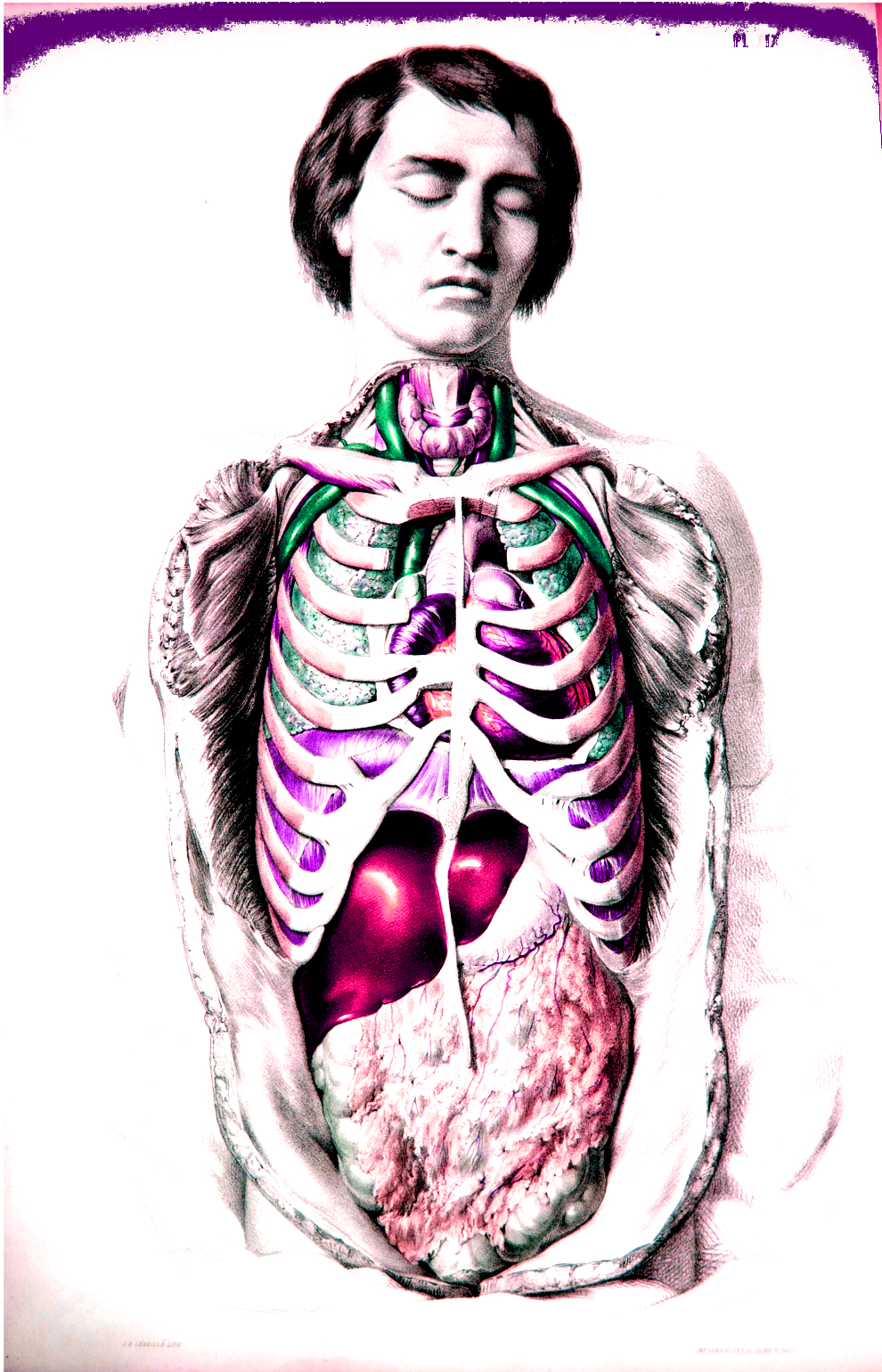
“The Ribcage Explains (Again) Why It Never Votes” and “The Ribcage Dreams of Dancing on a Grave (or Two)” are just two of five wonderfully surreal & acutely affecting ribcage-themed poems by J. Bradley in our Fall 2017 issue.
{ X }
“The Ribcage Explains (Again) Why It Never Votes”
YOU GERRYMANDERED YOUR HEART where only the wolves of his name
are allowed to live. They have the facts
and still they vote to gnaw the marrow
out of you. What’s the point of this story,
this lover asks. You peel back your blanket,
show him the gore in waking up alone.
A young lady undergoes some bizarre & bewildering changes in “Transformulation,” Serena Johe‘s gloriously gruesome short story from our Fall 2017 issue.
{ X }
A SERIES OF HARD SCABS FORMS JUST BELOW SAM’S LEFT ARMPIT. Brown and oddly geometric and bedrock dry, they overlap down the length of her torso, creating tiny roadways in the subtle spaces between her ribs. On Thursday, they darken to the color of dried blood, but Sam remembers the perpetual red and white volley of immune responses in her preteens, the patchy scabs like rows of magnified cells, and she convinces herself there’s probably nothing wrong.
The week after, she finds a lump at the base of her spine, and she begins to worry. It’s round and dimpled like a golf ball, in the space where her last vertebrae should be. When it distends and breaks the skin like a clay-colored bone cap, gleaming wetly in the light of her bedroom, she begs her parents to take her to the doctor, but they brush aside talk of cancer and laugh outright at the idea of mutating poisons.
Their nonchalance doesn’t convince her. True enough, Sam has seen many doctors for the multitude of anomalies that sometimes raise her flesh like a topographical map, and half the time they turn out to be minor irritations that hardly warranted medical attention. Still, she never regrets the visits. Nothing unsettles her quite like the appearance of an unidentified object bursting from beneath her skin. She is reminded of the parasitic creatures on the Discovery channel, of the long yellow stalk of cordyceps fungus she once saw blooming between two bamboo trees, and of the mutilated bodies of its hosts. They splinter apart in hardened sprays of tissue like a still-life explosion.
Sam taps the bulbous growth on her back and it clicks like hollow plastic. The dread and disgust pierce deep. When it doesn’t disappear by the end of the week, the sensation transforms into outright horror, but her parents insist she’s being melodramatic. Her arguments of flesh-eating bacteria and mind-controlling fungi don’t appear to help her case.
On the way to school on Monday, her mother’s eyes keep meeting hers in the rearview mirror.
Sam asks irritably, “What?”
“Don’t worry so much,” her mother smiles. “You’re going to give yourself wrinkles.”
Wrinkles are the last thing Sam’s worried about, and her mother’s lackadaisical attitude towards the quickly spreading rash does nothing but exacerbate her distress. When she gets out of the car, she pulls her shirt over the bulge at her back, which by now has discolored to the same blackish-red as the network of scabs on her side. She attempts to blend into the crowd as always.
At lunch, on her way to Izzy in the far corner of the cafeteria, she feels the pressure of a hundred pairs of eyes and tries not to tug at her sleeves or the scarf around her neck. She reminds herself that not many people would likely pay her so much attention. Then again, Izzy has known her since third grade. She notices something amiss soon after Sam slides into her seat.
“What’s with the outfit?”
Sam pokes a plastic spoon into her yogurt and tries to sound indifferent. “What do you mean?”
“No offense, but you’re dressed like a nun.”
“I am not.” Sam freezes as Izzy tugs at her scarf.
“It’s cute, don’t get me wrong, but it’s like eighty-five degrees outside–” Sam feels the scarf come loose and slaps Izzy’s hand away. “Ow! Sam, I hardly touched you!”
“I’m sorry, I’m not feeling well,” Sam says. She abandons her yogurt and hurries to the bathroom.
Standing over the sink, she pinches the spot where Izzy brushed her collar, right above the bone, as if to erase the sensation of having been touched there. She traces the line over and over to be certain that Izzy hadn’t discovered the mutinous spread of scabs that now reach her chest. Continue reading “Transformulation” – Fiction by Serena Johe→
Heinz Tomato Ketchup with fries, by theimpulsivebuy [CC BY-SA 2.0], via Wikimedia Commons“Existential Ketchup” is a savory & poignant poem of melancholy & fast food by James Croal Jackson from our Fall 2017 issue. (To hear a recording of James reading his poem, be sure to click play below…)
{ X }
GOT A HEINZ BOTTLE FULL OF REGRETS but it’s dried up as the crust of red’s
lost its use you try to squeeze something
from an old heart and look how flappily
it beats sags and wheezes yet I got a cold bag
of wendy’s to share salted and soggy
on our porch in december rain I said to go to be tax-free and carefree yes
but on the swinging bench white-bagged I see
your face in wendy’s and your eyes some
sad fake black pocket’s full of lint and loose change
and can’t stop sliding my hands in to feel my legs
burning with desire to get up and build trash
cans from scrap at the edge of the yard
then wait for the passersby
to throw their guilty pleasures in






 FLAPPERHOUSE

