Monthly Archives: November 2018

“New Names” – Fiction by Khaholi Bailey

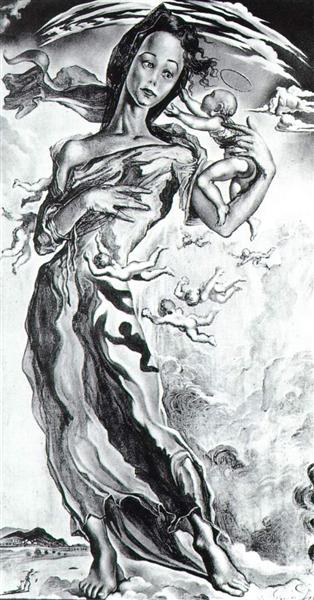
Madonna – Salvador Dali, 1943

A young girl approaches Catholic confirmation while remembering her Haitian roots in “New Names,” Khaholi Bailey‘s haunting & spiritual short story from our Fall 2018 issue.

{ X }

“WAKE UP, GIRL!” Lilith screeched. “Time to make the doughnuts!”

The Girl opened her eyes to a crescendo of light peeking between the pink comforter and the twin mattress, both soft with overuse.

With no response from her cousin, Lilith continued: “What did you say back home? ‘Time to plant the cassava?’ ‘Time to put on an Eagles Super Bowl Champion shirt and sandals made out of an old tire?’”

Lilith half smiled and folded her arms across her body.

“You know, time to get up, or something like that.” Lilith sighed loudly. “You Haitians have no sense of humor.”

The Girl prepared to leave the bed. She moved her head forward, closed her eyes, and slowly moved her knees away from her chest. The warmth that encased her was malleable and comforting, and for a few more seconds she luxuriated in this dreamy state between the world and her barely conscious mind. She likes this twilight of wakefulness more than any other state because it is before she realizes where she is and all that has happened. She felt for a second that she was once again on her mother’s lap where she used to lie. Before she could remember that that part of her life had gone away, she felt a gathering of wiry fingers pulling at the top of her head.

Lilith guided her up to a sitting position, first by lifting the top of her head then grabbing her shoulders. The Girl looked up at Lilith and was startled by the layer of makeup between Lilith’s face and the rest of the room. The Girl did her best to stifle a yawn, as to not inspire her cousin into another quip about foreigners and their odors.

The Girl placed her feet into slippers that were indented with Lilith’s footprints and headed to the bathroom. Without asking, Lilith followed and stood right behind her as she faced the mirror. Lilith took a handful of water from the faucet and poured it over The Girl’s hair. The Girl didn’t stop her. Lilith’s studious glare made her feel like she probably needed whatever help she was going to offer. She took a comb and secured it on The Girl’s hairline and pulled; the comb didn’t budge. Lilith leveraged her right foot on the toilet and leaned back with the left. The Girl’s head was pulled back, farther and farther until the plastic comb snapped.  She raked The Girl’s hair with her nails until she could gather enough hair into her fist. Lilith bent to look at her work. Sweat beaded on her nose, which wrinkled with dissatisfaction. She spat on her palm and smoothed it over The Girl’s rough hair. She took a rubber band and twisted her hair into a ball behind her head. She stepped back to look at her hard work, sighed and smiled at The Girl’s face. “All better,” she said, counting this as one of her good deeds for her otherwise hopeless immigrant cousin. “Maybe we break out the hot comb tomorrow.” She scanned The Girl’s hair triumphantly. “We’ll have to wake up extra early.”

The Girl’s hairline throbbed as she walked to Saint Angela Merici School for Girls, repeating in her mind a list of saints. She would have to choose one as her namesake for tomorrow’s Confirmation, but she still had no idea what she wanted to be called. So, she silently asked Saint Anthony for help: Help in remembering the names of the other saints; remembering why any of this was important; remembering which memories were real. She named her loa, her father, before Saint Diana and reminded herself that Catholic schools here did not honor her deceased father as her personal deity as they did in Haiti. She found herself closing her eyes and trying to picture his face more often lately, though the only reference she had was through pictures, stories from her mother, and her dreams. She was grateful that her loa kept her close by showing up in her mind as she slept, as she was too embarrassed to give him offerings once she moved to the States. She felt disconnected from him, but connecting to him through offerings isolated her from Lilith and her classmates. She figured it more practical to try and fit in here with the living and not with a man who has been dead for most of her life.

Continue reading “New Names” – Fiction by Khaholi Bailey

“The Jazz Man” – Fiction by Harley Claes

Jazz – Man Ray, 1919

“The Jazz Man” is Harley Claes‘s sensual & musical short fiction from our Fall 2018 issue.

{ X }

THE TALKING SHOP MONASTERY FOR TROUBLED SOULS was located within the inconceivable stretch of land in between Sunn and Elliot avenue, a hep spot for any lost bloke who finds himself awed by the remnants of the garden that once was, most many disregard. But behind the stacks of meaningless junk there is sentiment.

It takes the form of a vomit stain on the pavement.

There’s a manor behind it. You’d ought to think you’re seeing the bowels of the Earth. It’s all sodden with spirit speech & revolutionary manner. All of its inhabitants barely inhabited the body half the time. They were all too busy soul-searching.

But then came The Jazz Man, the most present of the local presence. He knew the tune, the vibe that set the joint in motion. His language was the music and the music his mantra.

He was a conspicuous character from the start. Could sit so undisturbed in a busy room. All the old folks had a kind word to say as he sat unspoken. No one else spoke his language.


During group meditation their only means of communication to him was a sitar loop that seemed to speak volumes. The circle of madhouse babble and artspeak made quite the revolutionary backdrop. Each melodic ragging soothed the bellied long-haired monks, that it was only a matter of ease that brought them to the light of jazz.

He hung his petticoat on the altar. They all hoorahed.

It was here they deemed each art a god, a holy practice.

The shell they shed like cicadas, all those bodies piled round on the burlap mat. Each passerby who heard that jazz spat obscenities like origins of the character were an offense to their tradition.

The lot of lucids was now ground for protest.

“No free thinking in my civil city! Enlightenment is a cult act!” They claimed, but not so wisely.

It was Bluebird that twisted the tables. She was bilingual. And knew each art naturally, had a hand for the harp and horn. Even wrote a few manifestos in her youth. The cat made a drag of her entrance. Clung to the poor pillared column that was at its end, already on tilt.

She kicked a saddle shoe to the ceiling and feigned speaking. Her bottom sat on the plum colored cushion where the Bobbies and the Rays served tinctured waters and teas. Mind you this was no ordinary establishment.

For one, it was rudimentary that they sit cross-legged when cushioned.

There was no leaving the premises without a piece to your name. And she, Bluebird of the talented gene, enticed each beneficiary with a tribute of her talent.

“Rosewine, Rosewine. You got Rosewine?”

“Straight with rainwater from the basin. That old barrel out back. Petals all garden grown. A soluble of white wine- you’ll adore it.”

And made so intrinsically with palms molded so thoughtfully around a moon mug, the drink was brought to her with bowed head.

She shifted in form of a painting, one elbow bracing the pavement. Tile disheveled with dirt stain, she was inviting every social strain with the flutter of a lash.

And the Jazz Man, The Jazz Man did what the Jazz Man can. He walked his way with the snap of his fingers down the great degraded avenue. Right into the premise of the great big bird blue.

To take a seat next to her– slightly slouched as she was sprawled. He rung up a Dharma Bum, one of their best beverages, a tea tincture. Milk-riddled. He sat in patience, a meditative state where he studied sheet music and one upped an octave.

Though something was an unusual distraction– a low-lite voice that screamed of vixen– and this had him interested.

“You’re a cat. Voice like an angel.” He says under his breath, hiding behind his dark skin as his voice boomed.

His big fumbling hands press against the oriental end tables that were used to snack upon.

Regulars were seen smoking hashish from hookahs, all gathered around in a rotating centerfold, fiendish for that muse. But big Jazzy only smoked from a pipe– puffing ground tobacco to entice the curious. And baby Bluebird had an itch. A song to sing, a tale to belt out all at once in soprano.

“Love is a beautiful thing,

Don’t you know it babe?

I love the Blues that I sing-”

“Hit the juke won’t you?”

She snapped and the religious fanatics came kicking to act on that beat. They did not understand the music, but they wished to. And the Jazz Man longed to convey the shock and bewilderment he’d faced from the voice.

Continue reading “The Jazz Man” – Fiction by Harley Claes

“Self-Adulation as a Note Accompanied with a Bouquet of Feathers” – Poetry by Wale Ayinla

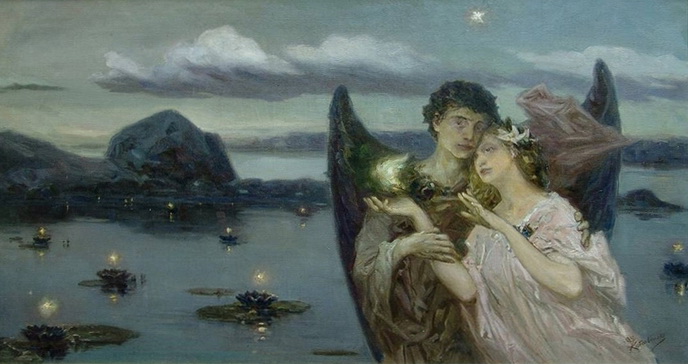
The Shipwreck – Henri-Edmond Cross, 1907

“Self-Adulation as a Note Accompanied with a Bouquet of Feathers” is one of two surreal & spiritual poems by Wale Ayinla in our Fall 2018 issue.

{ X }

TODAY, MY BODY FLOATS IN MAGENTA AIR;
and everything around me is falling
like the words rolled under mother’s sleeves.
Imagine that I am returning to a fever;
of green grass soaked in typhoid bedspread.
My sight tightens mother’s lips
as music. Frail fingers squeeze
her palms into a collage of dark hooks
and sirens, while the syringe buries itself.
Sometimes I feel like I might fold the night
into my armpit and run the length of the
city as a ghost, nevertheless, something draws me
back to my mother’s words like a magnet;
like an oath. (Never leave a widow opened
as a window.) A chimney of old wears
sewn on skin made with footprints.
I hold this memory firmly the same way
God tucks his secrets above the sky
under His soles. One day I will
hold a country and name it dreams.
Look at me the way you look a river
traveling with your face with words
holding you to a grudge. Do you see me
holding the hands of a father who is a heaven
away? Come, as a river paddling the body
into a shipwreck. I live here.

{ X }

WALE AYINLA writes from the ancient city of Abeokuta in Nigeria. His work appears or is forthcoming in Takahe, Kalahari ReviewVagabond CityThe Rising PhoenixExpoundand Dwarts. He is @Wale_Ayinla on Twitter and the founding editor of Dwarts Magazine.

“Beyond Love” – Poetry by J. David

After the Death – Wilhelm Kotarbinski, circa 1900

“Beyond Love” is J. David‘s macabre yet moving poem from our Fall 2018 issue.

{ X }

                                 — After Emma Bolden

IF THE SAINTS ARE TO BE BELIEVED then this body is a thin line
we walk between dead children stacked like xylophones
across a sad and lonely street. I am the only throat in this town.
The lights have been out for years, whole blocks are built from paper-

weights— the kind of city you keep with an envelope and mangoes
on the dresser. Through the broken of the glass I can see the body
as a wire, tapped between two lighting poles I am always looking past
in the dark. I look at you and whisper fuck me till the sky turns blue.

Isn’t it magical how the dead can still celebrate? How I can still believe
in this body as the space I take up between you and what I lose
next. I do not regard myself beyond love, but we all imagine death
to be a kinder bed than grief. We all lack proof enough
to make us stay.

{ X }

J. DAVID is from Cleveland, Ohio and serves as poetry editor for Flypaper Magazine.

“Dear Anybody” – Poetry by Denise Jarrott

Grotesque – Takato Yamamoto, 2005

“Dear Anybody” is one of two uniquely romantic poems by Denise Jarrott in our Fall 2018 issue.

{ X }

I CAN FIND ANYTHING ABOUT YOU BEAUTIFUL, even the things that other lovers told
you were grotesque. You don’t even have to ask. It isn’t that
I am incapable of endurance. If anything, I can go for miles trailing that part of
you behind me, that part which cannot be contained.
I am here with
you at your window. The things it faces will appear as
I see them: the dirty sparrows, the iron fence with the grapevine motif, the mailbox
you painted to appear more friendly to the mail carriers listening to podcasts
                       or gossiping about who was cheating on whom. Woe to
your landlord who glued the sills shut, so that no one can hear me when
I scream. And how I’d scream, uncontained.

Dear Anybody,
I cannot say anything about me is pure, except how like bread dough my love for
you expands with each punch, each indentation, stupidly it fills itself in, to the shape.
I take my shape based on the container. I will love
you, Anybody, the same way I’ve loved everyone else, as if
I am rich in time, in patience, if only to exist with
you in the transparent blue window in which no one else exists. If only
I could prove to you how deep the water is through the glass bottom boat
you agreed to board with me, scraping along the latest reef. This is to say
I am about to capsize, and the red of this coral breaks my heart only to have it mend to
your specifications, a different shape.

Dear Anybody, this is to say that
you will break me in a very specific way, as all bodies do. Once,
I asked someone, in the space of a poem such as this one, to let me sleep in
your bed and feed me seeds and let me drink bitter tea, to tie up my hair so that
I can exist only as a body. Once, I gave a whole book to someone wholly different from
you but it is like handing them a snake that sits so still on the wrist.
I gave over my whole life like handing over a jar of buttons, expecting devotion.

Dear Anybody,
I can tell you this, if you let me, I will give
you the strange objects I have made of my life, but
I cannot tell you what to do with them.

{ X }

11C778AA-14A2-448B-A630-288358E1828EDENISE JARROTT is the author of NYMPH(Vegetarian Alcoholic Press) and a chapbook, Nine Elegies (dancing girl press). She grew up in Iowa and currently lives in Brooklyn.

“Chemtrail Mist of the New World” – Fiction by C.D. Frelinghuysen

A frustrated husband and his paranoid wife try to cope with their realities in “Chemtrail Mist of the New World,” C.D. Frelinghuysen‘s paranoid & poignant flash fiction from our Fall 2018 issue.

{ X }

MORNINGS BERNADINE HAUNTS THE PORCH.  She glides back and forth, white hair untethered, clutching the egg timer, glaring at the sky. “I dare you,” she tells it, as if we don’t live under the Atlanta flightpath. Right on time, Delta 49 appears from the northwest, slicing the sky with a white wake. Bernadine mutters and winds the timer to five. Ever since the Doctor cut her to half time for unprofessionalism she’s been able to perfect the details of her delusions. And after Bernadine squandered our savings I’ve had to unretire from my fine decade of alcohol abuse and represent morons at traffic court, but business is slow and so most mornings I’m stuck here with her.

Last summer at a minor league game Bernadine got beaned by a foul ball, knocking her into the next seat. She was out for a full minute, but when she came to she waved off the paramedics and pushed through the crowd to the parking lot. She grabbed the car keys and drove home, but took a strange route, and kept looking in the rearview. When we got in the house she had a whiskey and a Tylenol and went to sleep. At three a.m. she suddenly woke and shuffled into Tricia’s vacant bedroom, which we’d turned into storage, and booted up the dusty computer. She spends most of each day in there now. I’d heard of a man who dove headfirst into the shallow end and could play piano afterwards. Bernadine, during her brief time in the void, had mastered keyboard and mouse. I caught the ball off the rebound, by the way. Bernadine called it the instrument of her trepanation, and had it mounted above the fireplace. But the baseball was only the final straw that broke her. Lightning ignites dead woods, not the living.

It’s her fault I know every plane by its name, how many engines move it, every federal poison it belches, and why five minutes of linger tells you what sort of smoke is coming out.

Yesterday I had to coax her down from a box in front of Chase Bank, where she was denouncing the fraud of fiat currency. The police officer didn’t scold me, or laugh. He just wrote down the phone number for Braxbury Convalescent.

The timer erupts. Bernadine measures the sky, clicks her tongue, goes inside and shuts all the windows, despite the heat. She clomps down the basement steps and I hurl my spent smoke into the yard. She comes out wearing her gas mask, no longer a ghost but an olive drab and dumpy elephant. “Looks like arsenic today,” she gasps. The Brauns are watching from their window.

Continue reading “Chemtrail Mist of the New World” – Fiction by C.D. Frelinghuysen

“Thirteen Reasons” – Poetry by Matthew Meriwether

Pure Reason – Rene Magritte, 1948

“Thirteen Reasons” is one of three trenchant yet tender poems by Matthew Meriwether in our Fall 2018 issue.

{ X }

BECAUSE ALL MY MONEY IS MADE OF MY DEAD SKIN

Because I am still trying to tell a long story to the dinner guests with a fly buzzing around my hair

Because I run toward the mirror every time I think I might look like a person

Because I’m still making eggs then throwing them in the trash, their bright yellow like daffodils or a girl in a dress laughing in a closet

Because it’s fun to pretend to have courage

Because it’s fun to pretend to die

Because I prefer spinning around an empty house

Because I wear a dress in the summer to trick all the dirty boys

Because my bucket of treats for the boys is a pile of my dead skin

Because I have sewn my skin into dresses, for tricks and for spinning around as if I were dumb

Because it’s fun to pretend you’re an unknown genius then vomit in the champagne bottle you brought with you

Because it’s fun to think of yourself as already dead, or as not having a body

Because I run to your house every time I think I know my name

{ X }

MATTHEW MERIWETHER is a writer and performer living in Fort Wayne, IN. He writes and performs music under the name Fresh Tar, and hosts events in cities across the country, including the reading series ‘Life is Sad, Here is Someone,’ and ‘A Party for All of Our Questions,’ an experimental social gathering. Matthew is recently the author of Knock Knock, a chapbook of narrative prose (Dandelion Review, 2018).

“omen” – Poetry by Monica Lewis

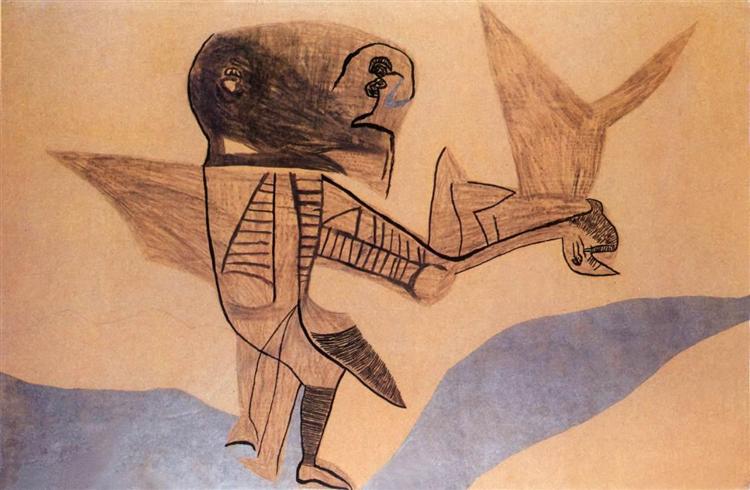
Winged Creature on Silvery Ground – Vajda Lajos, 1938

“omen” is Monica Lewis‘s beautiful, blooming poem from our Fall 2018 issue.

{ X }

A FLUTTER OF WINGS CAUGHT
stuck inside a rain soaked gutter
i count the seconds between
each beating

the tree they thought dead last year
now specked with tiny blooms on every arm
a hundred branches splitting themselves open
to flower the life that though
encased, all winter months,
never stopped breathing

this land where beauty lays herself
out like an easy lover, but
between every blink, she reminds,
for every inch given there is an inch
taken, and the seconds between
grow longer,
the beating of wings
grows weaker

he steps out into the mud, sweet, slow
heavy boots toward the life caught drowning
as five turns into ten turns into twenty seconds between
my own beating turns to a bleeding
and the gray fog clouds the mountains until
they are sucked into sky

and i can no longer see the blue or the green

but he returns
points a thick, steady finger to the elm tree
just as the night is all i start to see, i hear,
“there, there, there she goes” and a bird,
not our bird, but a bird with unwetted wings
flits, flies, and flutters above

and the branches are blooming
and the gutter is silent
and i remember amy’s words:
“the woman on the ledge will
ask herself a question, the
question that occurred to that man
in Bogotá. he wondered, how we know
that what happens to us
isn’t good?”

{ X }

MONICA LEWIS lives in Brooklyn, New York and holds an MFA from Columbia University. Both her fiction and nonfiction have appeared or are forthcoming in SmokeLong Quarterly, Apogee Journal’s Perigee, and The Margins, and her poetry has appeared or is forthcoming in Rust + Moth, Glass: A Journal of Poetry, The Boiler Journal, PUBLIC POOL, Yes, Poetryand(b)OINK, among others. She is a VONA/Voices alumna and has been twice nominated for “Best of the Net” in 2017 and 2018. Her full collection of poetry, Sexting the Dead, will be published later this year by Unknown Press. Follow her on Twitter at mclewis22.

“Be Open to the Miracle of Human Limitation” – A Conversation with Julie C. Day

Julie C. Day was one of our weird little zine’s earliest contributors, as her short story “Faerie Medicine” appeared in our second issue back in the Summer of 2014. Other stories by Julie have appeared in  InterzoneSplit Lip Magazine, and Black Static, to name just a few. She’s also the author of Uncommon Miracles, released this fall by PS Publishing, and currently available in hardcover or Kindle editions. Pulitzer Prize finalist Kelly Link called the book “a collection of stories to unsettle your dreams and make the world a stranger and more delightful place.”

Julie recently exchanged emails with our managing editor Joseph P. O’Brien about Uncommon Miracles, as well as analog artifacts, virtual travel, and the value of surrealism…

{ X }

JO’B: There are various kinds of “Uncommon Miracles” in the stories in your new book: scientific, religious, magical– sometimes even a mixture of two or three. Do you believe in miracles, in the supernatural sense? Or do you think most “miracles” are potentially explicable by science? Or do you believe both are possible?

JCD: Let me start by saying I believe in the part selves, subpersonalities and the dissonance of beliefs these various parts can create. In other words, yes and no. Humans, as biological creatures, can only perceive what our bodies are capable of experiencing. If you consider reality an amalgam of all the sensory data biological creatures perceive, we already miss so much, whether it’s the infrared markings on flower petals or the navigational guides provided by the earth’s magnetic fields. If you consider how much more there must be to the universe beyond that, we miss the majority of reality.

Science is a methodology that allows us to both gain and organize knowledge about the universe. But no matter how often people correct and refine and illuminate, our scientific understanding will never present the objective universe. We humans will always be limited to viewing the universe through the lens of our biology.

JO’B: Have you ever witnessed anything you’d describe as a miracle?

JCD: This is a bit of a sideways answer, but it’s also the best answer I can think of. When I was thirteen my family moved into a house that was over two hundred years old. On the right-front side of the house was a separate front door leading to a small room, too big to be a hallway. We were told that before funeral homes, the dead and their caskets were given their own entrance into and exit from the house. That feeling you have that you see something, like a trailing bit of white fog, from the corner of your eye? I repeatedly, though not frequently, felt that when I lived in that house. I even felt the emotional presence of people like my grandfather, someone who had died thousands of miles away. Part of me says none of it was real, my imagination is a wild tangle inserting itself in much of my experiences. Another part of me says be open to the miracle of human limitation. There will always be the miraculous, aspects to life we may never fully experience or understand.

JO’B: As someone who was raised Catholic (and has since lapsed), I get the sense while reading your work that you also might’ve had a somewhat religious upbringing (or at least been surrounded by religion as a child). Is that true, and if so, how do you think that may have influenced your writing?

JCD: I was born in the North of England but my family moved to southern Indiana when I was six. In other words, my first real experience with religion was abrupt and painful and incredibly alienating. Like many in the U.K. I was raised in a very secular family. Columbus, Indiana was full of churchgoers who believed in a very restrictive Christian orthodoxy. They were completely oblivious at best and antagonistic at worst to the idea that there were people unlike them in their midst. Despite our common language, English, it was a funhouse-mirror of what I considered the real world.

My imagination was my refuge. But I’ve also always had a very analytical mind. Thinking things through and finding the pattern or the common thread is very much my thing, that and a love of the unexpected truth found in our physical world—truths that require scientific observation and experimentation. So when a teacher taught creationism and evolution, making it clear evolution made no sense; when a teacher quoted a bible verse about women being silent in the church; when some civic group came around our elementary school handing out the new testament; when all of those things occurred, I felt trapped between needing to be quiet to feel safe and needing to be true to how I saw the world. It was an intensely uncomfortable experience. And because it is tangled up with far more personal family events, there is a deeper darkness tied to it as well. In the end, on an emotional level, organized religion will always have an association with that Bible Belt childhood.

All this and yet my younger child and spouse both attend a lovely local church that does much for the community. While I appreciate that sense of connection they find there, it’s not for me.

JO’B: Did you, like me, also spend a lot of time wandering through the woods as a kid? (I kind of get that sense too.)

JCD: Yeah, absolutely. I still do. 🙂 My childhood was a different time. On the outskirts of the subdivision where we lived, just a block or two away, were woods, a stream, and corn fields. My friends and I were very much “free range.” It seemed like we were the only ones who went down there. We attempted to cross the stream on rotted-down trees, messed around with the “quick sand” along its banks, and fretted about the possibility of lockjaw from the rusty nails we came across—or at least I did.

JO’B: Your story “Raising Babies,” as well as “Faerie Medicine,” the piece you contributed to FLAPPERHOUSE, involve people undergoing plant-related metamorphoses. If you were to shape-shift into some kind of vegetative life-form, what would it be, and why?

JCD: Can I cheat a little and claim kinship with fungi? With the entire fungi kingdom? They are thrilling. Some fungi reproduce both sexually and asexually at different points in their lifecycle. Funguses can poison or heal or provide nutrition. They decompose organic matter so that the living world can continue. They are mysterious and numerous and not nearly as well understood as the other two eukaryotic kingdoms. Looking at pictures of bioluminescent fungi raises my mood every time. That green-yellow light is my type of magic. And they have chitin—yes the material used for insect exoskeletons and fish scales—in their cell walls! Continue reading “Be Open to the Miracle of Human Limitation” – A Conversation with Julie C. Day

“The Moon Made Out of Bloated Cheese” – Poetry by Juliet Cook & j/j hastain

The Voice – Agnes Lawrence Pelton, 1930

“The Moon Made Out of Bloated Cheese” is one of two fantastically freaky poems by Juliet Cook & j/j hastain in our Fall 2018 issue.

{ X }

THE MOON WILL ALWAYS BE PRETTY WHEN IT’S OLD,
at least until it breaks the earth into pieces.
Flings more grappling hooks into each of our eyes.

It all ages quickly. Tomorrow is the day the leaped will
invade my larynx and contribute
to my paranoia. How are we supposed to know
what constitutes a healthy or unhealthy
size or shape of our own voice box?
How do we know if it’s even our own?

Sometimes I wonder where my voice comes from
and where it will go next.
My stomach keeps gurgling like it wants to be my voice.

I don’t think my stomach can handle American Cheese anymore.
It feels loaded with toxic chemicals.
When she asked me if she could change my voice for me,
I was not suspect I was grateful I am tired of this thud.
She got out a large carving knife.
What was she going to cut out

and what would it be replaced with?
Maybe she would somehow ascend
the tired parts of me to the moon

{ X }

Continue reading “The Moon Made Out of Bloated Cheese” – Poetry by Juliet Cook & j/j hastain