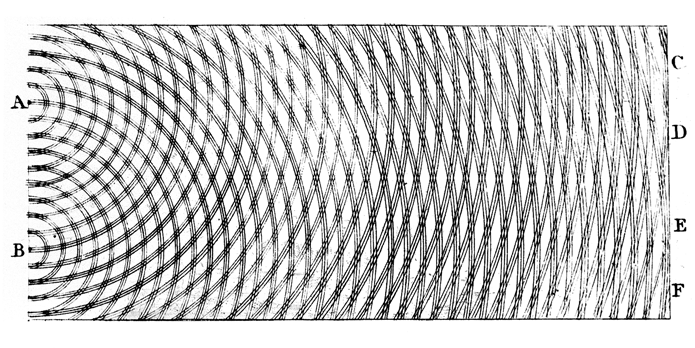
We must admit we’re not experts on Quantum Physics, or Social Physics, or any kind of physics for that matter. But we have observed plenty of odd behaviors in our family members, and we’re very intrigued by the theory proposed by Joseph Tomaras‘ “Hypothetical Foundations of a Quantum Theory of Familial Social Physics.” It’s just one of the many flappy lits in our Summer 2014 Issue, which flies out of the nest on June 20, and which you can now pre-order (in PDF form) for $3US.
{ X }
THOUGH I STARTED COLLECTING SECRETS AT THE AGE OF FIVE, it was not until my last year of graduate studies in physics that I discovered a use for my hoard.
Under another name, I am well-known within a small community, that of high-energy physics. We are the ones who send atomic nuclei smashing against each other at near light speed to see what peculiar entities escape the wreckage. Much as fiction writers do with invented families: I realized this when procrastinating on my thesis with a binge of Raymond Carver.
No offense to you writers, though, but how much more valuable would the data be if it were based on actual collisions, not your more or less stereotyped models, or your real-life examples slightly falsified to protect egos and innocents? Once the basic analogy is made, the fundamental theory almost explains itself—to those with a sufficient understanding.
For example: Every force that attracts or repels has an associated wave-particle. The force that binds quarks into protons and neutrons and binds them into an atomic nucleus is called the strong force, and its wave-particles are called gluons. Whatever we call the force that binds parents and children together into a nuclear family, its wave-particles must be what we call secrets.
 FLAPPERHOUSE