Lonnie Monka‘s poems “Waning & Waiting” and “Erotics of Silence”, included in our Summer 2014 issue, are very brief but very powerful, so without further ado:
{ X }
“Waning & Waiting”
BULLETS WHIZ past people’s ears
every day
on city streets;
I have shot
the same gun
others have used
for suicide.
The stop signs have
no gun holes here,
the sun is blocked
from flirting strands
of light, flickering
with the rising
& the setting
of lust-filled days:—
Maybe tomorrow
I’ll find her,
perhaps I will pull
hard on her hair.
Every day
I wake up
a blinded bird
that craves to fly:
Who can resist
the savage pleasure
of pushing hard
against the air?
{ X }
“Erotics of Silence”
IF ONLY—OH! IF ONLY THE BURNING, scorching bits
of I-don’t-know-what
would stop.
{ X }
LONNIE MONKAis a U.S. native now living in Jerusalem. He loves the finer things in life, like reading & writing. Lately, he’s been happily hard at work developing Jerusalism, a literary community based in Israel.
Our good buddy & hobo journalist extraordinaire Todd Pate gets personal and shares “Still Shooting,” a plaintive account from some of his darker days, which you can also find in our Summer 2014 issue.
{ X }
I CAME UPON THE OLD JUNKIE at the corner of 111th Street and 3rd Avenue. Spanish Harlem. He’d just finished shooting up in the middle of the sidewalk. The thin rope he’d used to cut off the circulation to his left arm dangled loosely around the elbow. The syringe lay on the sidewalk at his feet but he still held his right hand to his left arm in shooting position, pressing his thumb down on the invisible plunger, over and over. People passed by with Spring afternoon speed, going in and out of the bodega, dollar store, fried chicken shack, Cuban or Chinese joint or liquor store. Never noticing, never caring.
I can’t say I cared, either. I’d quit drinking that Winter, I cared about very little then. I had no compassion for myself, much less for that old junkie, in those early months without the drink. I didn’t even know what compassion was anymore. I knew nothing about anything in those days. Without the drink, everything was one greasy unformed thing. The only thing that made sense was drinking and I wasn’t drinking anymore and the only thing to do about that was to walk, day and night, above freezing or below, around Spanish Harlem. The noise in my head faded a little when my feet were moving. While in motion, I could forget about the gaping hole running through the center of me, quit worrying if it would ever close up. I took each step as if they’d been predetermined. But my feet froze about 10 feet from that old junkie. Seconds after I stopped, the noise rushed in. I fought to push it away, putting all my focus on the old junkie…
His eyes were broken windows in his sagging gray face, curtained by stringy, salt-and-pepper hair. Sparse cactus-needle whiskers grew around his open mouth that looked to be stuck on a syllable of a word he’d failed to finish. A skinny and bony creature, but rogue flab managed to collect about his midsection. Shoulders rose and fell with each slow breath. Dirty sweater, holes in it. Dirty pants hanging below a pale ass. Belt buckled in the last hole, excess of belt swinging about like the withered remnants of some mysterious appendage. Sockless feet disappearing in tattered tennis shoes much too large.
He took three tiny crab steps toward me as if to balance against a wind blowing in his mind. Once stabilized, he looked at me. I looked down. I was wearing a sweater, too. Belt buckled on the last hole, too. My green cargo pants too big, cuffs shredded. The pants I wore the last time I drank. I pulled them up over my waist and there were my black tennis shoes. I felt the hole in the right heel. I wore them the last night I drank, also. I looked up just as the wind blew the junkie again. He crab stepped closer, I crab stepped further away as if he were the bull and I the matador. I couldn’t take his eyes anymore so I looked down. The same pants, the same shoes. But I can’t remember anything else about the last time I drank. Crab steps, crab steps. I just know Mount Sinai was the hospital…
Daniel Ari has spent the past few years working in an original poetry form called “queron,” in which each poem contains three quintets and a final couplet, an interweaving rhyme scheme, and a question. We’re thrilled to include two of Daniel’s queron poems– “The fallow months” and “What’s cooking”— in our Summer 2014 issue.
{ X }
“The fallow months”
MY HUNGER, LOVE, IS LIKE AN ALIEN MOON. I know you feel its phases subtly
as tired nights pale from busy afternoons.
The strange globe with its aching liquid pull—
astronomical and inopportune—
has stirred storm clouds lately, love. It grows full
and stirs tides and winds into two hoarse cries.
In here, we’ve battened down, sorted the mail.
Do you remember the last time that eye
closed in satisfied rest in the cocoon,
turbulence muted under the duvet
of earth’s shadow? Did you know sixty-two
moons (nine of them provisional) fly by
Saturn, not to mention the rings? And do
you know how insistent my orbital
gravity winds up? Even typhoons blow!
You’re the sovereign sea, but I’m thirsty, too.
{ X }
“What’s cooking”
MY GRANDMOTHER CALLED THIS “SNARE-A-HUSBAND.” She never wrote out the recipe but
made me memorize it before she died.
I’m humming the song of ingredients,
stirring around your name, my bowl, my bird.
Yet your freedom’s what I love most, my heart,
and I’m far too giddy to bake a trap
even if I wanted to. When we part
tonight with our bellies full, night will wrap
its separate dreams around us. My David,
will you dream of me? Earthy smells rise up
layering the edible atmosphere
held steaming beneath the coal-crusted tarp
of stars. If you will be mine, then we’re here
for that purpose. Eat, my friend. Fill your plate.
Two birds told me about the weight you bear.
Swallow that bite then share, please, share your thoughts.
Many clowns are silly, and sad, and terrifying, but we doubt many clowns have experienced as many absurd twists of fate as the title character of John Grey‘s short story “Boko” from our Summer 2014 issue.
{ X }
MY REAL NAME IS JEREMIAH STEPHEN DENNIS KUNITZ, though people call me Boko. My story begins when I had just graduated clown school and was excited to be entering the real world of false noses and big stick-on ears. However, much to my dismay, the circuses were not hiring that year. My gloomy red smile drooped even gloomier.
And so it was that I spent at least two months pounding the pavement on my unicycle looking for work. Sadly, many doors were slammed in my face. If you’ve ever wandered down Fifth Avenue and wondered why many of the door-knobs are smeared with grease paint, then wonder no more.
I did think myself fortunate when, after sending in my résumé, I received a call from Human Resources at Bestial Labs. I was ushered into the office and steam-bath of a Professor Stamp. Unfortunately, there’d been a misunderstanding. The company was under the impression that my background was in cloning.
“Oh no,” I explained. “I’m a clown. I do squirting flowers and I’m absolutely amazing with a rubber chicken. Oh yes and I can ride an ostrich.”
Professor Stamp set his cloned voles upon me. I was lucky to escape with my red wig and pantaloons intact.
Without a job and no money, I soon found myself being kicked down the stairs by my landlady and almost strangled by her boa constrictor.
I tried an employment office. The woman assigned to interview me merely laughed in my face. Now whether that was because she had nothing for me at that time or she thought clowns to be hilarious creatures, I cannot say. The bites in my leg from her pit-bull service dog would indicate the former.
I must confess I was a very depressed clown and I had the scars on my wrists to prove it. But I refused to give up my dream and go into chicken sexing like my father. No way I would follow in anyone’s footsteps. Besides, my size three-foot-long shoes precluded such a mode of walking. I vowed to stick it out no matter what. I’ve always believed that people need a good laugh. Or any kind of laugh. Besides, my head was designed for shoving in the barrel of a cannon, not retail or banking.
For two sticky summer nights, I slept on a park bench. No one bothered me. A serial killer dressed as a clown had been disemboweling ballerinas up at the dance studio in the Heights. The lowlifes kept their distance in case I turned out to be the Baggy Pants Butcher.
On the third night, however, I was shaken out of my shaky dreams by a cop.
“It’s like a finger always touching you,” writes Judith Skillman in her poem “The New Mother.” It’s just one of several pieces inour Summer 2014 issue that wrestles with the anxiety of motherhood, and it dwells somewhere along the blurred edges between mundane suburban reality and the uncanny surrealism of subconsciousness.
{ X }
SHE STANDS ON HER DECK SMOKING, LEANING
on those lovely arms. How is he, we ask,
passing, nostalgia welling up
for our lost chunky ones. She stands
and smokes, steeped in her hair,
her face, her jeans. He’s good, his Dad came home late and took him for a walk. The secret’s out, she can’t put it back
but she does. I’m fine until 5 but after that, well, it’s like always being touched,
I can’t even pee without— We interrupt, our late middle-aged laughter
gnawing at what’s left of September summer. I remember, I say, I was always ready to— looking sidewise at a man
I barely remember marrying.
Glancing up at the loveliness of her,
all the elements of home lit
by the kitchen beyond, its canisters
where mystery blends and foments.
I’m fine until 5, she repeats, her faint smile
like the day moon, and we turn away,
see the father heading downhill, the stroller
and blanketed cargo, its selvages
burning like skin meant to be taken
and taken again. That night
we make love until we fall back,
old in faded blue sheets,
sated with too much—like a finger always touching you she said, it’s like that.
{ X }
JUDITH SKILLMANis the author of fifteen books of poetry. Her work has appeared in Poetry, The Iowa Review, Northwest Review, Midwest Quarterly Review, Southern Review, and Prairie Schooner. Visit her website at JudithSkillman.com
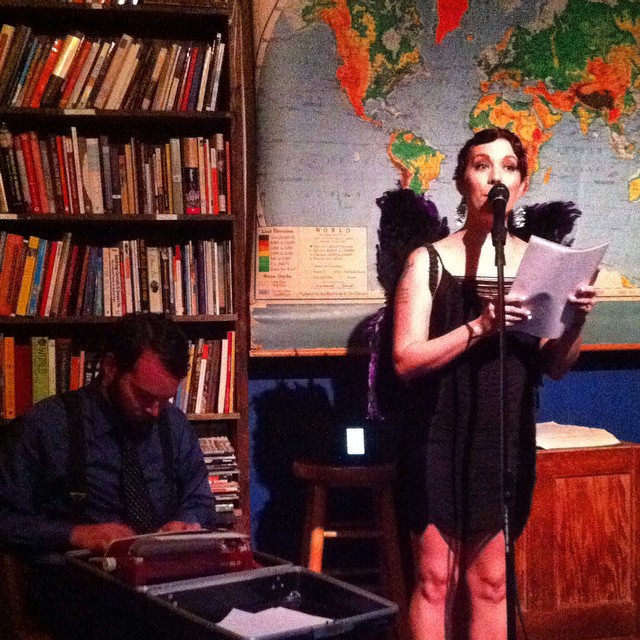
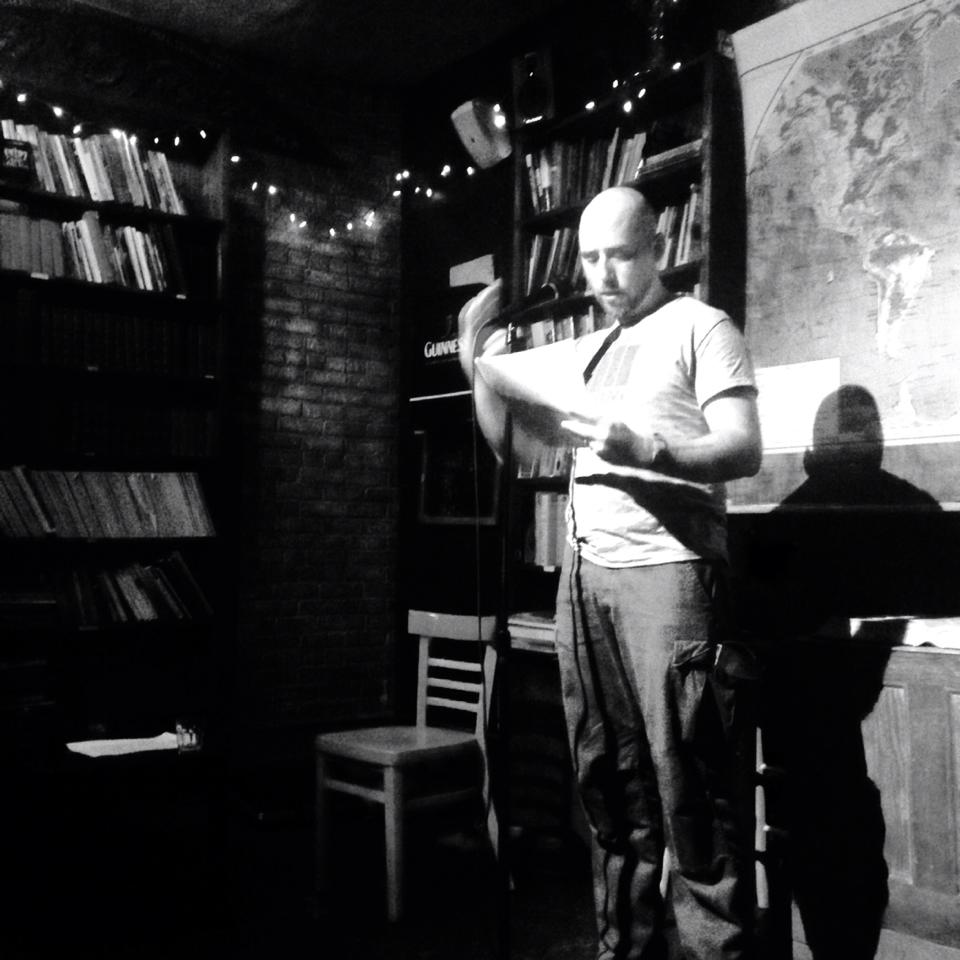
We wish to offer our warm, feathery gratitude to everyone who joined us for our first reading last night, as well as to those who couldn’t make it but were there in spirit, not to mention the extremely kind staff at Pacific Standard, to the amazing Alibi Jones for all her assistance and photography, and of course to our esteemed readers (Mila, Brendan, J.E., & T.). Maybe let’s do this again a few months down the road?
The editor & the amazing Alibi Jones welcome the crowd. Photo by Trisha Siegelstein.Mila Jaroniec reads from her novel-in-progress. Photo by Alibi Jones.Brendan Byrne reads from “Human Child,” from our forthcoming Fall issue. Photo by Alibi Jones.Joseph P. O’Brien reads his short story, “Reaper Taps.” Photo by Alibi Jones.J.E. Reich reads her short story “I Will Be There But I Will Not.” Photo by Alibi Jones.T. Mazzara reads “Rebel, Rebel” from FLAPPERHOUSE #1. Photo by Alibi Jones.
Great gods almighty it’s been a brutal summer, hasn’t it, with all the rage and hatred and violence and warfare piling up in our newsfeeds? It seems like every day’s been a fierce reminder that this mad world of ours could always use a little more mercy. With that in mind, we hope you enjoy Aoibheann McCann‘s “One of those women” from our Summer 2014 issue.
{ X }
I BROUGHT ON THE BLEEDING SEVEN TIMES OVER THE YEARS before it stopped altogether. Miriam down the road, then her daughter, would peer out from the darkness and give me what I needed.
I could have got my husband to leave me alone, but I knew he would blame my first lover. My husband was a quiet man. The other men avoided him, walked by him as he stood in the dust. The shame I had brought him and he had borne. Forever the man who had married a woman who bore her first lover’s bastard.
I am one of these women who from the beginning of time have known it was not time, not my time, not their time. I am one of the women who chose. I do not hide my face.
So my son was fed, and the others bled into the ground. I thought when he grew up and started to be a help to his father that I would not take the turn down the track for the bitter herbs. I would have a child I could kiss. My son never wanted to be kissed. He cried until I picked him up, then he would twist away and stare out, at what I could not see.
Who am I? Who are these women? Who are the six thousand from this country that leave to find an end to the not-bleeding? Year on year, multiplied by all the countries in the world. Who are these women who do not seem to know what is right? Who from the beginning of time have committed this evil. Continue this evil even as you march against them, stones in hand to throw at their glass houses and smash them.
It was my husband who would go to find him as he roamed, we’d only hear of the trouble afterwards. People whispered our renewed shame. I bore it as I had promised to when I first noticed the absence of bleeding, the morning lurch, the heightened sense of the smell of the junipers. Worrying long into the night, the thought repeating over and over; he is dead, he is dead. Then he was. It was a relief that there were no brothers and sisters to see his broken body.
I am the statue at the side of the road. I am the statue in your churches. My face appeared to you in France, in Portugal, in Mexico. In the West of Ireland where you pace righteously. I appear in the tree stumps and the cliff faces to remind you. I am not ashamed of what I chose. Let them choose.
You ask me to have mercy on you, you mouth it in your prayers; Hail Mary, Mother of God, have mercy on me. You pray to me in your cold churches, cut off from the world of heat, hunger and dust where I came from.
Have mercy on me, the woman who is now stone. Have mercy on those who are flesh and blood. They stand before you.
{ X }
AOIBHEANN McCANN lives on the West Coast of Ireland where she writes fiction, non-fiction, and the occasional poem. In real life she is the manager of a residential service for cancer patients. Her work has been published in THE EDGE, The Galway Advertiser, Xposed, The Galway Independent, The Galway Review, wordlegs, and Crannog. She has also been a featured writer at The Over the Edge Event and on Galway Culture Night 2013.
Like many of the pieces in our Summer 2014 issue, “Faerie Medicine” by Julie C. Dayis about metamorphosis. But it’s also a moving tale of folklore, family, and rebirth in the beautiful, mystical forests of New Brunswick.
{ X }
THE TREE’S QUESTION STARTED WITH A CLEAR PLASTIC BOTTLE. One of those liter containers of “mountain spring water” people buy from a gas station cooler for $1.99.
The brown-haired girl poured two bottles of Aquafina into the hole she’d dug at the base of its trunk.
“But, Molly, Poppa Chris isn’t leaving. He’s not like—” the boy said, hesitating nearby.
“The water’s for the faeries,” Molly cut in. “Just like Poppa Chris, sometimes they need help keeping their promises … even if they swear and cross their hearts.” She lifted a pendant from around her neck, a cluster of blood-red berries hanging from a silver chain, and dropped it into the hole.
The tree could sense the children’s mother just a few yards distant, near the line that divided forest from bog. The woman had long wavery-gray hair and frowning lips.
“I mean it,” the mother called. “I’m not waiting.”
“For the faeries,” the boy repeated and knelt down beside his sister. Soon both children were pressing rough handfuls of peat between the tree’s roots, sealing both the necklace and the spring water inside.
“Molly? Matthew?” The mother’s voice was fainter now. “What’s gotten into you? Chris will be waiting for us.”
Molly glanced around as though just noticing the dim light and the mass of stunted evergreens. “Mom, wait!” Soon both children were hurrying away into the gloom of the forest.
The little tree held itself still. A low breeze, cool in the fading twilight, pushed its branches out across the bog and then back toward the stand of pines. Something felt different. The water in the peat bog was plentiful, but also full of acids that seeped up into its branches. Almost worse was the lack of soil. The tree had to survive on nutrients from the rotting remains that had settled near its trunk.
From the outside, one hundred and fifty-three years of bog life had hardly changed the little pine. But, inside, the two liters of spring water carried with it something new. The tree found itself suddenly concerned with one particular question: the matter of its name.
Concern was something it hadn’t felt in over a century and a half.
We often wonder whether animals are smarter and sneakier than they let on. And after reading “Birdy Told Me,” the poem by Frederick Pollack from our Summer issue, we’re almost convinced that they must be.
{ X }
IF ANIMALS COULD TALK THEY’D LIE. Consider:
they know people know how they suffer
yet do nothing; maybe
(they think) we’d do better
running individual scams.
Crows get tips from pigeons on ledges
on Wall Street, at race-tracks,
exchange them for carrion. Raccoons
promise to police your rain-gutters,
guard your house; eventually
they sell protection. (Dogs keep
their mouths shut, except when eating.) Deer
set up as gurus. They’re so cute and can do
charisma. Are one with all life, with
the Goddess, they say. Whoever
shoots one of us or runs one of us down
will burn. In every city or town
there is within easy distance a vacant
lot or patch of weeds beside
a road. Sit in it, say the deer, sit
long enough in the center of the weeds
and you will be made whole and purified.
{ x }
FREDERICK POLLACK is the author of two book-length narrative poems, The Adventure and Happiness, both published by Story Line Press. Other poems in print and online journals. Adjunct professor creative writing George Washington University. Poetics: neither navelgazing mainstream nor academic pseudo-avant-garde.
From our summer issue, “Lemon Lane” by Foust is a witty, bitter, melancholy riff on fame, identity, and memory through the eyes of a former sitcom star.
{ X }
LET’S GET THIS PART OUT OF THE WAY: I know I look familiar to you. Believe me, we’ve never met before. I was Krissy on that TV show “Lemon Lane.” Back in the early seventies. Here, let me refresh your memory: If I put my hands on my hips and tilt my head to the side, you might see it. Now, I have to say “Hey! Don’t look at me.” Yes. I was that little girl with pigtails who was always in trouble.
I get that look all the time. That “Don’t I know you?” look. It’s because I was in your house. I was in everyone’s house. People think they know me. Well, they used to. I’ve almost aged out of it, but these two little moles on my cheek give me away. Remember the episode where I—errr, Krissy—tried to sand them off with sandpaper? And then she had to be in the Christmas play. And they made me be a shepherd because then I could wear a beard over where I’d sanded my face.
You know, I was a lot older than Krissy. Most people thought she was six. But I was actually nine when I got the part. When I started to get boobs, they fired me. Well, on the show I got written off to boarding school and my family adopted a little girl named Brandy who was supposed to be the daughter of a family friend who died. Her catch phrase was “Are you kidding?” She had to tilt her head to one side the same way I used to. But she didn’t have to put her hands on her hips.
Sometimes, I would get called in to make a guest appearance. Maybe for a holiday show or something. They would write up something so I could say “Hey! Don’t look at me.” The studio audience would laugh. And then the writers would find a reason for me to leave so they could get back to finding ways to make Brandy say “Are you kidding?”
After “Lemon Lane,” I didn’t get another TV show. I did do some commercials—remember Fudgy Squares? Or Kiddle Kids?
It’s strange, looking like someone who’s been in everybody’s house. I have two lives that run side-by-side like train tracks. Sometimes people forget which stories are real and which are from the show. It happens to me too. But when I remember something that happened and I realize that I was wearing pigtails, then I know it’s a show memory, rather than a real one. Those pigtails were fake. They just attached them to my real hair with some water soluble glue. At the end of every day, I had to tip my head over the sink in the dressing room and spend twenty minutes washing the glue out of my hair.
{ X }
FOUST is a writer, printmaker, and curmudgeon. She lives in Richmond VA with her lovely husband Melvyn and several spoiled rescue dogs. She has an MFA from Spalding University. She goes by one name in order to save time.










 FLAPPERHOUSE