Category Archives: Fiction

“Just Another Evening” – Fiction by Dusty Wallace

photoOne of the most bizarre pieces from our decidedly bizarre Fall 2014 issue has to be Dusty Wallace‘s giddy flash of Python-esque absurdity titled “Just Another Evening.”

{ X }

THAT FUCKING ALLIGATOR stretched out on the nine-foot Steinway in the center of the stage was really distracting.

I nudged the guy next to me, “Do you see that?”

He looked offended at the interruption or maybe he was just worried I’d creased his penguin suit. “Yes. Mr. Nakamura’s agility makes Chopin’s Minute Waltz look simple.”

He was probably right. But who the fuck cares about Chopin when there’s an alligator on the piano? And why were me and this posh motherfucker the only people in the theater?

“Perhaps because you’re naked,” said Posh Motherfucker like he’s reading my mind.

Wait a tick… I’m naked. Naked. That explained the draft, but not the alligator.

Mr. Nakamura stopped playing, standing to face the auditorium. “Would you two please shut the fuck up?” he shouted. “It’s hard enough playing with this fucking alligator on the piano. The last thing I need are two disrespectful assholes running their mouths right in the middle of the waltz.”

He sat back down at the piano, cracking his knuckles, and picked up exactly where he left off.

When he hit the last note Posh and I gave a standing ovation. I clapped with such enthusiasm that my penis slapped back and forth on my naked thighs and it sounded like three people applauding.

“Like I give a fuck,” Nakamura said, ambling off stage.

“Well, it was nice seein’ ya,” Posh said.

“Wait, aren’t you gonna give me a ride home?” I asked.

“Why would I do that?”

“I’m naked. I don’t even know how I got here.”

“You find yourself in this position often?”

“What? Fuck you,” I said.

“Good luck finding a ride,” he said. “Maybe you should ask Eric.”

“Who’s Eric?”

Posh pointed to the stage. Only the alligator was in sight, still stretched across the old grand. “You don’t really expect me to…” I began, but when I turned around Posh was gone. Continue reading “Just Another Evening” – Fiction by Dusty Wallace
“The Hole” – Fiction by Samantha Eliot Stier

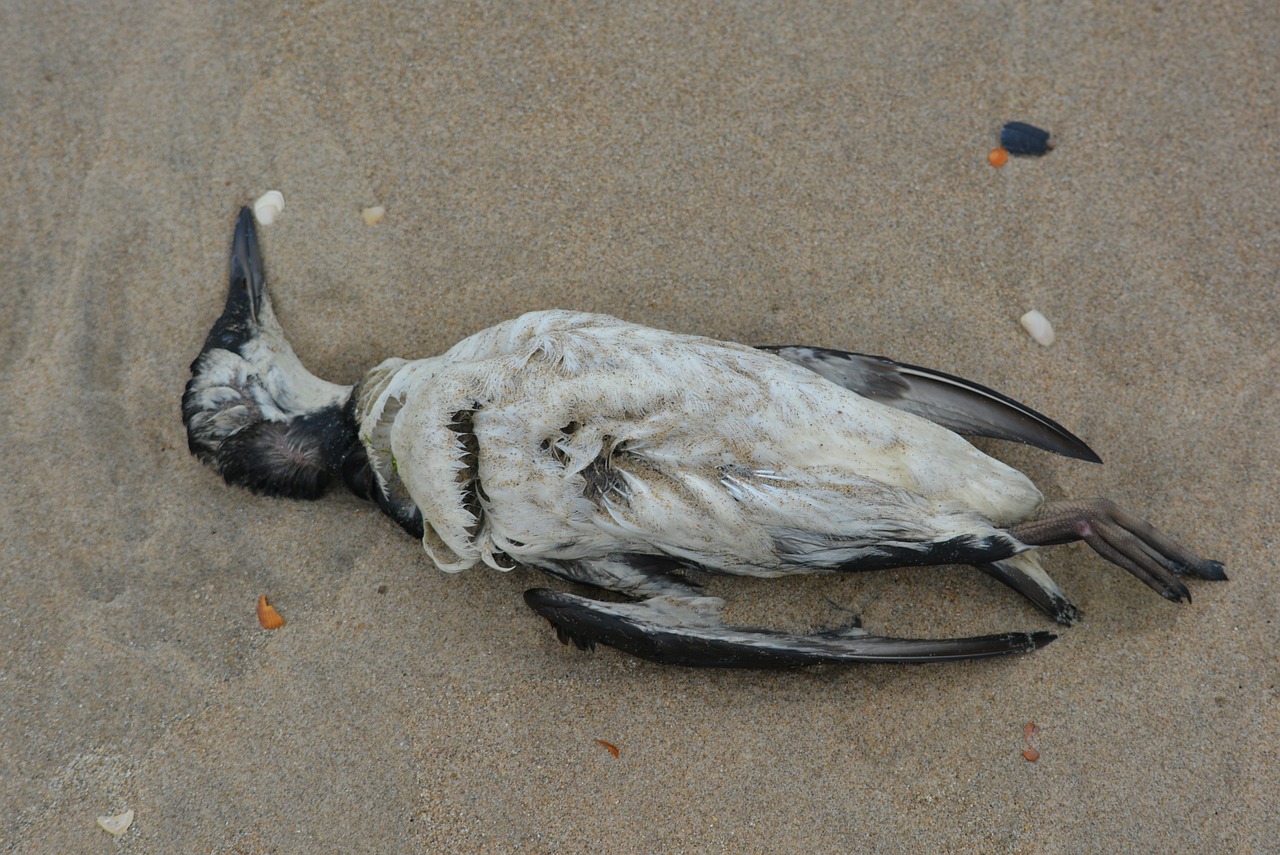
Seagull - Ben Kerckx, 2014
Seagull – Ben Kerckx, 2014

Book nerds have written thousands of words musing upon the significance of the dead seagull in Anton Chekhov’s “The Seagull.” We’re not sure if the dead seagull in Samantha Eliot Stier‘s “The Hole” (from our Fall 2014 issue) is also supposed to represent a dichotomy between old and new art, or something like that– but we do know that we never get tired of reading this delightfully daft story.

{ X }

WE MEET IN A HOLE IN THE SAND. There’s also a dead seagull in the hole, but it’s a big enough hole that we don’t step on it.

He had seen some kids digging the hole earlier, he says, so it was silly of him to fall right into it. He was jogging, he says, staring at the sun as it sprinkled his eyes with little flash-pops. When he looked forward again, he couldn’t see where he was going. That was how he’d fallen into the hole.

He says he twisted his ankle but it will probably be fine. He reaches for my hand, but first I want to bury the seagull. I pull sand with my fingers until the seagull is covered. You can still see one of his feathers sort of sticking up through the sand, but I leave it like that, a grave marker.

What if someone else falls in the hole? I ask.

He shrugs. I say we should probably fill the hole.

But that would take too long, he says. Instead, we gather seaweed and circle the hole, so people will see it. The tide’s coming in, he says.

He hobbles along next to me, asks where I’m going. If I’m not too busy, he says, would I be willing to help him distribute his CDs? He’s a musician, and his musician name is Lion. He leaves his CDs under people’s windshield wipers and in their mailboxes. He says people love his music so much they give his CD to their friends and family. He has Fans, he says. Lots of them.

They had told me to be more careful, and I know they would be mad if I went with this man, but I will tell them he had kind eyes, that he helped me bury the seagull. Continue reading “The Hole” – Fiction by Samantha Eliot Stier

“We Dream Of Our Dead Pets” – Fiction by Carl Fuerst

Greyhounds royal hunting - Valentin Serov, 1901
Greyhounds royal hunting – Valentin Serov, 1901

There’s an uncanny dream-logic at work in Carl Fuerst‘s “We Dream Of Our Dead Pets” (from our Fall 2014 issue)– but is it actually a dream? Or could it be an irregular reality caused by galactic cannibalism? All we know for sure is that this surreal little story has burrowed its tiny fangs beneath our skin and we can’t quite yank it out.

{ X }

I DROVE ON THE ROAD THAT CIRCLES THE TOWN where I live, an island of crumbling low-roofed brick buildings surrounded by countless miles of cornfields. Once, three summers before, on a late summer night bordering on an early summer morning, I stood on the balcony of my second-floor apartment and watched the cornstalks in the rising sun, anticipating the brief and unpredictable moment when the new day’s light would make the leaves look like emeralds heated to their melting point and hammered flat.

Since then, I’d been in my car, and a small part of me was starting to wonder why it had always been night.

I took a road into the cornfields. It had recently snowed, and the roads were dark, snowy, icy, and bad. A blurry, white-robed man hunched by the road’s shoulder every few miles. Whenever I passed, he strained towards the car, snapping his jaws and howling, some invisible force dragging him in the direction of the fields.

This made it difficult to listen to my passenger, who reclined in the back seat, smoking a joint and staring at his phone’s glowing screen.

“See, stars form when gas inside galaxies becomes dense enough to collapse,” he said, “usually under the effect of gravitation. But when galaxies merge, see, it increases the random motions of their gas-generating whirls of turbulence, which should hinder the collapse of the gas. Intuitively, this turbulence should slow down the formation of the stars, but, in reality, the opposite is true.”

“Do galaxies collide often?” I asked. “Is this something we should be worried about?” It was nice, for once, to think about something besides the reasons why I couldn’t remember when I wasn’t driving in circles around the little corn-town where I lived.

“It’s very common,” said my passenger. “But ‘interaction’ would be a more accurate term than ‘collision,’ accounting for the extremely tenuous distribution of matter in galaxies.”

“Sure,” I said.

“Meanwhile, galactic cannibalism happens when a galaxy, through tidal gravitational interactions with a companion, merges with that companion, resulting in a larger, often irregular galaxy.”

My car skidded off the road and down a steep hill and rolled to a stop on a farm pond’s black bank. I got out of my car and snow spilled into my boots. The pond wasn’t frozen. I watched icy water lap at my front two tires.

Continue reading “We Dream Of Our Dead Pets” – Fiction by Carl Fuerst

“We Call Her Mama” – Fiction by Natalia Theodoridou

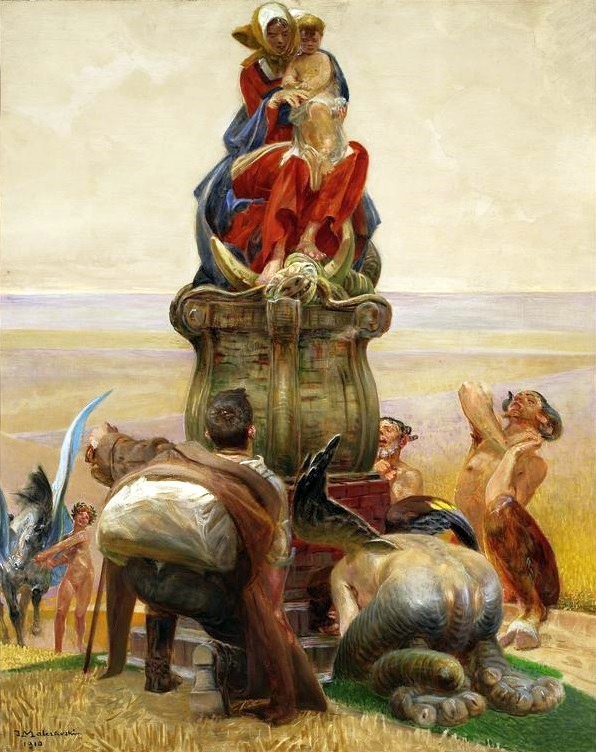
Adoration of the Madonna - Jacek Malczewski, 1910
Adoration of the Madonna – Jacek Malczewski, 1910

When you’re a god, or a goddess, or any other kind of immortal being, death’s cold embrace can be the ultimate– and most elusive– high. Read all about it in Natalia Theodoridou‘s “We Call Her Mama,” one of the many flappy lits contained in our Fall 2014 issue.

{ X }

“IF I TAKE ENOUGH, WILL I BE ABLE TO DIE?” I asked.

She looked at me, with her boundless eyelashes sparkling under the club lights.

“I don’t know, baby,” she said. “No one has tried that before. I guess we’ll have to wait and see. Here.” She held out her iridescent hand. I buried my face in her open palm and snorted the golden dust. My heart imploded right then, I swear. And then we danced, danced, danced like the gods that we were, until there was no club, no dust, no Father (Who art in heaven), just her and me, her unworthy, unfashionable, forever moribund Son.

{ X }

We called her Mama. She was no-one’s mother, but she was Mama to us all.

“Come on, boys and girls,” she would say. “Gather round.” And we did. We rushed to her feet to taste the golden dust that fell from her heels. Who was she? She was the joy of life when dying was but a party trick, and she was the face of death when we were sick and tired of living. And who were we? We liked to say we were fallen legends, desperado gods and renegade dreams, but really we were just a bunch of lost children, trying to forget we were immortal, looking for love. And she gave it to us; I don’t know what was in it for her, but she loved us all, and loved us plenty.

Before love, though, there was the drug. We thought it was the fairy dust that would make us into real boys. It almost did, too; the golden drug makes you laugh hard, and fear hard, and hurt as if you were human. But that’s it. Can’t make you mortal.

We all took it for different reasons, of course, but Mama accommodated each of her children without judgment. We were equals in her eyes. She danced with us, lay with us, dressed our wounds and licked the blood hot off our skin. And then, when we were done, when we had gotten what we needed, she let us go.

That’s how I know I’ll never leave this place. I can never have what I need. Continue reading “We Call Her Mama” – Fiction by Natalia Theodoridou

“Blood Ties” – Fiction by Diana Clarke

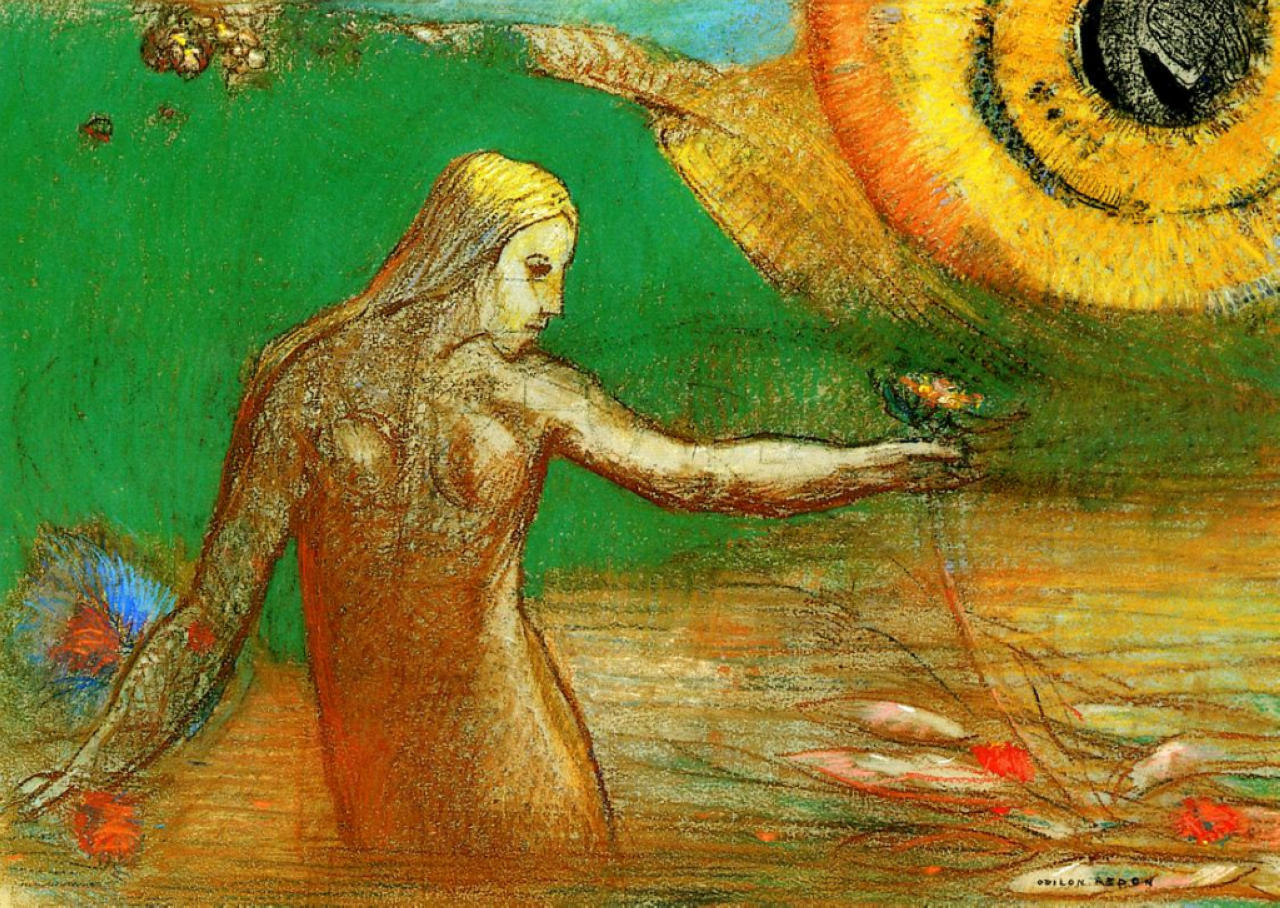
Flower of Blood - Odilon Redon, 1895
Flower of Blood – Odilon Redon, 1895

On one level, Diana Clarke‘s “Blood Ties” (from our Fall 2014 Issue) is a coming-of-age story about an adolescent Jewish girl in New York City. But bubbling below the surface there’s also darkness and mystery and sex– and, of course, blood– all rushing headlong toward an unforgettable conclusion.

{ X }

I CRUMPLE MY FINGERS AS THE CLERK APPROACHES, hiding the red crusted in my nail beds. I can smell the iron, but the clerk doesn’t even turn her head. She’s too focused on an errant coat three rows away. Its unrumpledness signals that it does not belong in the sale room, any more than I belong on the main floor. She approaches the coat, barcode scanner already raised like a torch or a gun, then tags the thick green fabric and drags it away, sedated. Without the weight and darkness of the coat, the retired summer clothes that are past shopping season but still appropriate for the weather outside seem to list from their hangers toward the light. They are a swarm of fireflies, they are road dust rising, they are a dandelion head diffused.

​I rub my palms together, pinch my fingertips, watch my menstrual blood flake to the floor where it becomes invisible. I can never bring myself to wash it off, not when I know they’ll refuse to touch me later for the fear of it. In my neighborhood, Yiddish is like a curtain we draw between us and the rest of the world—keeps us warm in winter, and dark the rest of the year. My mother doesn’t even speak it well, but her gestures are so Jewish that from far away you wouldn’t know it. We moved here three years ago, and in one more year I’m leaving, but for the meantime what I have is not to wash. Rebellion comes in all kinds.

​When I was a child, my mother’s friend Julia would sit at the kitchen table, hair piled on her head and bare shoulders shaking with laughter, remembering how the two of them used to ride the subways, how their bodies learned to bleed together, and how when they did neither one of them wore anything to stop it. “It was the eighties,” Julia would say, turning to me. Years of sun had turned her brown in the deepest part of her chest. “The subways were just us and the homeless people, and even the homeless people sat at the other end of the car.” My mother always shushed her with half a heart.

​I would go back to my room after and imagine the wetness between their legs, how it slicked them then dried till it stuck, how they would have to peel their pants away or shower still wearing them. Continue reading “Blood Ties” – Fiction by Diana Clarke

“Human Child” – Fiction by Brendan Byrne

By SJNikon - Sam Roberts [CC-BY-2.0 (http://creativecommons.org/licenses/by/2.0)], via Wikimedia Commons
Worship – Sam Roberts, 2010

There’s a vague but undeniable dread stalking the reader from the margins of “Human Child,” Brendan Byrne‘s story from our Fall 2014 Issue.

{ X }

IT HAS BEEN AN ACHING DAY. The sky heals like a scab, but nothing has split it, and it has never bled an ounce of fluid. Light the first of the evening. My hands ache. Fluxing bone pain which doesn’t dissipate. Rest my elbows on the black metal railing adjacent to the basement stairs. A Japanese guy with coiffed hair and a model’s blank face brushes by, street-level. I think I hear him say, sotto voce, into a phone curled against the side of his skull,  “…other territories… how does it feel there?”

The door jerks towards me: I catch it.  The last of the maggots file out, pawing at coats, extracting packs of cigarettes, demanding lights off each other, howling about the stupidity of associates and lovers. I wait till they’re halfway down the block, then go back inside. Clear the scrap-wood tables of barely begun drinks, kick the chairs and jerk the tables back into some kind of order. I have my head down, starting the wash, when the door heaves and wheezes.

Kid. Small and thin. White-stained hoodie draped, obscuring features. He’s looking at my face in the way people who know you look at you. I straighten up and move down the bar towards him. Just from the way he’s standing, I know I don’t know him.

“Gonna have to see ID, man.”

As I approach, the candle throws up yellow globe light, and I can see the shorn sides of his head. Scraped unclean with cheap razors. I tighten, keep a good deal of the bar between the two of us. I think of the metal bar under the wash.

“Not looking for a drink.” His voice is a slurry of broken things. His hands jammed into the hoodie’s pockets. He hasn’t looked anywhere except right at me. There’s a bunch of things I could say. None of them would ease the situation in the necessary direction.

His eyes are somewhere I’ve never been. “Knowa girl named Kimmie?”

“Don’t know anyone named that, no.”

“Kimmie.”

“No idea.”

The kid leans slightly over the bar. I can see the beginning of lazy slashes of tribal tattooing on his wrists. There is what looks like at first a severe case of eczema on his neck, but as he comes closer, I can see it’s scar-art, created through glass laceration. Thought it was out of style.

And I can smell him. Old puke and new trash. Like one of the gutter punks who camps out in Tompkins Square Park and adjoining streets, but they don’t come in here, they know better than that.

“Said she knew you.”

“No idea, man. Sorry.”

“You’re Aaron.”

“No, that’s not my name.”

His single, simple grin. “Kimmie said.”

“Not me.”

“Aaron.”

“No.”

“Aaron.” It’s a statement. He places both his hands on the bar like they’re dead birds he’s been carrying around too long in his pockets. “She said you knew how to get back.”

“Get back where?”

He thinks this is funny: his face begins to convulse around the slit of a smile. His body is impossibly still, like a caryatid of an unseen palace. Then his neck begins to spasm, and something happens to his eyes. His shoulder twitches, and his head drops as if he’s mid-seizure. I step back, place the base of my spine against the counter behind me. A middle age couple comes through the door bubbling and laughing, talking about the never-removed Christmas lights, calling for two Stella. In the second I look away from the kid, he was out the door, quick-lurching up the stairs. The couple brightly ignores his transit, settling. I pour the beer, take money, give change. Stymie attempted dialogue, “How long has this place been here…” Curve around the bar. Outside. Up the concrete stairs.

There is nothing on the sidewalk except for dog shit, menthols smoked down to the nub, and chip bags, inside-out, gleaming. The sky is wet and swirled with grays, refusing to rain.


Continue reading “Human Child” – Fiction by Brendan Byrne

“ARG” – Fiction by Anthony Michael Morena

The Cheerleader - Norman Rockwell, 1961
The Cheerleader – Norman Rockwell, 1961

We’re absolutely giddy to present the first excerpt from our Fall 2014 issue today! “ARG” by Anthony Michael Morena is what you’d normally call “flash fiction,” but we think that’s an inadequate term for this explosive, subversive, wickedly enjoyable story. We think it should be called something like “blast fiction” instead.

{ X }

WE ALL HAVE OUR SPECIAL ROLES TO PLAY. Some of us have cameras. Some of us are handing out leaflets. Some of us are in a van idling across the street, waiting for the right moment. Everything has been planned and everything is going according to plan. We are gathered together at the park. This makes sense.  You would want to launch an alternate reality game in a highly trafficked area. Everything makes sense.

The plot of our alternate reality game centers around the fight between aliens who have infiltrated all levels of society, a cult built around resisting them, and our players. The aliens cannot be recognized on sight. There is no way to tell who is an alien and who isn’t an alien. The distinction between the aliens among us and normal humans will be up to the players to figure out. A player might even consider him or herself an alien. The pretense of secrecy suggests that everyone is being watched.

Everything is set. We have a plot, websites, email addresses, hidden objects, puzzles, codes. The flyers we are about to hand out contain an oblique warning that is actually a clue for where players can find out more. We are dressed in black jumpsuits and riot gear. We are dressed as the hidden threats among us, in Giants jerseys. This park is one of the most highly trafficked parts of the city. Its proximity to subway access and retail markets make it the perfect place to introduce our ARG. Everything is going according to plan. Everything makes sense.

Except for cheerleaders.

Continue reading “ARG” – Fiction by Anthony Michael Morena

“San Vicente” – Fiction by Robin Wyatt Dunn

Bathsheba - Franz Stuck, 1912
Bathsheba – Franz Stuck, 1912

The grand finale of our Summer 2014 Issue is Robin Wyatt Dunn‘s short story “San Vicente,” a surreal, shadowy, sensual, and satirical tale about the purposes of art, the products of revolution, and a few other things we’re kind of scared to examine too closely.

{ X }

THE KUMBAYAH SCENE AT THE END WAS THE BEST PART: The Jews, and the gays, and the Uzbeks, they all held hands and danced in a circle, singing pretty songs. I was crying throughout it, though I knew Janie found it a bit much.  Still, it had great production design, the color was beautiful.  I think they’d actually shot it in 35.  It was a shame we had to watch it over the noise of the generator.

Afterwards we went out to get a cup of coffee from the man on the street;  shootings were way down this month and the air smelled okay to me, so Janie and I stood there for a bit, drinking the coffee and sharing a French cigarette.

“What the fuck was that movie about?” she said.

“I don’t know, umm, overcoming personal obstacles.  Empowerment.  A new spirit of internationalism.”

“It sucked,” Janie said.  Her eyes were hard, and flat.

“Well, I liked it,” I said.  “You can pick the next one.”

“Why would you go to all the trouble of making a movie about a bunch of random people who all hate each other only to have them improbably embrace, sing and flow their tears at the end?”

“Well, Shakespeare had a lot of improbable endings like that,” I said.  “What’s the matter with it?  Besides, people like it.”

“It sucks,” she said.

“Shall we go home?” I said.  “You want me to call a cab?”

“I’ll walk home,” she said.

“You don’t want to walk home at this hour,” I said.  “Come on, I’ll call a cab.”

“No,” she said.  “I’m walking.”  And she took off.  I followed.

San Vicente got a lot weirder after the revolution.  It was not unique in this respect, I knew, but I knew its weirdness was unique.  For one thing, we had no cars at all now, only jitney-cabs.

Continue reading “San Vicente” – Fiction by Robin Wyatt Dunn

“Boko” – Fiction by John Grey

The Clown - Edward Middleton Manigault, 1912
The Clown – Edward Middleton Manigault, 1912

Many clowns are silly, and sad, and terrifying, but we doubt many clowns have experienced as many absurd twists of fate as the title character of John Grey‘s short story “Boko” from our Summer 2014 issue.

{ X }

MY REAL NAME IS JEREMIAH STEPHEN DENNIS KUNITZ, though people call me Boko. My story begins when I had just graduated clown school and was excited to be entering the real world of false noses and big stick-on ears. However, much to my dismay, the circuses were not hiring that year. My gloomy red smile drooped even gloomier.

And so it was that I spent at least two months pounding the pavement on my unicycle looking for work. Sadly, many doors were slammed in my face. If you’ve ever wandered down Fifth Avenue and wondered why many of the door-knobs are smeared with grease paint, then wonder no more.

I did think myself fortunate when, after sending in my résumé, I received a call from Human Resources at Bestial Labs. I was ushered into the office and steam-bath of a Professor Stamp. Unfortunately, there’d been a misunderstanding. The company was under the impression that my background was in cloning.

“Oh no,” I explained. “I’m a clown. I do squirting flowers and I’m absolutely amazing with a rubber chicken. Oh yes and I can ride an ostrich.”

Professor Stamp set his cloned voles upon me. I was lucky to escape with my red wig and pantaloons intact.

Without a job and no money, I soon found myself being kicked down the stairs by my landlady and almost strangled by her boa constrictor.

I tried an employment office. The woman assigned to interview me merely laughed in my face. Now whether that was because she had nothing for me at that time or she thought clowns to be hilarious creatures, I cannot say. The bites in my leg from her pit-bull service dog would indicate the former.

I must confess I was a very depressed clown and I had the scars on my wrists to prove it. But I refused to give up my dream and go into chicken sexing like my father. No way I would follow in anyone’s footsteps. Besides, my size three-foot-long shoes precluded such a mode of walking. I vowed to stick it out no matter what. I’ve always believed that people need a good laugh. Or any kind of laugh. Besides, my head was designed for shoving in the barrel of a cannon, not retail or banking.

For two sticky summer nights, I slept on a park bench. No one bothered me. A serial killer dressed as a clown had been disemboweling ballerinas up at the dance studio in the Heights. The lowlifes kept their distance in case I turned out to be the Baggy Pants Butcher.

On the third night, however, I was shaken out of my shaky dreams by a cop.

Continue reading “Boko” – Fiction by John Grey

“One of those women” – Fiction by Aoibheann McCann

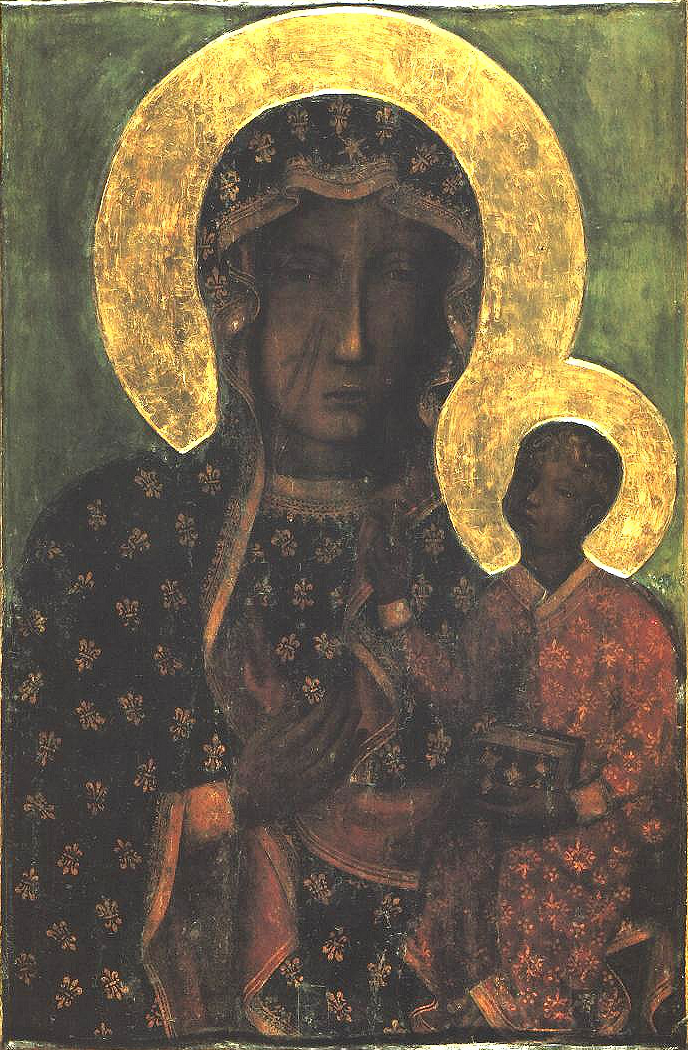
Black Madonna of Częstochowa, Poland.

Great gods almighty it’s been a brutal summer, hasn’t it, with all the rage and hatred and violence and warfare piling up in our newsfeeds?  It seems like every day’s been a fierce reminder that this mad world of ours could always use a little more mercy. With that in mind, we hope you enjoy Aoibheann McCann‘s “One of those women” from our Summer 2014 issue.

{ X }

I BROUGHT ON THE BLEEDING SEVEN TIMES OVER THE YEARS before it stopped altogether. Miriam down the road, then her daughter, would peer out from the darkness and give me what I needed.

I could have got my husband to leave me alone, but I knew he would blame my first lover. My husband was a quiet man. The other men avoided him, walked by him as he stood in the dust. The shame I had brought him and he had borne. Forever the man who had married a woman who bore her first lover’s bastard.

I am one of these women who from the beginning of time have known it was not time, not my time, not their time. I am one of the women who chose. I do not hide my face.

So my son was fed, and the others bled into the ground. I thought when he grew up and started to be a help to his father that I would not take the turn down the track for the bitter herbs. I would have a child I could kiss. My son never wanted to be kissed. He cried until I picked him up, then he would twist away and stare out, at what I could not see.

Who am I? Who are these women? Who are the six thousand from this country that leave to find an end to the not-bleeding? Year on year, multiplied by all the countries in the world. Who are these women who do not seem to know what is right? Who from the beginning of time have committed this evil. Continue this evil even as you march against them, stones in hand to throw at their glass houses and smash them.

It was my husband who would go to find him as he roamed, we’d only hear of the trouble afterwards. People whispered our renewed shame. I bore it as I had promised to when I first noticed the absence of bleeding, the morning lurch, the heightened sense of the smell of the junipers. Worrying long into the night, the thought repeating over and over; he is dead, he is dead. Then he was. It was a relief that there were no brothers and sisters to see his broken body.

I am the statue at the side of the road. I am the statue in your churches. My face appeared to you in France, in Portugal, in Mexico. In the West of Ireland where you pace righteously. I appear in the tree stumps and the cliff faces to remind you. I am not ashamed of what I chose. Let them choose.

You ask me to have mercy on you, you mouth it in your prayers; Hail Mary, Mother of God, have mercy on me. You pray to me in your cold churches, cut off from the world of heat, hunger and dust where I came from.

Have mercy on me, the woman who is now stone. Have mercy on those who are flesh and blood. They stand before you.

{ X }

8x10_High Res_DSC_0560AOIBHEANN McCANN lives on the West Coast of Ireland where she writes fiction, non-fiction, and the occasional poem. In real life she is the manager of a residential service for cancer patients. Her work has been published in THE EDGE, The Galway Advertiser, Xposed, The Galway Independent, The Galway Review, wordlegs, and Crannog. She has also been a featured writer at The Over the Edge Event and on Galway Culture Night 2013.