Category Archives: Excerpts

“Dare” – Poetry by Lauren Seligman

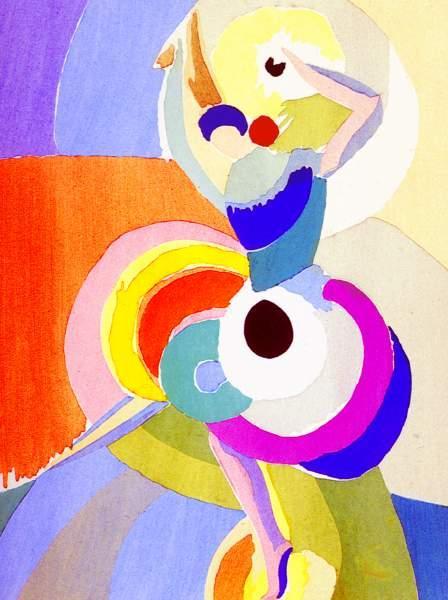
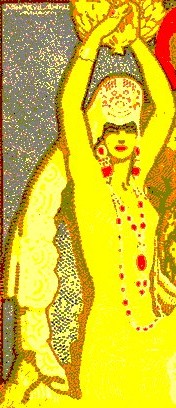
Flamenco Dancer - Sonia Delaunay, 1916
Flamenco Dancer – Sonia Delaunay, 1916


From our Spring 2014 Issue, we proudly present Lauren Seligman‘s sultry, swaggering “Dare.”

{ X }

SPLIT ME WIDE OPEN, an egg on the side
of a dish. Eat me alive, attack
without permission. I dare you to
come. Godzilla on the prowl for me. Turn over
billboards, trucks on your way. Take me by
the shoulders, shake me
hard, a natural disaster. Burn down

forests thickened in black
ash so villagers choke. Collapse houses into
the pea green ocean. Do not flash, a lightning
storm, be no mumble of thunder that a midnight
shower can bust. I am a flamenco
dancer standing in an adolescent boys’
choir, exotic in my obsessions and intuitions. I am dark

Poland, fragrant bark on the backyard beech
tree I climbed, crouched in the fork, scars on my
knees the color of persimmon fruit. I am July-hot
Washington Square Park, those gypsy
guitar tunes played at sticky night time, London’s
Cheshire Street stones slicked with moss where I
slipped, laughing on my back. I am veiled

Continue reading “Dare” – Poetry by Lauren Seligman

“The Root of Everything Arty” – Fiction by Jenean McBrearty

The Truth at the bottom of a Well Jean-Leon Gerome, 1895
The Truth at the bottom of a Well
Jean-Leon Gerome, 1895

The truth about ourselves is at the bottom of a well, says Donnie Babcock in “The Root of Everything Arty.” Jenean McBrearty‘s story is a droll, twisted riff on art, violence, vanity, and the subconscious, co-starring Gala Dali. Read it alongside other exciting lit in our Spring 2014 Issue (FLAPPERHOUSE #1), now on sale for just $3.

{ X }

“AN APPOINTMENT IS IMPOSSIBLE, and Salvador wouldn’t keep it anyway,” Gala told Mrs. Green, the crinkled-lipped woman who had roused her at ten. It was too early to juggle American dilettantes. The Dali Ball had been tiresome after the first half hour. Dali’s glass case and brassiere, worn on his chest to shock the fawners, would work well with the press, but would soon be followed by a what’s next? from the American public.

“I spoke to him about my nephew. Donald. Bunny Babcock’s son. He’s an artist.”

“I know my husband’s an artist, Madame.” Gala was at the phone about to order breakfast.

“No, Donald’s an artist.” Although just sixteen, he was also a high school graduate and his Uncle Marion’s protégé.  “Senor Dali will remember, I’m sure…”

It’s clear why time melts under the persistence of memory. Americans seemed to have infinite recall capabilities no matter how much gin they consumed, and their persistence jellied the nerves. “Could you bring tres huevos and toast?” she said into the phone, and gave Mrs. Green a nod. “Perhaps this afternoon.”

Mrs. Green hoisted a brown leather portfolio case in front of her. “Donald gave me this. He’s says they’re his best portraits. You could tell me if Dali would be interested in them.”

The woman in the crepe dress and open-toed shoes was giving her a way out. She’d take a quick look and deliver a swift dissuasion. “All right.” Gala removed the white porcelain vase stuffed with orange and yellow gladiolas from the table and set the case on it, untied the laces and peeled back one side. She turned the separators slowly, as though reading a manuscript, feeling Mrs. Green’s expectation at her back.  “Have you seen your nephew’s portraits, Madame? They’re all pudenda.”

Continue reading “The Root of Everything Arty” – Fiction by Jenean McBrearty

“Rebel, Rebel” – Fiction by T. Mazzara

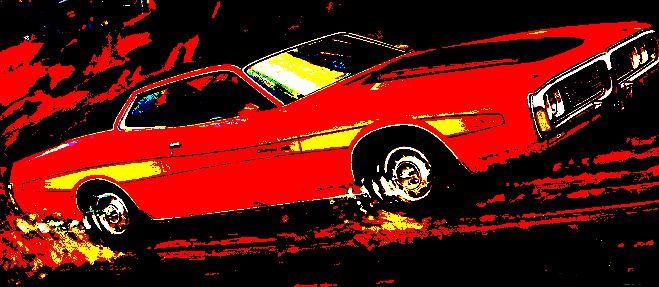
ChargerBe warned: T. Mazzara‘s “Rebel, Rebel,” one of the short stories from our Spring 2014 issue, contains some extremely salty language. But beneath all that salt there’s also tremendous tenderness. 

{ X }

for Shawn

I GOTTA GET TO NEW YORK BEFORE 3 AM or Big Meanie, Jimmy Dread, is gonna fuckin stick-rape me with a broom handle and feed my bones to his bulls, gonna cut off my ears and chop off my head. I been driving this route and driving it drifted for two years now, trying to buy the ticket on dad’s ranch house. Buy it back from my sunk-headed Moms. She’s got not a marble left and they’re gonna take the dump from her, she don’t get square with the bank. I been driving this route since Jean Genie bit the big assfuckin farm on it. That’s my cousin, Jean Genie.

Jean died when his box truck launched off this elevated road (that’s Route 17 East to New York-fuckin-Shitty). Jean buried truck and driver in the woods just betwixt Beaver Kill and Roscoe. And that’s Roscoe “Trout Town USA.” Upstate. He buried Jean Genie good too. Fucker was a mess of blood and knotty, greasy hair and white meat and wood and red meat and metal splinters, buried in bark and sticks and branches, cloaked in wet red and steam and smoke and brake lights. Twisted metal, twisted Genie. Twisted sister. Jean Genie. Ziggy Stardust.

I’m carrying a load of H (and some blow on the side). All packaged neat in 50 pound bags of organic flour. Genie still talks to me. I’m the Jazz. It’s something I do. It’s something I do for the Dread. It’s something that’s done.

I’m passing Slaterville Springs, now. Bug zappers zapping and flashing and it’s 35mph thru here so they’re easy to hear over this godawful loud engine. I’m still on east 79. It goes up to 55mph after here and then I’ll be headed thru Richford and past Robinson’s Hollow Road and there’s fuckin nothing out there.

But there is a red Dodge Charger here now and he’s been behind me and beside me and I’ve passed him real careful-like, twice now, and he’s weaving like a motherfucker. There’s drunks at night out here. Small town, not much to do at night. Day too. Not certain if this one’s a drunk. Can’t never be certain of anything, really, Jean Genie used to say. But Dodge Charger keeps slowing and I pass him and then he’ll waggle in my rearviews and he’s in and out of lanes and I lose sight of him around a bend til he guns it and smashes past me, suckin wind and shakin the Bigtop.

You never can be sure of much. Jean Genie used to say black holes was planets that had evolved some species into machines that needed to eat and needed power to eat and they then went off and e’en everything. And it wasn’t like astronomers said and what the hell did astronomers know? They had theories and observations. Hell, we could make theories and observations. We could make observations and theories all we fuckin wanted, but unless they could magic his ass up to the center of the galaxy and let him stick his finger in a supermassive black hole, he didn’t believe in black holes and thought the center of the galaxy must just be filled with unicorn farts and marshmallow fluff.

He always said that the world as we know it was coming to an end and that everything that is just now, even as I say this sentence here, is now the past and everything back then is questionable and every configuration of us was different from one moment to the next. Or some shit like that. I think I said it right. I don’t know. He was a confusing shit and I was faced when he told me that.

Never seen you so faced.

Continue reading “Rebel, Rebel” – Fiction by T. Mazzara

“Stanley Kubrick’s Shit Happens” – Review by Joseph P. O’Brien

Kubrick

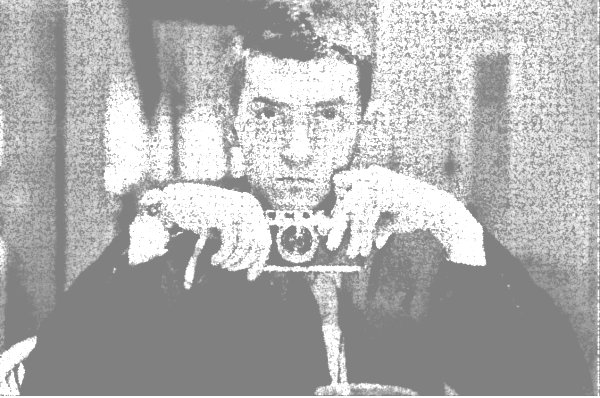
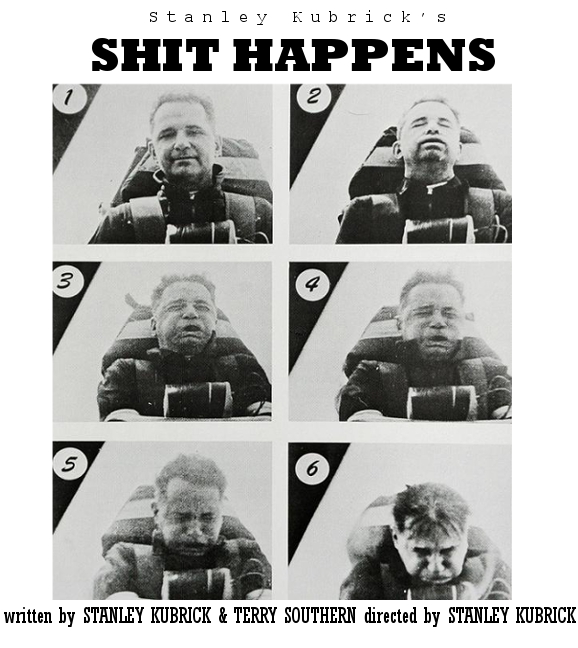
Only in FLAPPERHOUSE could you read a review of Stanley Kubrick’s least-famous Lost Film, “Stanley Kubrick’s Shit Happens.” Hey look up there: Stanley Kubrick took selfies.

{ X }

IT’S EASY TO FORGET THAT STANLEY KUBRICK, the pensive, punctilious director of 2001 and The Shining, was also the cheeky, impish ringmaster behind wickedly funny films like Dr. Strangelove and Full Metal Jacket.  Read any critique of Kubrick’s work– even a favorable one– and chances are you’ll find words like “clinical” and “icy-balls.”

Perhaps that’s because so few have ever seen (or even heard of) this esteemed filmmaker’s least-famous Lost Film.

SHITHAPPENSLegend has it that after wrapping up The Shining in 1980, Kubrick was, as you might expect, hungry for a more jocular project.  One night he rents a stack of videotapes, comedy movies he’s been meaning to watch for a personal film festival. About 20 minutes into the first film there’s a loud, plasticky smash. Kubrick’s daughter hears it from all the way up in her bedroom, and she runs to her father’s screening room to see what’s the matter. “I’m fine,” he tells her, standing over shards of shattered videocassette. “Just  disposing of some dreadfully boring cinema. Don’t be alarmed if you hear it again later.”

Sure enough, Kubrick’s daughter hears the smash of VHS-versus-wall roughly every 20 minutes for the next couple hours. Until she hears laughter. Ecstatic, soul-saving laughter, like she’s never heard her father laugh before.

He’s watching  Airplane!

Continue reading “Stanley Kubrick’s Shit Happens” – Review by Joseph P. O’Brien

“No More Poems About Resolutions” – Poetry by J. Bradley

Fingerprints In Smoke - Alibi Jones, 2014
Fingerprints In Smoke – Alibi Jones, 2014

According to Factual Science Magazine, the average New Year’s Resolution is abandoned by January 14th, at approximately 11:38 Greenwich Mean Time. So now that, statistically, you’ve probably already given up on yet another feeble attempt at self-improvement– that is if you cared enough to make a feeble attempt in the first place– please enjoy J. Bradley‘s “No More Poems About Resolutions” below. (This poem, along with 3 other poems by J. Bradley, will appear in our Spring 2014 Issue, which you can pre-order here for $3.)

{ X }

You learn the metric system
to wear new kinds of weight.

You hold career day
for your lungs, show them
all the types of mines
they could collapse as.

You bend love like a hair pin,
treat zippers and buttons as locks.

There are names waiting
to become bricks; how gingerly
will you walk over them?

{ x }

jbradleypicJ. BRADLEY is the author of the forthcoming graphic poetry collection, The Bones of Us (YesYes Books, 2014). He lives at iheartfailure.net.

“The Better Cowboy” – Fiction by Todd Pate

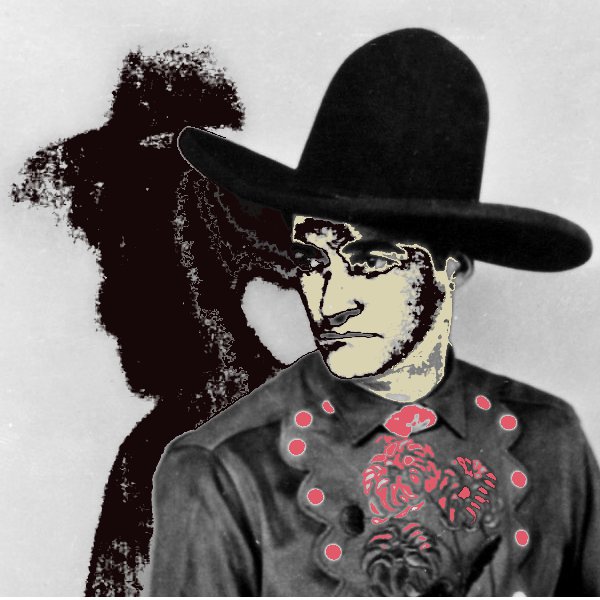
BetterCowboyThe first piece we snatched up for our Spring 2014 issue was a short story called “The Better Cowboy,” written by our good friend Todd Pate. We were quickly seduced by its mix of Western American mythology and cosmic psychological horror– we like to think of it as a bad-ass bastard spawn of Cormac McCarthy and HP Lovecraft.

{ X }

ELLIOT ROUNDED THE BEND in the dry Paria River bed and came face to face with his own shadow. He pulled the reins, stopped his horse. He’d seen his shadow all along, bouncing across the red wall of the dry riverbank as he followed the missing calf’s hoof-prints through the desert. But the bend in the river put the sun at his back. Now his shadow confronted him, stood still and clear in form but filled only with darkness. The tracks continued through his shadow and beyond but he went no further.

Instead he rode out of the river bed onto a slight hill. Standing in his stirrups, he gazed far out at the massive canyon into which the river flowed, when there was water. A shadow rose out of the giant, jagged canyon as the sun lowered and his own shadow stretched toward the abyss as if he and his horse were caught by a massive black hole. As his shadow grew longer and thinner, a heavy, dark feeling came over him. For a moment Elliot thought it could be loneliness. It was easy to be lonely out in the high desert on the Utah-Arizona border at the end of an incinerating day. Breathing, strictly voluntary. Sandblasted, sun-burnt face. Hands swollen, cracked open, stinging wherever they weren’t calloused. Nothing left to sweat out, shivering in the evening wind. Under those conditions, one could admit he’s lonely. That’d be acceptable, maybe even admirable for a cowboy.

But Elliot knew he couldn’t call it loneliness. He saw Hedges at the line shack that morning, and would see Hedges there in the evening, just like the day before, the day before that, just like all summer long. He searched for a name for the feeling until his shadow stretched to a form no longer human. He closed his eyes just before it touched the darkness of the canyon. Whatever the feeling was, he would never call it fear.

From the darkness of his mind came the high-pitched bays of a calf.

Never fear.

The calf.

When he finally opened his eyes, most of the land before him was in shadow.

No calf. Only the soft whistle of wind.

He rode away. The deep wound in the land, its bottomless darkness sucking in all earth, sound, and light to certain annihilation, would be there for Hedges tomorrow.

Maybe even the lost calf, too. Elliot didn’t care. He’d go back to the rest of the herd and do nothing until dusk. Then he’d take the twilight ride back to the line shack.

Continue reading “The Better Cowboy” – Fiction by Todd Pate