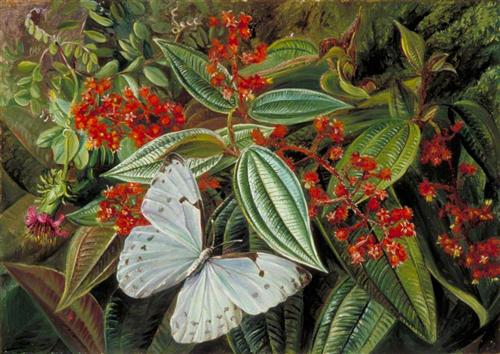
Trees Laden with Parasites and Epiphytes in a Brazilian Garden – Marianne North, 1873
An author’s memoir grows like plant life in “Memoir Recalls,” one of four short lyric essays by j/j hastain in our Winter 2015 issue.
{ X }
WANTING HER LIFE TO COME OFF AS HAVING SOMEHOW CURVED ITSELF, she began writing her memoir at age 13. She wanted to give her experiences the chance to grow along with her, wrap around her. She wanted to work the necessary asphyxiations and the necessary surrogacies in order that they enable unexpected refinement in her. She planned to write her memoir as a synesthesiac plot: something that goes on in many different directions of her for the duration of her.
She needed for the form in which she wrote to evolve along with a continuity of her coming of age by trance. Trance means travelling, but so, without your mind as it usually functions. She believed that by way of her work, her memories could eventually have a mind of their own. Flirting with cliché she took personally what happened when it softened and became vulnerable to her voice: touch-butter for a way for her to tell her stories.
Perform the complexities you create. Track the molecules of an ongoing beast fable. Douse in sentences; dowse for sentences as rotund extremes.
The Banyan tree’s roots are upward and its branches downward: aspects reaching inversely. She wonders on the form of her memoir as an inverse-universal, a startling epiphyte: mutual turning and traction in which miracles can be expressed. It flourishes by what first seems like embellishment. In the flourish, it then slowly strangles what was, eventually leaving its beginning hollow, able to move on.
{ X }
j/j hastain is a collaborator, writer and maker of things. j/j performs ceremonial gore. Chasing and courting the animate and potentially enlivening decay that exists between seer and singer, j/j simply hopes to make the god/dess of stone moan and nod deeply through the waxing and waning seasons of the moon.
YOU CAN’T TELL BY LOOKING IN OUR FACES. For some of us the tests are just routine.
For others, of course, a sentence of death.
Brave or stupid, cowardly or aware,
more or less imaginative or astute —
strange that we should all be called a patient.
Then the friendly helpful receptionist
who shuffles and cuts evolving decks of files.
Then the corridors, buffed and vacuumed daily.
As many times as we sit and wait
for each procedure labeled as routine,
the first that isn’t can only mean
but one link in a chain that holds a swing
on a porch from which we watch the healthy pass.
{ X }
M.A. SCHAFFNER has had poems published in Shenandoah, Prairie Schooner, Agni, Poetry Ireland, Poetry Wales, and elsewhere. Other writings include the poetry collection The Good Opinion of Squirrels, and the novel War Boys. Schaffner spends most days in Arlington, Virginia or the 19th century.
LIPS TO SAINT JOAN’S EARS, brown hoods cup water
in their tiny hands,
scavenging for bits of bone in the Seine.
A blacksmith remembers her: Fragile and lemur-like, raked over the coals
three times to
wring the witch out.
Psalm pages hang in the branches
Of the weeping willows,
heavy with the softness of girl’s skin.
Branches miss their little doll
with high cheek bones.
Like Cinderella’s birds
Who knew too much
clothing scraps are woven into
nests for remembrance near
the family farm in Dom Remy.
The proverbial sword struck
down the tiniest shape;
everyone wants to harm little girls.
Crowns not up to contemplating
the cosmos, acquiesce throughout eternity.
The healing is measured.
Firstonebreath.
Thenasecond.
Then a year has gone by.
Measured by guest book signatures.
Creeping in from forests,
forms conjoin to assemble
one gargantuan black robed priest.
The townspeople sweep,
chant, light candles,
cradle pieces of warmth,
this one I will protect, that one, lost.
{ X }
JENNIFER MacBAIN-STEPHENSis the author of three chapbooks: Every Her Dies (ELJ Publications), Clotheshorse (Finishing Line Press, forthcoming, 2014), and Backyard Poems (Dancing Girl Press, forthcoming, 2015). Her work has been nominated for Best of the Net, and has appeared in public places in Iowa City. Recent work can be seen / is forthcoming at Dressing Room Poetry Journal, The Blue Hour, The Golden Walkman, Split Rock Review, Toad Suck Review, Red Savina Review, The Poetry Storehouse, and Hobart. For a complete list of publications and other odds and ends, visitJenniferMacBainStephens.wordpress.com
TURNING THE AWARENESS OF ANOMALIES into a community of anomalies proves that anomalies are not something far off. They are each one of us and if it is one it is always more than one.
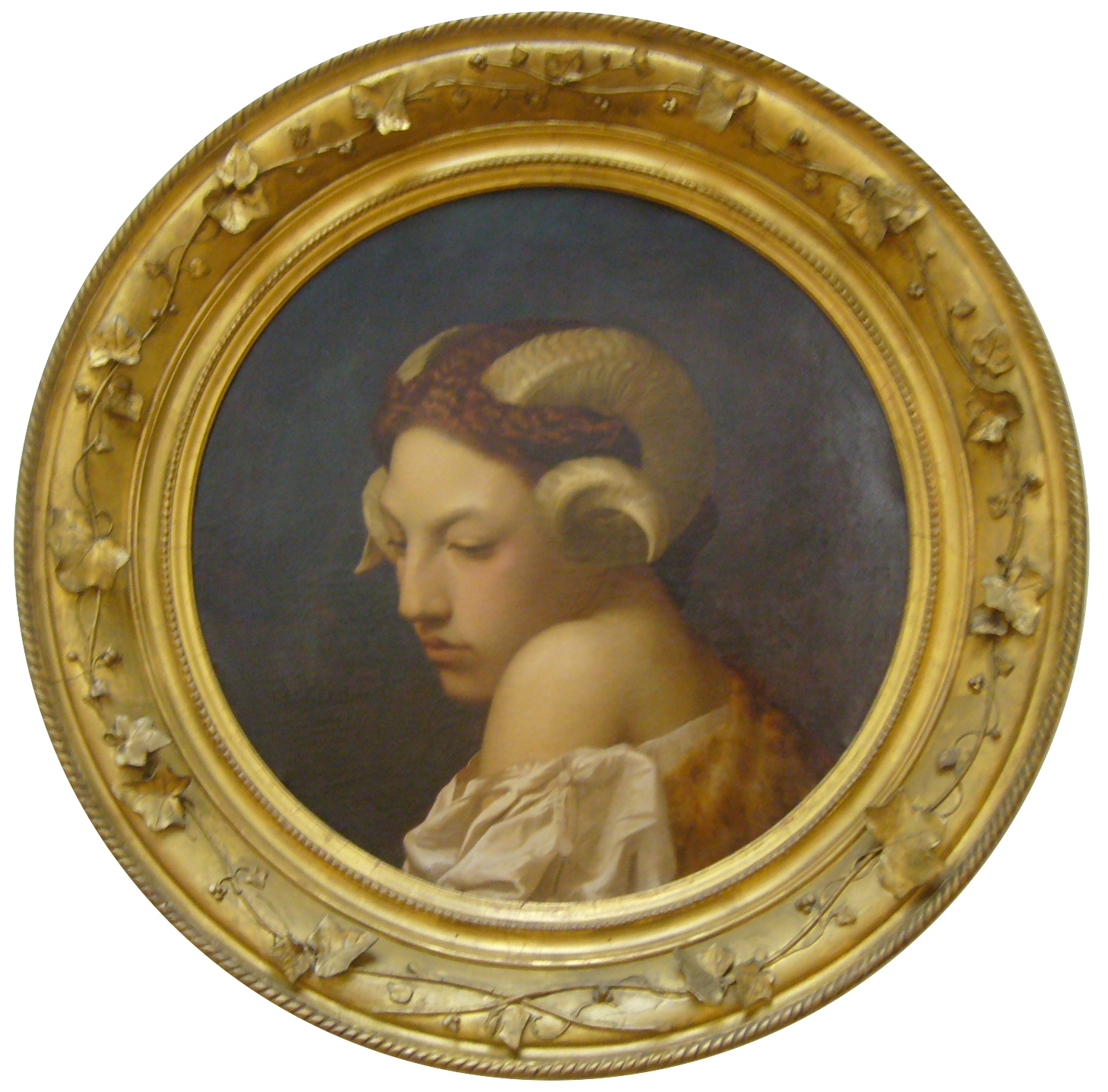
She has been wrestling with them her whole life. There is only conjecture as to their cause. She has two while others have one protruding from the middle of their forehead. She is called devil as a child. In high school she tries to cut them off with her own razor. She fixates. She saws and saws with her eyes wide open until there is blood in her hair. She worries about them showing. When she is cutting them off she does not even remember to shave her legs.
She learns much later on in life that her horns could have come up through skin vulnerabilities, scarring from the burns of fires. She has never experienced being physically burned by a fire, though she often dreams of girls screaming and nodding their heads wildly, emitting flames in a voluptuous yes, as they run toward and project themselves into damp vats of salt and hair: hot englut, temperature as a way to clot wetness.
THE SLOW, WET, GAPING PULSE of Chew Stum Valley morning. I place the cup of crap hotel coffee, cold, on the front porch and lift the crime scene tape, blue and white on this side of the ocean. The door is unlocked behind it.
The hallway is boring; the siderooms are boring. They look kitted out by some mid-century landlady, keen on boiled breakfasts and bachelor boys, all of life justified by air raids. This, despite the fact that Thorne lived alone and unaided for the past several decades. I skip rooms, ignoring the outdated TV, the slack bookshelves with Protestant classics bound in imitation leather, dull watercolors of sheep and boulders and sheep. True Arcadia kitsch.
I treat the home like a canal, cut through it straight. Out the bookdoor, down the pseudo-quaint little cobble-stone steps and through the dead, knee-high garden (how is it that I’m sweating?), straight to the door of the old small chapel, which sits at the edge of the property. No caution tape here which, if I pause and force myself to smirk, I can see the irony of. This is where Thorne really lived. This is where the Glassblower, whoever he was, was born.
I open the door.
Earlier, Nailsea
Hanging in the air of the small club is a special kind of exhaustion. Post-synth drainage and slow throb the color of headaches. The patient mold of the interior of an orgasm on the screen behind the stage. Two white-suited henchmen disassemble the two hundred-odd pounds of equipment, exchanging quiet, sick little stories. A squat and beautiful young woman with deliberate scaration decorating her shoulders picks crushed plastic cups and discarded drug delivery systems off the floor. Edward sits on the small, high stool propping open the emergency exit, smoking Silk Cut. A heavy, though not fat man, he has shed his own straightjacket and now wears a gray hunter’s flannel above leather pants. His beard is russet and dirty snow, but he does not sit like a mage, more like a Catholic schoolboy, tilted as if to avoid notice and suggest other perpetrators. He exhales a plume of gray, which then leaks out the door where hot scummy rain pounds the twist of a convoluted alleyway. The resultant battering on concrete is almost a nothing sound. It is distinct, but as if you are always hearing it and have only just caught on.
“Where do you live?”
“Me?” I adjust the glowing iPhone on my right thigh, the digital read of the recording time running what seems impossibly fast.
“You.”
His voice isn’t the soft, unstrained tone it is on the more lunar tracks, nor does it approach his dead bandmate’s abrasive, churning yowl, once over-described very well in the NME as the final screams of a fetus about to be eaten by its twin. It is moderate, a cast-off discursive tone, flowing and clipped simultaneously. I don’t know enough about England to place it, if its origin is in fact geographic.
“I live a bunch of places.”
Edward tightens his posture, legs crossed, knees snug together. Back straight, barely inches away from touching that metal door. He watches as I light my own cigarette, eyes following my movements. I find myself secreting from some kind of self-conscious gland.
“Berlin. Sometimes. I lived in New York longer than anywhere else. My parents live in Roanoke. Thought you’d like that,” I say, even though he’s given no sign he recognizes the name. “CROATOAN and all that. It’s a one-story beach house. They have most of my library, but it’s wilting. Salt air.” I drink some of the Powers he prefers. His is still untouched. “I have an ex in Austin.”
“But you never lived there.”
“No, not really.”
“We lived,” he inclines his chin out the door into the alley, as if Silence was out there, spectral and soaked, leaking fetid ectoplasm from his wounds. “In the same place for nearly 19 years. A few miles west of here, actually.” He accentuates the directionality with the inverse of a hiss, taps ash onto the floor with absent deliberation. “But you knew that.”
“Yes.”
“You work with Hélène?”
“Sometimes.”
“I like her.”
“She speaks of you highly. We got extremely drunk once, and she said how much she enjoyed visiting your… chalet.”
His laughter is an immediate, reserved thing, not trailing off but ending with extreme deliberation. “Is that the word she used?”
“Yes, not without some irony.”
“She wanted to talk about sex, so we talked about sex, though I don’t think she got quite what she wanted. But you don’t want to talk about sex.”
“No. I don’t think so at least.”
“You don’t want to talk about music either. You want to talk about James.”
“Never made a secret of it. It was in the email.”
“I never read the email.”
“It was in the subject line of the email.”
He smiles once, the muscles’ contraction and relaxation forming feral movements. He is still heavily avuncular, without the attendant smarm.
“You don’t want to talk about it. Fine. Let’s talk about The Quartered Man’s commitment to spontaneity.”
“There was no commitment to anything.” And then, before I could figure out exactly what the fuck to say to that: “At times, we could have been spontaneous.”
“‘Could have been?’”
“We were capable of it.”
“Your choice of recording spaces seemed to have been fluid.”
“Choice?” Someone else’s laugh runs wild in the alley. “I cannot remember, dear boy, the number of places we recorded. I believe I slept, shat, ate, and fucked in all of them though. If that helps you.” His cigarette has not gone out yet. I find this difficult to believe. Perhaps I simply did not notice him light a new one. Shafts of remembered cinema history: Cigarettes, despite their prevalence, were always a bitch for editors to keep track of. Whether they were lit, how far they had burned down. It makes me light another of my own, for continuity.
“Do you know much about the Vietnamese culture?”
“I read a bit, knowing I’d be talking to you.”
“Co bac?”
I shake my head, sip my whiskey. His is almost gone. Another continuity problem.
“It’s not a test. Ong bac are spirits of the ancestor. Co bac are spirits of strangers. But neither is given preferential treatment. They are obvious, in a way nothing is obvious to the Occidental mind, which needs proof.” He says the word as if shitting with his mouth. “They are equal. Even if the particular co bac was, in life, an aggressor. Such as an American service-man. Each is acknowledged and granted a social existence.” His spent cigarette arcs into the alley; it is struck down by droplets. “That is why I am going to Vietnam.” Soft, dignified smile. “They will know how to look after my spirit.”
“Half-Price Wednesday”, one of three pieces by Cassandra de Alba in our Winter 2015 issue, may be a very tiny poem but it gives us some awfully big shivers.
{ X }
THREE WEEKS AFTER YOUR GRANDMOTHER DIED
in these boots I bought them at Salvation Army
for the change in my back pocket. Wore them casual
with paint-stained jeans and dirty sweaters. Wondered
when my fingers started to tremble as I turned pages.
Developed a taste for good gin. Didn’t question
until the morning I woke up without feet.
“I detest all my sins because they offend thee, my God / who art all good and deserving of all my love,” says the Catholic prayer known as the “Act of Contrition.”
“The next age’s illusions will depend / on Gods we’ve yet to discover,” writes M.A. Schaffner in “Act of Contrition,” one of four poems he contributed to our Winter 2015 issue.
{ X }
IF GOD WERE HEARTILY SORRY WE’D UNDERSTAND,
but there are no sins, not even creation
ranks above reflexive pathology.
I’d clean the erasers for that schoolgirl
each long afternoon her mother spent at work
mixing poisons for her daughter’s future.
It wasn’t just wanting only one thing
but continuing to want, and to plan
a life along those lines of honesty.
The garden will go in just a little while,
the soil scraped back to the Pleistocene,
and stacked with pre-fab sections of Versailles.
The next age’s illusions will depend
on Gods we’ve yet to discover — on prayers
pleading for eternities just like this.
{ X }
M.A. SCHAFFNER has had poems published in Shenandoah, Prairie Schooner, Agni, Poetry Ireland, Poetry Wales, and elsewhere. Other writings include the poetry collection The Good Opinion of Squirrels, and the novel War Boys. Schaffner spends most days in Arlington, Virginia or the 19th century.
AT THIS TEA PARTY OF BENCHES AND BIBLES, the lecturer is part drone, all queen bee.
All of the bigwigs wear wigs. They need more hair to think. Posturing as females, the powdered procure statements. The Statements sound like questions. The questions spit syllables like a furtive glance. Like a good Democrat, Joan attempts a reach across the aisle but she never learned furtive in the womb. A grandiose evening filmed for CNN or Soul Train, all the interesting bits are off camera when it’s all “take my pocket square,” and “Comb out that nest.” The robed ones might as well model maxi dresses. They in drag, She in garb. They sit and stare at each other through stained glass and vaulted ceilings. Go on, tell your tea party story how I came from underground and I will recap how they came from the sky. Our ears will foster care odd sounds of treason and devil. You do the ranting. I will do the pouring. And at the end of month’s end, whispers of pyres, of throwing a cat in for the ride, I will succumb. All because I would rather be right than apologize. All that’s missing are knuckle rings and a boom box.
{ X }
JENNIFER MacBAIN-STEPHENSis the author of three chapbooks: Every Her Dies (ELJ Publications),Clotheshorse (Finishing Line Press, 2014) and Backyard Poems (forthcoming, 2015). Her work has been nominated for Best of the Net, and has appeared in public place in Iowa City. Recent work can bee seen / is forthcoming at Dressing Room Poetry Journal, The Blue Hour, The Golden Walkman,Split Rock Review, Toad Suck Review, Red Savina Review, The Poetry Storehouse, and Hobart. For a complete list of publications and other odds and ends, visit JenniferMacBainStephens.wordpress.com
“We always recognize the evil we make,” says the narrator of “The Love Spell,” Tom Stephan‘s chilling yet heartfelt tale from our Winter 2015 issue.
{ X }
I TOOK IN THE CABIN. Sundown streamed through small, sturdy windows, caressing dust motes crazed in the agitated air. Warped pine floor, black as the stove that pierced the roof like an ancient pylon. Refrigerator, stovetop, sink, all lined up in martial order against the wall. In the opposite corner squatted a comfortably broken-in bed with brass head and footboard, perfect in patina, covered in a bright, threadbare quilt. To the right, a claw-foot bathtub old as the Wild West, visible plumbing jerry-rigged together with plastic pipes and curtain rods, suspended by chains and ropes.
“This is my cabin,” he said proudly, holding me tightly from behind. “Turn of the century. Some of the wood is a hundred years old. See that beam above the bed? A hundred years!”
I breathed in the smell of the potbellied stove, wet wool, undertones of pine and unwashed clothes.
“I’ll start the pipes for the water. You have to drain them in the winter or they’ll freeze,” he said, running for the door like a teenage boy, pausing only to grab a wrench. “If you need to use the bathroom, let me know and I’ll stand outside.”
When he came back I took his hands and pulled him in for a long kiss. When he leaned back for air I said, “This is perfect.”
His face lit up like Christmas. “It is?” I nodded, smiled, and kissed him again.
{ X }
We spent four days in that cabin. In the mornings I woke up early, pulled the scorching feather quilt off my legs and stepped lightly onto the frozen floor. Dressing hastily, I would re-light the stove, grab my coat and go out to walk the ridge.
He had neighbors on the hill. The Chicken Man was out every morning with his pail and his flock. His wife was fat and he was lean, both with smiling, achingly sweet faces like dried apples. I would wave and march up the hill to the cemetery, the bench in the middle and the gorge beyond. I would bunch my fists in my pockets and watch the sunrise pull color into the gray fields of snow. It felt like freedom.
About an hour later, I would see him poke his head up the hill. “What are you doing here?” he’d call in mock surprise. “Hanging out with dead people?”
“Multicolored Blood,” one of two poems by Juliet Cook in our Winter 2015 issue, was written during Ekphrasis at the Cleveland Museum of Art, Ohio Poetry Association, led by Clarissa Jakobsons, and inspired by various abstract paintings and other art pieces.
{ X }
WHERE DO HER MISSING FINGERS LIVE?
Extracted from asylum tubes, re-shaped
into new modules with tiny insects
crawling out the mouth and growing,
glowing with dark shimmers.
These mouths are multicolored vessels,
some of them poisoned, some of them frozen,
some of them fresh but trapped.
Tiny red palpitations dangling
from the bottom of a stingray.
Bright red tissues dripping wet
confetti from abstract fetus, growing
into a horse throat cut.
It turns gelatinous and then skeletal.
A skull head with dark red painted
inside a purple casket sinking down
underwater and then swimming.
 j/j hastain is a collaborator, writer and maker of things. j/j performs ceremonial gore. Chasing and courting the animate and potentially enlivening decay that exists between seer and singer, j/j simply hopes to make the god/dess of stone moan and nod deeply through the waxing and waning seasons of the moon.






 FLAPPERHOUSE
