Category Archives: Excerpts

“The David Foster Wallace Empathy Contest” – Fiction by Wm. Samuel Bradford

Sea Turtle - Mike Brice, 2014
Sea Turtle – Mike Brice, 2014

“The David Foster Wallace Empathy Contest” (contributed by Wm. Samuel Bradford for our Spring 2015 issue) is not merely a satirical homage to the work & fans of David Foster Wallace, it’s also a touching story of camaraderie and survival in a harsh, chaotic world.

{ X }

IN ITS LAST YEAR, WALLACEFEST HAD ONLY THREE ATTENDEES. The event was advertised as “an alcohol-free weekend of mutual appreciation for Wallace’s principles.” For Roland, it was a balls-to-the-wall competition.

Roland, Jon, and Bendiks sat on the pier behind the beach house rented for the occasion. They had just released the live lobsters they had purchased from a restaurant.

Roland, who had long ago realized that his looks and wit impressed no one, had latched onto Wallace fandom as his chance to be noticed. He had spent his inheritance building the no-kill dog shelter Wallace had allegedly dreamed of. He called it the David Wallace Foster House. No one would outdo him.

“So, I mean, I just felt so much gratitude. It wasn’t revealed by D or bolstered by D–it was, like, caused by D,” Roland said.

As Roland spoke, Jon spooned pureed squash into the lipless mouth of Bendiks. He had pointed Bendiks’s wheelchair to face the sunset, even though Bendiks’s eyes were rolled back in his head behind closed, twitching eyelids.

“How did you and Bendiks meet?” Roland asked.

Jon took a swig of non-alcoholic beer and wiped the rubber-capped spoon.

“So this new Latvian woman works with me in the lab. We wanted her to feel a part of the group, so we listened to Latvian folk music on internet radio while we worked. The lab started to get into it–all the zithers and stuff. It’s cool. Anyway, one day we’re listening and this news report begins, and the Latvian woman was like ‘Jesus Christ! Jesus Christ!’ and no one else speaks Latvian, and we’re all like ‘What is it, Dagnija?’ and she starts telling us about the report.

“You know bath salts, the drug? Well, it had just hit Latvia, and this kid had taken a ton of bath salts and went into a pet store and like, went nuts. He started eating puppies. I’m talking, like, eating them alive. Then he bites himself. Chunks of his arms. He bent over and bit his calves off. He bit his own lips off.”

Continue reading “The David Foster Wallace Empathy Contest” – Fiction by Wm. Samuel Bradford

“Reset Your Heart” – Poetry by Bud Smith

Jack of Hearts - Olga Rozanova, 1915
Jack of Hearts – Olga Rozanova, 1915

“Reset Your Heart,” Bud Smith‘s poem from our Spring 2015 issue, is thick with unforgettable imagery and indispensable life advice.

{ X }

FORGET YOUR NAME. Hold your heart in your palm till it finally
stops.
“Friends may know you better than you know yourself”

Fling silver key to City into sewer.
Deny mountain of problems: call them routine riots; daily
avalanche; plain life, ordinary fire.
“Friends may know you better than you know”

Flip a doctor’s desk.
Sip sap from a falling tree, domino’n the rest of the forest.
Circle a lost love with a chalk line on the sperm bank sidewalk.
“Friends may know better than you”

Check out of abandoned hospital.
Eat a million marshmallows, not a single soggy Cheerio.
Avoid tears any smaller than a soft ball.
Dump paint thinner on car; wolf out in red moonlight,
lurking down twitching street.
“You may know better”

Continue reading “Reset Your Heart” – Poetry by Bud Smith

“A Lesser Cement” – Fiction by Anna Lea Jancewicz

In some ways, “A Lesser Cement” (Anna Lea Jancewicz‘s flash fiction from our Spring 2015 issue) is a love story like countless others. But in other ways, it’s a unique love story– particularly in the way that it’s about a girl who marries a hammer.

{ X }

THERE WAS A GIRL WHO MARRIED A HAMMER. At first, it seemed like a pretty great idea. He was the strong and silent type. She found him on Craigslist, and he only cost her five bucks. She knew he was used, but she had a checkered past herself, one she didn’t want to talk about, so that part was okay. Their first date was awesome. She made a huge pot of matzo ball soup and they lay on her couch, binge-watching Firefly in its entirety. He didn’t complain when she ate all the matzo balls, and she never had to pause the show for him to take pee breaks or get beers. When he fell asleep on the couch, she covered him with a freshly laundered dish towel, tucking it under his sloping claw. He looked serene in the blue television glow. She was sure they’d be very happy together.

She liked his soft rubber grip, the way it fit perfectly in her hand, as if they were made for each other. Things could get a little rough in the bedroom, but it wasn’t so bad. He cracked one of her molars, but she liked that she could sit at her desk at her job during the day tonguing the sharp edge of the broken tooth and thinking about him. It felt like a barnacle. She was glad he never discarded used cotton swabs on the bathroom floor or insisted on listening to NPR when he rode in her car, because she liked to rock out. She was glad he didn’t make fun of her when she didn’t know how to fix something on her computer and it took her a long time to do it. She liked that he had no misguided opinions about female underarm hair equating to lax hygiene. He didn’t snore. He didn’t smugly correct the way she mispronounced certain words that she’d only ever read but never heard aloud.

Continue reading “A Lesser Cement” – Fiction by Anna Lea Jancewicz

“She Used to Be on a Milk Carton” – Poetry by Kailey Tedesco

Girls in the Surf With Moon Casting a Shadow - Joan Brown, 1962
Girls in the Surf With Moon Casting a Shadow – Joan Brown, 1962

“She Used to Be on a Milk Carton” is one of two wonderfully surreal poems by Kailey Tedesco featured in our Spring 2015 issue.

{ X }

SOMETIMES I TALK TO A GIRL WHO HAS THE MOON STUCK
between her teeth like the wedge of an orange.

This girl is all moon, I think – when she moves
the ocean is clearer in my conch shell.

There were only stars where she was and when
asked where she belongs and she says anywhere

but the sky and that she misses
her pearls: Where are they?

She was pleased when I handed her a costume
strand, but it made her look even more moony.

At night, I see her waning, and constellations
could skitter to the planet with a single tug.

{ X }

Headshot UpdateKAILEY TEDESCO is currently enrolled in Arcadia University’s MFA in Poetry program. She edits for Lehigh Valley Vanguard and Marathon Literary Magazine, while also teaching eighth grade English. A long-time flapper at heart, Kailey enjoys hanging out  in speakeasies, cemeteries, and abandoned amusement parks for all of her poetic inspiration. She is a resident poet of the aforementioned LVV, and her work has been featured in Boston Poetry Magazine and Jersey Devil Press

“The Burning Moon” – Poetry by Jasper Lo

Strong Dream - Paul Klee, 1929
Strong Dream – Paul Klee, 1929

“The Burning Moon” is one of two haunting yet beautiful poems by Jasper Lo featured in our Spring 2015 issue.

{ X }

LAST NIGHT, I DREAMT
the blue moon
caught fire. Its marble

craters formed
Greek columns as fire consumed
each pillar, pulling its Ionic scrolls

into the dark carpet sky.
As it burned,
I lay pushing against the ground,

watching a patrol breathe fog
into their chemical masks.
I flipped down my night vision goggle

and watched quietly as my squad pulled
me closer to our exit; my hip sliding
and my legs shimmying

towards the entrance
of a tunnel.
The moon breathed, burning

more violently, sobbing
combustion. Touching
the door, I turned to see a figure

hoisted in a carry, illuminated
by the patrol’s lights. Then I sprinted
arriving at the stairway’s

secluded base where my body
weight became unbearable
and my stomach dived.

Last night, I dreamt
the cheesy blue moon immolated-
and I watched it burn.

{ X }

Jasper ProfileJASPER LO is a Chinese-American twenty-something US Army veteran. He is recovering from the trauma of being raised Chinese in New York and is a graduate of Boston University.

“Khepri” – Poetry by Sally J. Johnson

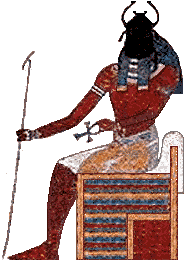
Wall painting of Khepri - Author unknown, circa 2nd Millennium BC
Wall painting of Khepri – Artist unknown, circa 2nd Millennium BC

“Khepri” is a scarab-headed sun god, and the inspiration for one of two poems by Sally J. Johnson featured in our Spring 2015 issue

{ X }

BORN FULLY FORMED
I can tell you about coming
into being about birthing
out bodies from sun shit and earth
to rise again and emerge whole
from darkness from dung from
the lungs of dirt do not stand
witness against me sing my scarab sisters
into the skin of the dead I am born
of the underworld to show you light
lifting my burden across the burning
sky I am born buried
born again alive
in knowing my time

I’ll embalm your beautiful sun
give you darkness at dawn
I’ll tug at your eyelashes
with my antennae wake you
every day until you die

{ X }

SallyJSALLY J. JOHNSON received her MFA from the University of North Carolina at Wilmington where she served as Managing Editor for the award-winning literary journal Ecotone. Her poetry and nonfiction have appeared or are forthcoming in the Collagist, Bodega, the Pinch, Weave, So to Speak, Everyday Genius and elsewhere. She is a poetry editor for Green Briar Review and works as a publicist in Winston-Salem, North Carolina. Find her online:@sallyjayjohnson.

“The Rud Yard” – Fiction by Vajra Chandrasekera

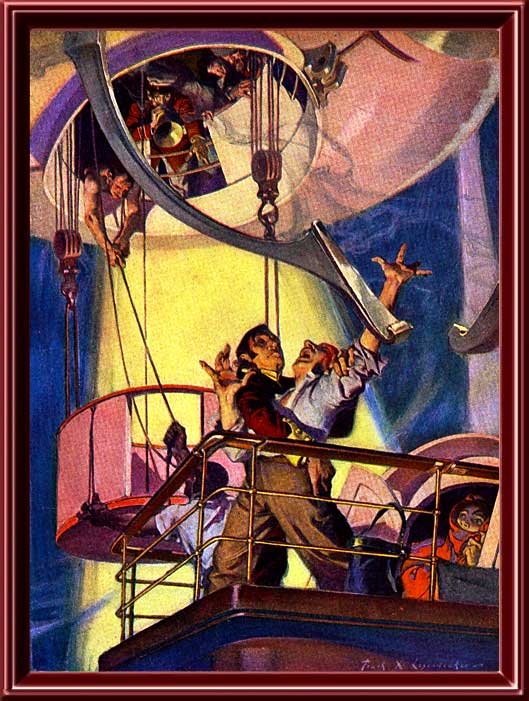
Illustration for Rudyard Kipling's "With the Night Mail" - F.X. Leyendecker, 1905
Illustration for Rudyard Kipling’s “With the Night Mail” – F.X. Leyendecker, 1905

Should you care for another taste of our Spring 2015 issue before it flies on March 20, here’s “The Rud Yard,” Vajra Chandrasekera‘s hilariously terrifying take on the future of the surveillance state.

{ X }

HE SAYS HE’S ALLERGIC TO EVERYTHING, only as if he’d like to be bitten by a radioactive spider and wake up the next morning without any allergies and with 20/20 vision and surprise abs. What he has instead is a pain in his belly from, he claims, the constant stress of the surveillance state. He refuses to let me use his name, so let’s call him M.

I get M’s shirt off and discover a belly like that of a woman just barely pregnant. I place my hands on it reverently and make a face like the baby just kicked.

“You have a radiant glow,” I tell him. Then I have to explain that this glow has nothing to do with the radioactive spider, and we get sidetracked into an argument about the Radium Age of science fiction a hundred years ago. Specifically, about Kipling’s Aerial Board of Control stories, which he thinks should definitely count and I don’t, mostly because I haven’t read these stories. M says they’re about airships that rule the world or something like that.

“Oh, like drones!”

M says no. Not like drones. He says one time when he was twelve the President came to his school for prize day.

“What does this have to do with Kipling?” I say, “Or for that matter, the surveillance state?” and he says shush, wait for it.

So the President came to his school for prize day and the entire auditorium was full of important people and parents –these were non-overlapping groups, with the important people in the front and the parents in the back– and there was no room for the kids, so they set up some plastic chairs outside the auditorium, under a tin roof still glowing cherry red from the afternoon sun.

Sweltering under it and choking slowly to death on their ties, the boys –it was a boys-only school, he says, all rum and sodomy and the lash– practiced their bad seventh-grade French, which consisted entirely of all the French swear words they had learned to that point, and the useful phrase je ne sais pas.

“The two most important stages of language acquisition,” I say.

Yeah, M says, the parts of speech that are always permitted: swearing and denial.

The reason M refuses to let me use his real name is, of course, the surveillance state. It’s not that he thinks they don’t already know it, as M always says, but it makes him uncomfortable to hear it said at all any more.

Continue reading “The Rud Yard” – Fiction by Vajra Chandrasekera

“9 lessons in witchcraft” – Poetry by Danielle Perry

Witch going to the Sabbath - Remedios Varo, 1957
Witch going to the Sabbath – Remedios Varo, 1957

Care for a quick peek at our Spring 2015 issue, FLAPPERHOUSE #5, which flies on March 20? Sit for a spell & learn “9 lessons in witchcraft” from Danielle Perry.


{ X }

for Jodi

i. THE NATURE OF MAGIC

if you do not already understand magic
i am not sure i can explain it to you.

ii. sisterhood

we were sisters, or so the story goes, which
made it very confusing when i realized
that my feelings were not exactly sisterly.

iii. witch, witch, burn the witch

i learned the lesson early:
no one ever chooses the witch in the end.

iv. set aside childish things

i never learned that one.
some things stick with you, even
when you don’t intend them to.

Continue reading “9 lessons in witchcraft” – Poetry by Danielle Perry

“Gelid” – Prose Poetry by T. Mazzara

The great ice barrier -- looking east from Cape Crozier - Edward Adrian Wilson, 1911
The great ice barrier — looking east from Cape Crozier – Edward Adrian Wilson, 1911

The grand finale of our Winter 2015 issue is T. Mazzara‘s touching prose poem “Gelid.”

{ X }

For Mike and Jess

YOUR HANDS WERE STOCKY AND ROUGH from hundreds of nights of drunken trips and drifted fights, medicated and on the nod. The chewed fingers heavy nicked from days of banging shoes, carving flaked and solid horn from the wobbly soles of timid horses. You had hard fists from shoving against the threatening lean of breathing flanks, banging clips against shuddering ribs, hooves elbowed and ungainly. I saw you clip a goat once. You made art.

And danger. But we all loved it. Out in the wild near Lock Haven, on careless nights, those cut hands gripped the steerage of your truck and pulled us three (four with Daisy) all sharp, fishtailing drunk and loose through gravelly firecuts beside potential falls and real peril, beside cliffs and sheer drops. It was a cold day.

I thought of you on the Ice, out past the dust and diesel, the back-action beeps of reversing machinery, past all the sound and smells and grit and thin humanity that make up that smoking cradle, that McMurdo Station. I remembered Daisy was so well-behaved in the extended cab.

I thought of you as the Royals stretched chalky and awesome. Fata morganas hashed impossible parapets into the distant coast. Didn’t we kick a dozen or so beer cans out the door and all over that gas station parking lot?

I thought of you in Antarctica as I moved a pallet of oil drums from the line in an outside storage area to the trembling gray shutters of the Vehicle Maintenance Facility. Shrill ice bits and volcanic ash snaked their way through the cracked door of my front-end loader. And I remembered all the locals at that gas station laughed.

Everything was okay. My own rough hand gripped the brodie knob on the steering wheel, the drums cargo-strapped tight against the forks. You showed me around that cool and rocky back road. There was snow between the trees. You pointed out where you’d crashed your truck.

I thought of your truck on all those careless back roads as I turned and rumbled at the bottom of the planet. I thought that I’d ask you down next season. And I thought that the world is not flat.

Why didn’t you come with me to the Ice, my friend? Why did you go the way you chose? Why did you choose what you did? Why that? We could have driven heavy equipment and welded things. We could have been drunk at Southern and stumbled ungainly over volcanic ash to the stolid sea ice. We could have toasted the melting ice pier or a passing gray skua. Raised oily glasses of golden whiskey to the fantasy of the Ross Dependency. Your hands would have been useful on the Ice.

And I thought of you this last Monday. I was in a phony house on West 10th Street in New York. It had rained earlier and I was soaked through and surrounded by the young and the phony and the untested and your voice came to me in my foolish writing. Faraway.

“Our time together was ours and mine was short. I had no time for the rest of the world.”

I thought of your empty hands, useless in the ground. I thought of the Ice again. Maybe I should have invited you. I thought of your wife. It gives me some comfort to know I took you with me. It may give her some now to know the same. Nearly winter here again.

In this hemisphere, at least.

I can’t wait for the snow.

And I’m okay, in case you’re worried.

{ X }

T. MazzaraT. MAZZARA was born in Virginia and studied at Trinity College Dublin.

“Grackles” – Poetry by Jennifer MacBain-Stephens

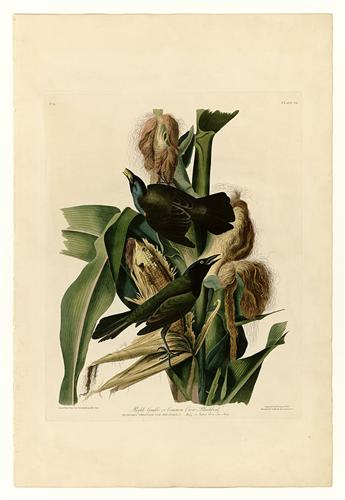
Purple Grackle or Common Crow Blackbird - John James Audubon, circa 1830
Purple Grackle or Common Crow Blackbird – John James Audubon, circa 1830

“Grackles” is one of five pieces contributed by Jennifer MacBain-Stephens to our Winter 2015 issue, a kind of epilogue to her series of poems on Joan of Arc.

{ X }

ROBERTO RAVEN CIRCLES THE BATTLEFIELD, waits for the logs and squares to stop shaking and gurgling. Opposite of Quick Care, the beaks seek grossness, go to the quiet ones first. Little silver boxes squirm in the grass. Two argue in the sky If someone is dead, do you say “I love” or “I loved.” Birds are just addicts who come to any gathering for the free coffee.  The buzzing molecules won’t stop mowing science down. New diagrams of buzzards break open encyclopedias. No one has any ears to hear the panting and murdered ecology. Put your energy into this field project management. Weed, mow, pluck, fertilize. Goats are good at bloodletting. Harvest the forearms and flies. You can tell how old something is by the smell. Roberto, the only feathered Italian in France at the time, is outnumbered by the xenophobic blackbirds. Christopher chipmunk’s only interest is nuts. Roberto is pissed and finds his voice again in the sky: message my wing beats in screams and piercing darkness through round orbital messages in a bottle. Christopher and Roberto are too scary to be illustrated properly. Real life never stops pulsing long enough for a proper water color. Roberto refuses to blind the corpses. A prisoner in another camp looks east, the morning bells ring. Armor a memory like the ocean.

And it’s over a thousand years later and we are back on the banks of the Seine, opening a bottle of wine with a corkscrew, loosening hiking boots. Telling each other about our small steps every fucking day.

{ X }

AuthorphotoJENNIFER MacBAIN-STEPHENS is the author of three chapbooks: Every Her Dies (ELJ Publications), Clotheshorse (Finishing Line Press, forthcoming, 2014), and Backyard Poems (Dancing Girl Press, forthcoming, 2015). Her work has been nominated for Best of the Net, and has appeared in public places in Iowa City. Recent work can be seen / is forthcoming at Dressing Room Poetry Journal, The Blue Hour, The Golden Walkman, Split Rock Review, Toad Suck Review, Red Savina Review, The Poetry Storehouse, and Hobart. For a complete list of publications and other odds and ends, visit JenniferMacBainStephens.wordpress.com