Category Archives: Excerpts

“Mother to Chick” – Fiction by Rebecca Ann Jordan

Young girl eating a bird (The pleasure) - Rene Magritte, 1927
Young girl eating a bird (The pleasure) – Rene Magritte, 1927

Earlier this year, we asked Rebecca Ann Jordan if she could write us a flash fiction inspired by Rene Magritte’s painting “Young girl eating a bird.” The result is the enchantingly eccentric & superbly disturbing “Mother to Chick,” one of many flappy lits you can read in our Fall 2015 issue.

{ X }

IN THOSE DAYS, WOMEN WEREN’T PERMITTED TO FLY. It would have been unseemly, like wearing pants then, or wearing skirts now.

I was born with feathers tucked between my teeth. I bet they don’t tell it that way. Screams of horror at being thrust into a cold world turned to giggles, feathers tickling the mouth’s roof. They who grasped my ankles and spun me around, who made me lust for vertigo, also made me vomit out the feathers.

It was already too late for me. I’d been hooked on flight.

The birds, they listen to me in the way that dogs or horses listen to men but not women. I’ve never seen a man could charm a finch down from an apple tree. (Disregard tall tales, always shinier in hindsight anyway.)

I, avian hoarder, began to accumulate them young. A hummingbird perched on my ear, woodpecker on shoulder, quail hurrying along in my perfumed wake. Now they hover, churning flurry, behind me—a mile-long veil of feathers and cacophonic chirps. All want attention.

All prove their value with flight.

My little dog chases the ground-dwellers until they’re forced to light upon my skin, digging in little claws.

I made my own attempt in all the usual ways, plus:

  • Lifting molted feathers, fallen in a flurry from my train. First glued, then soldered to my skin, shoved into holey pores. I thought then to skip the easily-melted wax; I’m not incapable of learning from the past
  • Weaving a net the larger birds could burrow up inside, press against the roof, and me with fingers twined in the ends, they my balloon, I their weight. (Here, you can still see the rope burn that redly elongates my lines of head/lines of heart)
  • Making a machine. Perhaps the magic wasn’t in the birds; selfish to keep it to themselves. I made it from branches and leaves; gingham and lace from my dress I tore to pieces; strings and papa’s gears and rubber bands. Rubber bands propelled the gears that tugged the strings that pulled the branches and gingham and lace, all strapped between my shoulder blades. Up and down, went my fake branch / gingham wings, up and down and up and down and up and down. I almost felt myself getting lighter on the upswing, but down always counteracted

Continue reading “Mother to Chick” – Fiction by Rebecca Ann Jordan

An Excerpt from Nothing Granted – Poetry by Anna Meister

Two Girls in the Flower Garden - Le Pho, circa 1955
Two Girls in the Flower Garden – Le Pho, circa 1955

Our Fall 2015 issue features three outstanding poems by Anna Meister, from her series titled Nothing Granted. We’ve posted one of these poems below, and if you’d like to read the rest, you can purchase the issue in print for $6 or as a good old-fashioned PDF for $3.

{ X }

REMEMBER WHEN I’D ALLOW HER TO TALK ABOUT PUSSY.
Expected flush, the natural heat of power. She runs
over my feelings with great sweetness, eyes
intent on me. She used to say You can be
whoever you want, but is tired of me now
that I look at her more. I show up & leave
as myself. Continue past the moment, say I am
thirsty. Pick a million tiny pieces up. We like loss
to ground us, learn to love people quietly.

Outside, flowers like lemons & not
the other way around. I remember her
mouth never closing. When I speak to the sun,
I’m dressed before we hang up. I speak over the light
while she wails & knocks. I exhale
loss, a pretty girl sleeping. If my love expires,
I’ll renew it for the weekend. If I fucked her less I would
be aggressively lonely. Outside, each flower makes
a face. Each looks, she says, the same.

Stopping for gas late, an angel kissed me.
I like how summer bent. We like loss to come,
like to feel it quiet. What a luxury to be without
hands. Whatever I got is enough
to drive back. The silver, long unraveled
eye, the motherfucker rinsing
another fork. We’re clean as the chicken,
but not that inspiring, just
bones in the water when they simmer.

{ X }

anna_meisterANNA MEISTER is an MFA candidate in Poetry at New York University, where she serves as a Goldwater Writing Fellow. A Pushcart Prize & Best of the Net nominee, her poems are forthcoming in Powder Keg, Whiskey Island, Barrelhouse, The Mackinac, & elsewhere. Anna is a 2015 Saltonstall Foundation for the Arts Fellow. She lives & works in Brooklyn.

“Earth Comes Down” – Fiction by Maria Pinto

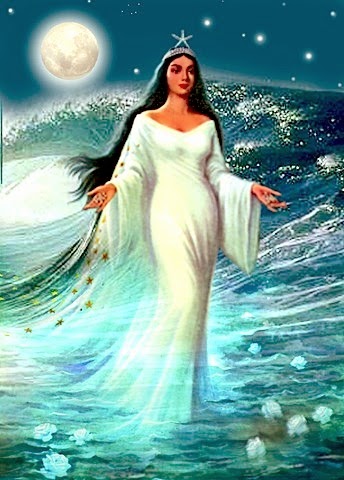
Yemaya - artist unknown
Yemaya – artist unknown

“Earth Comes Down” is Maria Pinto‘s bluesy slipstream short story about a mysterious woman who appears following a powerful storm. It’s just one of many cosmically flappy lits in our Fall 2015 issue, now available in print ($6) & PDF ($3). 

{ 1 }

SHE WAS FOUND ON THE WOODED SIDE OF THE HIGHWAY by two paramedics on their way back to dispatch. The eye of mega-storm Yemaya had lately passed over us. Though the rain had stopped, the sky still roiled grey and white like restless marble. Downed trees and branches hindered evacuation travel, so the highway was otherwise bare, and there she was beside it, pacific and strange in the mud. Though the medics initially feared she might be pinned there by flotsam from the woods, this was not the case. She was a sight. Her skin glistened with some sort of arctic-blue ooze. Twigs and leaves stuck to it. She wore a thin blue, brown, and green shift and no underthings. Not enough for the way the winds still huffed. Her mouth opened and shut like that of a beached fish, though she made no sound. She was maybe biracial, her hair wavy and matted in places.

Wilson, who is now under investigation for the woman’s disappearance, sat in the back of the ambulance while Reece drove. Wilson claimed that during the long ride to the hospital, even though she had not made the slightest noise before they strapped her to the bed, the woman stared up at the ceiling, babbling like a child. A coo here, a gurgle there. She was breathtaking, according to the report Wilson gave. It was superfluous information, to be sure, but it had been included anyhow. She was “so damned gorgeous we could barely look at her; so gorgeous it was easy to imagine that a man or group of men had taken what he or they wanted and left her for dead on the side of the road.” It was too easy to imagine this and too easy to imagine it again. Like a nightmare fantasy you close your eyes and savor. The report said that at least the paramedics had had the grace to look sheepish as they rhapsodized upon the beauty and violability of her form. They could not help themselves. Men will be men. Continue reading “Earth Comes Down” – Fiction by Maria Pinto

“Creature Feature: Caligynachtmare: Dread the Beauty” – Poetry by Shannon Moore Shepherd

The Angel of the home or the Triumph of Surrealism - Max Ernst, 1937
The Angel of the home or the Triumph of Surrealism – Max Ernst, 1937

Shannon Moore Shepherd‘s fiendishly fantastic poem “Creature Feature: Caligynachtmare: Dread the Beauty” is the opening spell of our Fall 2015 issue. If it adequately stokes your demonically ravenous hunger for more surreal, shadowy, sensual, & satirical lit, you could pre-order a digital copy of FLAPPERHOUSE #7 now so that it flies into your emailbox before the Autumnal Equinox. And if you’re in the NYC area, you also could come watch Shannon perform, along with some other uber-flappy writers we love, at FLAPPERHOUSE Reading #4 on September 23.

{ X }

I AM COMING FROM FAR AWAY,
and not to fold your laundry.
A bat lights on one shoulder,
a starling on the other. I am
fortified by what meets
in the middle of dark
and light. Little star, shining,
goodbye Earth and all its
years (How are we not all covered
in dust? How do you keep your
toe pointed, little star?)
But I am coming with no
history and all of it balled up and popped into
my mouth and sliding down my throat, so do not
ask how I keep myself warm.
Saturn’s belt of crushed rock around
its belly I can ride like
a thunder cat. I am a silver-skinned wonder
setting down your tea to watch you shiver.
I am Isis’ darkest vein, but as if through an
orchid, I am sick with beauty.
Continue reading “Creature Feature: Caligynachtmare: Dread the Beauty” – Poetry by Shannon Moore Shepherd

“The Boy Princess” – Fiction by Jane Flett

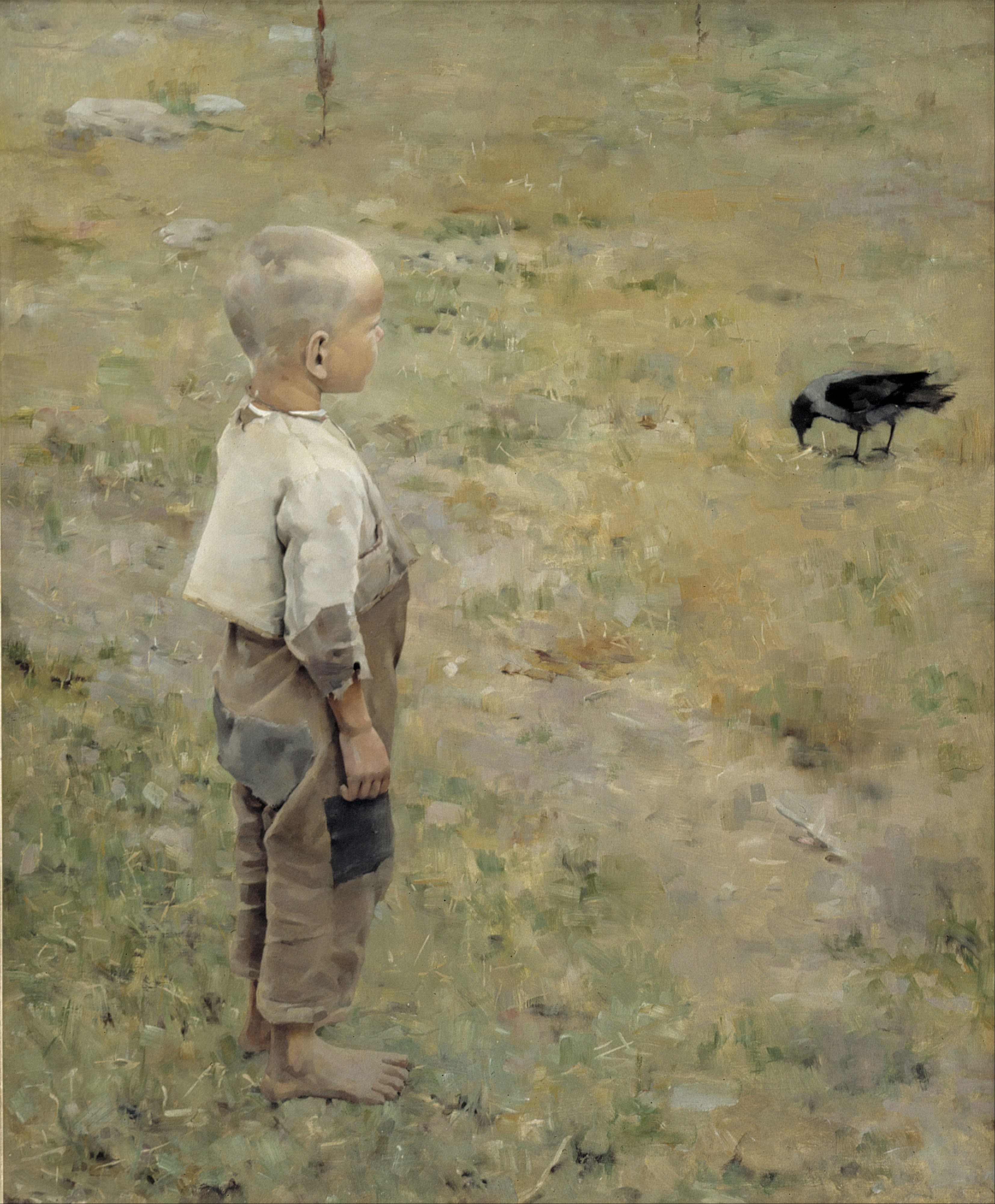
Boy with a Crow - Akseli Gallen-Kallela, 1884
Boy with a Crow – Akseli Gallen-Kallela, 1884

The grand finale of our Summer 2015 issue is “The Boy Princess” by Jane Flett, an unforgettable fairy tale that’s as bizarre as it is touching.

{ X }

EVERYWHERE IT IS AUTUMN, the leaves are capsizing, and yesterday I saw the boy princess in the woods. He was squatting beneath a stone bridge, throwing pebbles into the stream, while I watched from the other bank. I like to watch him balance. His thighs are sturdy—meaty, in fact—though I could see the muscles quivering underneath the skin. A pulse in the neck of a baby bird. His garter had begun to unravel, and the dirty end of the lace was lapping in the stream.

I didn’t want to disturb him. The boy princess is a paper sack of contradictions—part brittle sugar-glass, part thick, sure flesh. The pebbles made an empty thwack when they hit the water and I thought of wishes and wells. If I could be granted one true thing by the wish master, what would it be?

To be the stream, nuzzling at that grubby lace? No—

To be the garter, quick against his thigh? No—

To take the boy princess in my mouth and taste him, so sweet and slick he hurts my teeth.

The wish master gave me none of these things. I left the boy princess to his pebbles and reflection, and climbed over the rocky banks towards home.

{ X }

I try to pretend I can take or leave the boy princess, but of course, either is impossible. The moment I met him last spring, he crawled beneath my heart, and he dwells there now with sharp canine honesty.

I met him on the mountain of rejected objects one morning when the sun was fat in the sky. He was exercising his pet crow. That is, he was throwing scraps of bacon from a paper bag into the void past the cliff and the three-legged crow would swoop and caw and plummet, racing against meat and gravity, to rise up victorious with a morsel in its mouth. I didn’t know he was the boy princess then. I didn’t know the crow was his. But there was something transfixing about the arc of his arm.

The skin was covered in ragged black sketches. An owl’s eye, which seemed to follow me when I walked. A map of islands with a sea full of kraken. The languid silhouette of a bear. But the skin was also very pale. It looked as if it would puncture if you pressed too firm a nib against it. As if any line of ink would be followed by blood.

I watched the crow. It was lovely to watch the balance of his body as he landed. His back leg hit the grass first, then the middle, then the front, and the crow would rock forward, bob, and settle back against his tail. Every time, a gentle crow curtsey: Thank you.

“That’s a good crow,” I said.

The boy princess turned around. He narrowed his eyes, or perhaps it was just mascara smudging in the sockets.

“He’s not,” said the boy princess.

“But—”

“He might seem good. It’s because he’s got three legs, isn’t it? But trust me—” at this, he lobbed another morsel of bacon over the cliff top “—this crow is impossible.”

Continue reading “The Boy Princess” – Fiction by Jane Flett

“Dance” – Poetry by CL Bledsoe

The Dancers - Fernando Botero
The Dancers – Fernando Botero, 1987

“Dance” is one of five wry yet poignant poems by CL Bledsoe in our Summer 2015 issue, which you can order online via Amazon and Createspace. Copies are also available at fine independent brick-and-mortar stores like Bluestockings and St. Mark’s Bookshop.

{ X }

WE WERE ALL BEAUTIFUL ONCE,
some will be again if we
remember to let ourselves.

Grow your hair long to hide those
scars on your neck, your shoulders;
one day, when no one suspects,

cut it short and see that they’ve
faded. My neighbor only
smiles when she thinks no one can

see, walking her dog, alone
in her car. She’s beautiful
in a way that makes me want

to lose 50 pounds and ask
her to dance. I don’t even
have any interesting

shoes anymore; just nice ones.
The days used to mean so much.
Now, it’s all turn signals, slow

dryers. I’m not making sense;
this girl, she’s not exactly
pretty. I just want to dance.

{ X }

HeadshotCL BLEDSOE is the author of a dozen books, most recently the poetry collection Riceland and the novel Man of Clay. He lives in northern Virginia with his daughter.

“Red Hair, Red Venison, Brown Summer Sun” – Poetry by Jessie Janeshek

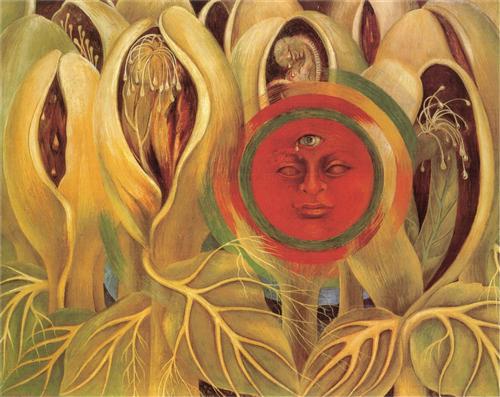
Sun and Life - Frida Kahlo, 1947
Sun and Life – Frida Kahlo, 1947

Jessie Janeshek‘s magical and mischievous “Red Hair, Red Venison, Brown Summer Sun” is merely one of four poems she contributed to our Summer 2015 issue, currently orderable online via Amazon and Createspace. Copies are also on sale at independent brick-and-mortar stores like Bluestockings and St. Mark’s Bookshop.

{ X }

WE’RE A FOX FOR ALL SEASONS             eat bonbons like bad pigs
      cry every rain for the bones of an idol
          the colts of an emblem
      the house-cat shaped hole in the tree.

We wake sick once a month   eat dried baby’s breath
      vomit hinges and hexes        track our black sex on money               since worms are inside.


All signs point to yes, unsympathetic.
      We spray piss, make it coarse
      since it’s not crime if it’s habit
            and we’re the white horse
      the slim beehived bride in the iron lung
      still watching          Dark Shadows
      in retrospect.


Author’s Acknowledgment: The phrase “the bones of an idol” is the title of a song by The New Pornographers.

{ X }

jessie janeshek headshotJESSIE JANESHEK‘s first book of poems is Invisible Mink (Iris Press, 2010). An Assistant Professor of English and the Director of Writing at Bethany College, she holds a Ph.D. from the University of Tennessee-Knoxville and an M.F.A. from Emerson College. She co-edited the literary anthology Outscape: Writings on Fences and Frontiers (KWG Press, 2008).

“When All the Trees Go Up in Flames, Only Water Puts Them Back to Sleep” – Poetry by Kailey Tedesco

The Fire - Rene Magritte, 1943
The Fire – Rene Magritte, 1943

“When All the Trees Go Up in Flames, Only Water Puts Them Back to Sleep” is just one of three superbly flappy poems by Kailey Tedesco in our Summer 2015 issue (available here, herehere, or here).

{ X }

SHE HELD THE FOREST
like a hairbrush in
one hand, and my
grandmother’s pond
like a hand-mirror.

With her vanity set,
lifted gently from
the alabaster of earth
she spends seven days
combing through

the tangles of her fire-
streaked hair as fallen
strands puddle in the under-
growth –

A reflection ripples
over her drowsed eyelids –
the foxes wake to hunt.

{ X }

Headshot UpdateKAILEY TEDESCO is currently enrolled in Arcadia University’s MFA in Poetry program. She edits for Lehigh Valley Vanguard and Marathon Literary Magazine, while also teaching eighth grade English. A long-time flapper at heart, Kailey enjoys hanging out  in speakeasies, cemeteries, and abandoned amusement parks for all of her poetic inspiration. She is a resident poet of the aforementioned LVV, and her work has been featured in Boston Poetry Magazine and Jersey Devil Press

“The Story of Essa” – Fiction by Alison McBain

Enchanted Beach - Boris Mago, 1938
Enchanted Beach – Boris Mago, 1938

Alison McBain‘s “The Story of Essa” is a stirring, dream-like tale of transformation from our Summer 2015 issue, which you can order online via Amazon and Createspace. Copies are also available at fine independent brick-and-mortar stores like Bluestockings and St. Mark’s Bookshop.

{ X }

I. SAND

BEFORE HE BROUGHT THE KEY, Essa had been chained to the basement door her whole life–locked within the confines of her own ten fingers and the ability to work small magicks when on call. Before she sunk her feet into the sand, before the rough-hued grains cascaded over her toes, she had never known how to move with any sort of rhythm.

The seagulls sang, and the wind came down to partner her, and she danced and she danced and she danced.

II. SILENCE

Words had never been required. She saw herself as a newborn, the thin loops of the basement chains cascading around chubby wrists and baby cankles, and the admonishment of angels telling her to hush. When he came before her, he didn’t ask questions–he gave her fully-formed sentences, directives for training and the execution of purpose. He taught her how to summon her will and focus it to the desires of the mind; he taught her how to name, silently, all the colors held inside.

But her words were not noticed when she tried them out. Her mouth fell idle in the absence of encouragement. Her tongue dwindled down until it became a tube and split at the end. Sometimes, she cast her tongue out like a net to scent the air, little lizard-girl pining for the day. Continue reading “The Story of Essa” – Fiction by Alison McBain

“Nice Things” – Poetry by CL Bledsoe

Back Room - John French Sloan, 1912
Back Room – John French Sloan, 1912

“Nice Things” is one of five wry yet poignant poems by CL Bledsoe in our Summer 2015 issue, which you can order online via Amazon and Createspace. Copies are also available at fine independent brick-and-mortar stores like Bluestockings and St. Mark’s Bookshop.

{ X }

MY IDOLS HAVE ALL GONE BALD OR TAKEN
day jobs. It was a question of wear-

and-tear on tire treads, the desire
to no longer wince when introduced.

Shoulders stoop under the weight
of freedom, all that designer pizza and cheap

beer, and I’ve finally run out of cool tee-shirts.
Listen: I know the real money’s in pet

psychiatry but I’ve always been allergic
to their saliva. I know there’s nothing

to be gained from an understanding
of the self, a concern for actually solving

problems, the wisdom to attempt empathy.
There are no important things in life except

the fear we might be the last ones in the room
when the bar closes.

{ X }

HeadshotCL BLEDSOE is the author of a dozen books, most recently the poetry collection Riceland and the novel Man of Clay. He lives in northern Virginia with his daughter.