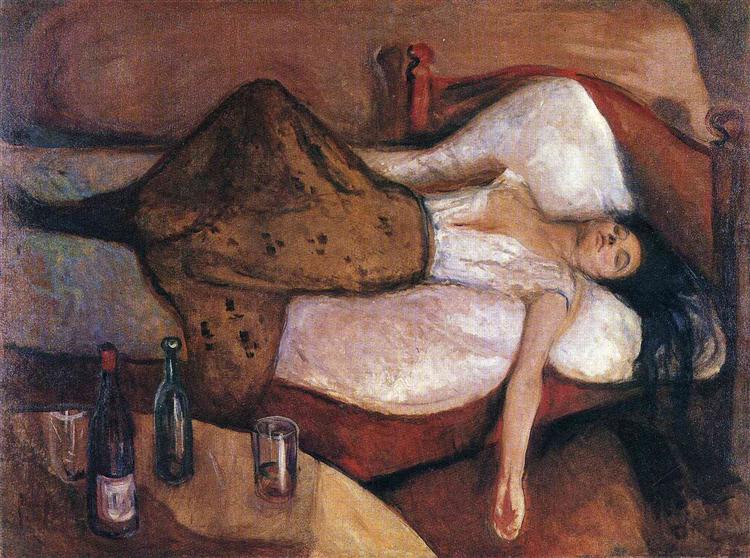
I TOOK NIGHTTIME TO HIDE IN MY HAIR AND considered how I confused lust with
a periscope. How intimacy was a seeing eye,
people’s faces in orgasm.
Through muscle memory, I learned to grab a bottle
from thin air. Since it only takes 21 days to make a habit
I hammered this magic in like ideology,
fists unsure what to make of sleep.
I dreamt of whiskey bottles with false bottoms
filled with index cards listing coping mechanisms
that I could call my own so I could stop
living as a caricature of myself.
Then sleeping alone started to feel like a victory
because I could pass out with wine in my mouth
a lump of gleaming brie on my nightstand
and for all my social inclinations, my time
in bed alone increased. I read the news and
considered myself lucky. I tucked corks into
jars around the house: awards for effective self-
medication. Smug quotidian trophies.
MY HABITS ARE BAD I don’t know what’s at the wheel
sleeping long days dreaming dead deer
or deer horns or nothing.
Alive alive-o forms a good number
crumbling old letters feast or fiesta
but this blue candle does not smell like fall
and I can’t tell if the groan
is my home or an animal
or why I am walking this ice storm alone
devil gloves and pink puffballs
the starlet zone code
in a world without love when this could be Hollywood.
The fine-fingered winged girls
black lips/silent o’s
but I don’t have enough time between assaults
to let my hair grow back natural
so I find icy playboys
the ways their lips tingle with scotch
give the white high heels another shot
vow I’ll be productive
drink less or more little sips vow I’d be better
off in lands of moors
since I can’t stand your voices.
Introductions are worthless
you know my winged liner
another faux fur and this is the dusk
through which I tote a glass lantern
through money and glitter
and Mari Lywd gloaming
and there’s not enough coffee
to mix with the liquor before we jump in the roadster
or the river.
In the film I’m the dead aunt
and the contemporary ghost of myself
too afraid to move and I’m afraid I’ll lose
men, cigarettes or electricity
my cologne smells like moss
and I’ll find places to hang
my photos of Jean Harlow’s graves
and we’ll meet in the bathroom
and fuck in our bathrobes
as the topcoat smooths everything.
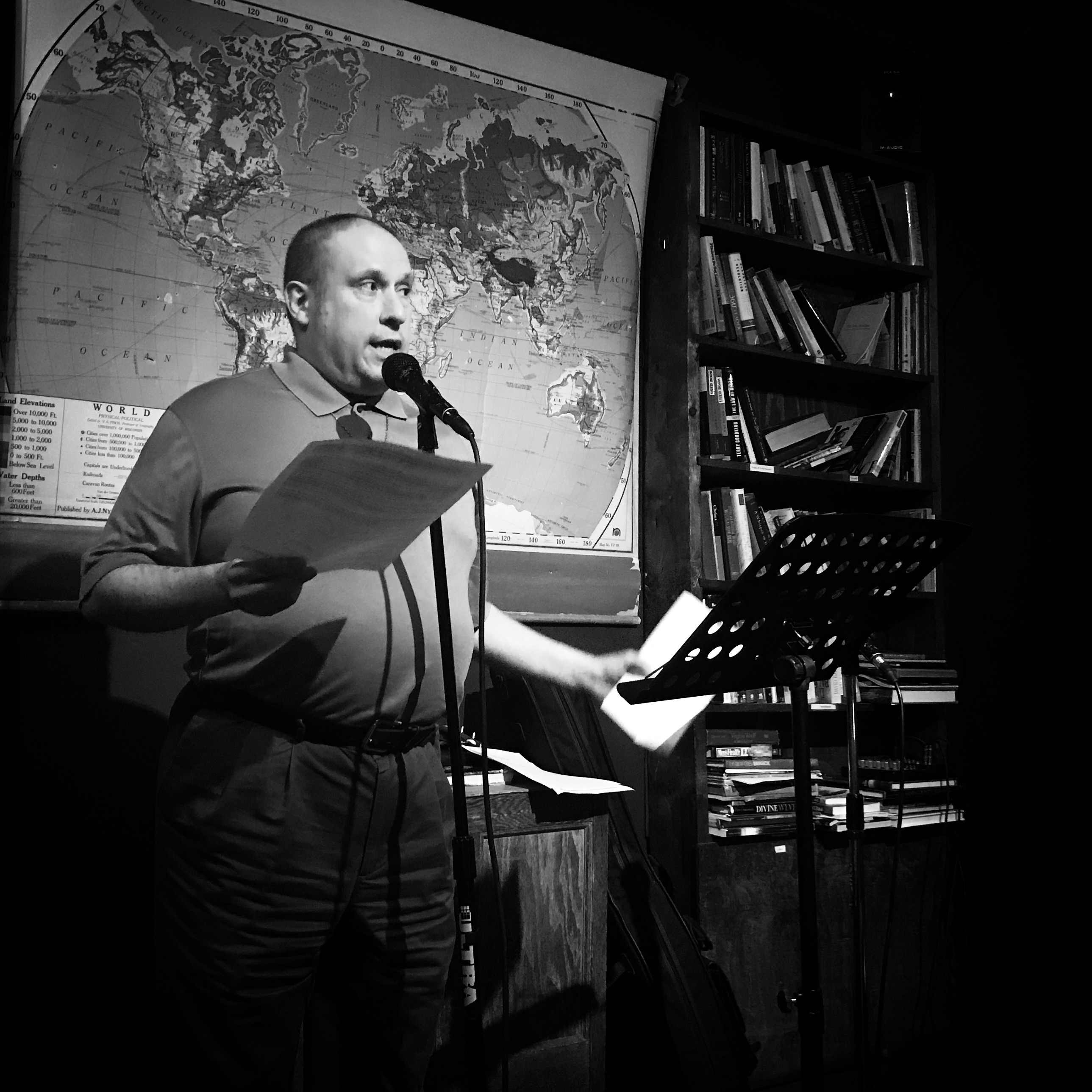
A tremendous tidal wave of thank-yous to everyone who helped make last night’s reading such a blast: Leland, Kailey, John, Olivia, and Ariel for performing your flappy lits; Alibi for your scintillating singing and photography; Pacific Standard for the always-gracious hospitality; and all you gorgeous humans who came to join the party.
We hope to see y’all again later this summer…
[photos by Alibi Jones]
Leland Cheuk reads his sharp & satirical tale about “Social Media Selves”
Kailey Tedesco reads some of her ring-themed poems from She Used to Be on a Milk Carton
Our Summer 2018 issue, FLAPPERHOUSE #18, has finally risen from the deep! It’s stuffed to the gills with sex magic, hurricanes, leviathans, anti-romcoms, overly-realistic dreams,
doll-written novels, talking bodega cats, and so so much more…
PRINT copies available for $6US via Amazon
DIGITAL (PDF) copies now available for $3US via PayPal
(PLEASE NOTE: Unfortunately we are currently unable to email PDFs immediately upon order. Delivery of your PDF may take anywhere from several seconds to several hours, but rest assured, we will complete your purchase as soon as humanly possible. We apologize profusely for any inconvenience or delayed gratification.)
Our Summer 2018 issue won’t rise from the deep until June 21, but should you care for a preview of what’s to come, here’s Perry Lopez‘s historical & horrific short story “Snapshot from the Revolution.”
{ X }
THE NIGHT WAVES WERE ROLLING TOWARD CUBA, beating their steady pulse against the hull of the yacht. A rhythmic skip and crash in perfect blackness, and all our bodies leaning together. A jump and plunge amidst the rattle of ammunition, the dishing of gasoline in drums that we had lashed to the handrails because the tank would not hold enough to get us there, the sky that was starless, pure blackout, and pressed down upon our heads. Petroleum and sulfur and potassium nitrate, human sweat and nervous breath, the various agents of conflagration—all inert for the moment, jostling together. My finger was on the shutter release. Across my chest there was a double-bandolier full of flashbulbs. Magnesium, the smell of magnesium powder, which burns with near the same quality as sunlight: 5500 Kelvin.
I try not to hear the Giant’s voice, but there it is anyway. Words which he never spoke but instead I gave to him and believed in absolutely, there in that moment of body-terror and doubt, seminal blindness across the Atlantic, which was the power he had over all of us. Have spirit, brother Gusano.We do not need the heavens to steer by, not when we have pinned fresh constellations to the roofs of our minds. Would the man himself have said that? I can see his face speaking the words clearly enough, but cannot say for sure. I have written far too many speeches for Fidel Castro in my thoughts, and now he is dead—idol dead, paper dead—heartbroken at the age of ninety and buried beneath a kernel of corn, as you already know.
So instead take my clearest picture, the only one I know for sure was captured with my own senses. Everything afterward will be lies: Graffiti on their monuments. I remember salt on my lips. Body salt, sea salt, and an accordion crush of lungs fighting for space to expand. The deck was not meant to hold so many bodies. A compression of moncadistas and stark-ribbed exiles on the pleasure boat that had seen happier voyages. Eighty-two men in total, all packed to the gunwales, hustled aboard the North American vessel with its engine that stalled and stuttered like my own flawed heart, sending up the first oily smoke of our revolution, some of them sitting upon the very edges and holding onto the shoulders of their comrades so that they would not fall into the sea. An orgiastic colony of sweaty limbs and whispered confidences—Sierra Maestra, José Martí, the Latifundia, Our Lady of El Cobre, Castro, Castro, Castro—the germ of a new country caught between two great slates of emptiness, the sea and the sky, and a few brave ones sitting atop the crates of grenades packed in straw. A man coughed up vomit to my right and another leaned over the side to dribble his empty stomach across the midnight rollers. From somewhere close to the bow a voice was singing out in a bold, solemn spinto: Cuba, oh Cuba, a bright red flower for Cuba / One which smells not so sweet / Nor which bears aught to eat / Yet will bloom on from Gitmo to Bauta, as his words were sucked away by the wind. Where in all this was Fidel? Where was Che? Which of these darkly groping forms were Raul and Camilo and Almeida? And whose voice was that singing? Never mind. It is wrong to ask. Let them be for an instant like what was promised. A hum of bodies and voices and futures converging.
But in this polyrhythm of heartbeats they had their guns and I had my camera. A 35mm Zeiss that would be the eye through which the world watched our revolution (Castro’s hopeful thinking) and the tool we would wield against Batista’s newspapers. It swung from its strap and knocked against my chest so I raised a hand to hold it still. Already a bruise had begun to form there, a distinct green and yellow impression of the metal case stamped upon my skin. Your press card, brother, said Raul the day before, giving the bruise a rap with his knuckles. Now they will know not to shoot you. A painful blemish that would only grow with time. But for the moment it was best not to take the camera from my neck, I had decided, because if it somehow got lost or broken they would give me a rifle to replace it. One of those old American Nazi-killers we had bought in bulk off the Mexican black market. Rusty barrels with warped wooden stocks—M1 Garands and weathered carbines, Springfields as likely to explode in your hands as kill anyone, a few German Mausers with their dull metal luster—weapons whose history I wanted no part of, yet I think the others were eager to see me burdened with.
Some of the men had already urged as much. Their spirits took a vicious turn after four days at sea in the cramped vessel and several of them had cornered me in the back of the yacht. Open spaces are bad for revolutions, and in all that vacant water and cloudless atmosphere they had turned their eyes away from the horizon and found me there with my camera. Why should Gusano’s burden be so little, they asked. Why should he have to do none of the killing? Is he a coward? Their faces drew close as they took the Zeiss away from my neck, passing it from man to man and judging its heft against the weight of their weapons. I thought for a second they might throw it into the waves and that would be that; I would have to become a Guerilla too. But it was Fidel himself who came to my rescue. “Leave Gusano be,” the Giant said. In the noon scorch our Comandante stood high upon the flying bridge with his body like a stain against the sun and all of us squinting up at him, his wolfish nose and wolfish eyes directed down upon his militia, his arms held out cruciform and his fatigues snapping in the breeze, saying, “The purity of our Mexican must be preserved at all costs. A steady hand and a steady conscience. How else will he take good pictures of us?” This had quieted them and I was left in peace, or at least what passes for peace aboard a boat crowded with barbudos trained to kill their own countrymen. So I waited for the nighttime when we would all be blinded together again.
We offer a variety of packages– in print & digital, or digital only, for one year, two years, or your whole entire beautiful freaking life. There are a number of ways to support our brand of weird independent lit & join the pursuit of flappiness… peruse our menu below, won’t you? And have a super sultry summer…
*please note that these prices are available for US shipping addresses only. if you live outside the US & would be interested in a print subscription, email FLAPPERHOUSE at gmail dot com & we’ll see if we can figure out a comparable price for you~
And then one day, the marble fortress with armored windows at the corner of profusion boulevard and especial avenue sold a moment of lucent insight instead of diamonds.
For an extraordinary occasion surpassing even the summoning to fertility of the wedding, the chronicling of survival in the birthday, gratitude for fertility of the anniversary, and the annulling of failures of the funeral,
they opened the hefty and segregating doors and emptied onto the display case their lifetime savings of begrudging tolerances, spurious excuses, and self-serving deceptions in return for a tiny box tied in ribbons the jeweler slid across the glass. They will never afford such luxury again. But if they grasp how this can be — an empty box, nothingness wrapped in preciousness — they won’t look to.
{ X }
STEVEN RAY SMITH‘s poetry has appeared in Slice, The Yale Review, Southwest Review, The Kenyon Review, New Madrid, Tar River Poetry, Puerto del Sol, THINK and others. New work is forthcoming in Barrow Street and Clarion Magazine. His web site is at www.StevenRaySmith.org.
YOU WAKE IN THE DARK & are not suicidal
so much as flirting
with the look of it
the way you consider
pie under glass at
a diner, polished
& dark red beneath
a cross-hatched top.
Who really sits down
at the diner & orders
just a slice of pie.
It would probably
taste like all those
things you could
never eat as a child,
like chugging pink
lemonade at the barbecue
because it was never
allowed in the house
unless there was company
over. It would taste
like the first time
someone sucked your
tits & didn’t call.
Our bodies have all been
through the desert.
We’ve all had a mirage
of water on the blank
ceiling & wondered
what it might be like
to take a sip.
{ X }
GABRIELA GARCIA is a Pushcart Prize nominee whose work has appeared or is forthcoming in North American Review, Word Riot,No Dearand elsewhere. She is a James Hearst Poetry Prize finalist, the founder of the podcast On Poetry, and an MFA candidate at Columbia University, where she serves as Poetry Editor for Columbia Journal.
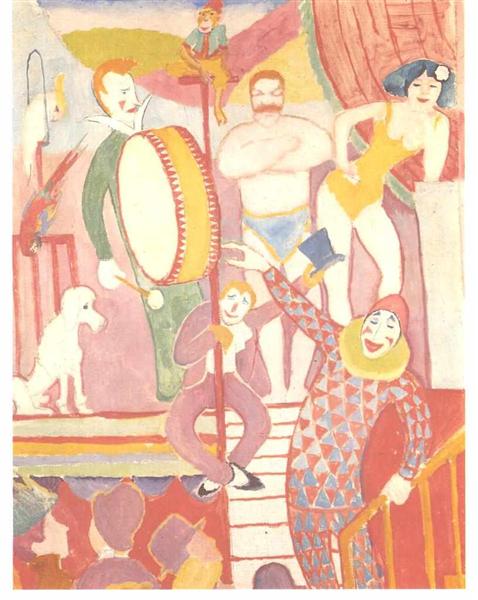
An unemployed young man meets a passionate and charismatic woman who literally makes his life a circus in “Forever,”Michael Chin‘s wild and haunting short story from our Spring 2018 issue.
{ X }
YOU FALL IN LOVE WITH A WOMAN ALL AT ONCE. You lose her in pieces.
The Ringmaster, before he was The Ringmaster, met a woman with hair the color of ripe peaches, and the whitest skin you’ve ever seen. The kind of woman you sensed you could bite right into and she’d dissolve like cotton candy.
His name was Verne in those days. He met her at a drugstore where she was shoplifting lipstick. The owner caught her, an Iranian man with a bald head and a handlebar moustache. “Thief! Thief!” he screamed, followed by a tantrum of curse words and guttural sounds. His six year-old son stopped taking inventory with the nub of a red crayon to look up. The Iranian’s wife, a white woman with a patch over her left eye, watched from the counter.
Verne pitied the family and loathed the Iranian, but his store was close by and he carried the frozen orange chicken Verne liked—the Americanized Chinese food his parents would never abide. He was third generation Chinese. The first in his family not to know Mandarin. The one who was supposed to fulfill all of the American dreams. A doctor, or a lawyer, or a physicist. Someone to be counted. Instead, Johnny Walker and orange chicken consumed his nights while he collected unemployment checks that would run dry exactly one week from that night.
“She was going to pay for it,” Verne said.
The Iranian held the woman by her wrist. Knuckles turning white. Verne thought he might take a cleaver to her hand like they did in the old country.
“You know her?”
The woman’s eyes grew glassy.
“I do,” Verne said
The Iranian waved the tube of lipstick in the air. The shiny black outside caught the light for a second. “Why’d she put it in her purse?”
Because she was stealing, of course, but that was the only answer Verne couldn’t give.
The woman kneed the Iranian in his balls. He doubled over and crumpled to the floor. She snatched the lipstick from him and took Verne’s hand.
Before he could think, they were outside and running. Verne clutched three cardboard boxes of orange chicken under his arm.
The Iranian came outside, still bent, clutching his crotch. “You never come back to my store! You come back and I’ll kill you!”
The woman laughed maniacally.
They wound up at Verne’s apartment, a studio cast in dull yellow by a single desk lamp. “Would you like some chicken?” He laughed as he said it, all that adrenaline and nervous energy and the absurdity of the moment overwhelming him.
“Sounds delicious.”
He opened a box and perforated the plastic film, then put the first plastic tray in the microwave. When he turned back around the woman was there waiting for him. Taller than him. His eyes met her neck. She held the canister of lipstick in her fingers. “Since we’re sharing stolen goods, can I interest you in some ravishing red?”
He took the lipstick and smeared it over his lips, drunk on her.
He took the first tray of chicken out and put in the second. “Chopsticks or fork?”
“No thanks.” She picked up her first piece of chicken, still steaming, between thumb and forefinger.
He started in with his chopsticks. She asked him to show her how to use them.
“I don’t use them right,” he admitted. He was self-taught—annoyed when he was little and his older cousins made fun of him. His parents never taught him the proper technique.
“They wanted me to be an American. Leave Chinese things behind.” He held a piece of chicken up in front of them. His extended family still laughed at him for holding the chopsticks wrong. White people never noticed.
“It’s silly,” the woman said. “Our parents tell us what to be. Most people never realize they can be anything else.”
The woman had drawn close to him. He could smell the orange sauce on her breath and feel the steam from the plastic tray rise at his neck. A scrap of the fried chicken skin had affixed itself to her lower lip.
“What do you want to be?” she asked.
“I don’t know.”
She kissed him.
“I don’t even know your name,” he said.
“Penelope.”
She kissed him again. This time, he expected it and clutched her. Wrestled her to the floor. Or maybe she wrestled him. First he was on top, then her. The floor felt rough against his back. Her hair tumbled down, surrounding him. Darkness with orange edges where the light peeked between strands.
“Tell me you’ll want me forever,” she said.
He touched her breasts and salivated. He couldn’t imagine a circumstance in which he wouldn’t want her. “I will.”
“You will what?”
“I will want you forever.”
They continued. He wasn’t sure how long they carried on, only that the first morning rays to shine through the window made the film of sweat on her skin shine.
He woke hours, minutes, maybe seconds later, to the sound of the microwave. The smell of hot orange chicken. Penelope perched herself on the counter, wearing Verne’s shirt from the night before, and feasted.
Movement meant agony. Verne stretched his arm up over his shoulder, and dipped his hand onto the tender flesh of his back. His skin had broken, bleeding over the bare hardwood.

 RITA MOOKERJEE‘s poetry is featured or forthcoming in Hollow, Lavender Review, Cosmonauts Avenue, Spider Mirror Journal, and others. Her critical work has been featured in the Routledge Companion of Literature and Food, The Bloomsbury Handbook to Literary and Cultural Theory, and The Bloomsbury Handbook of Twenty-First Century Feminist Theory. She is a PhD candidate at Florida State University specializing in contemporary Caribbean literature.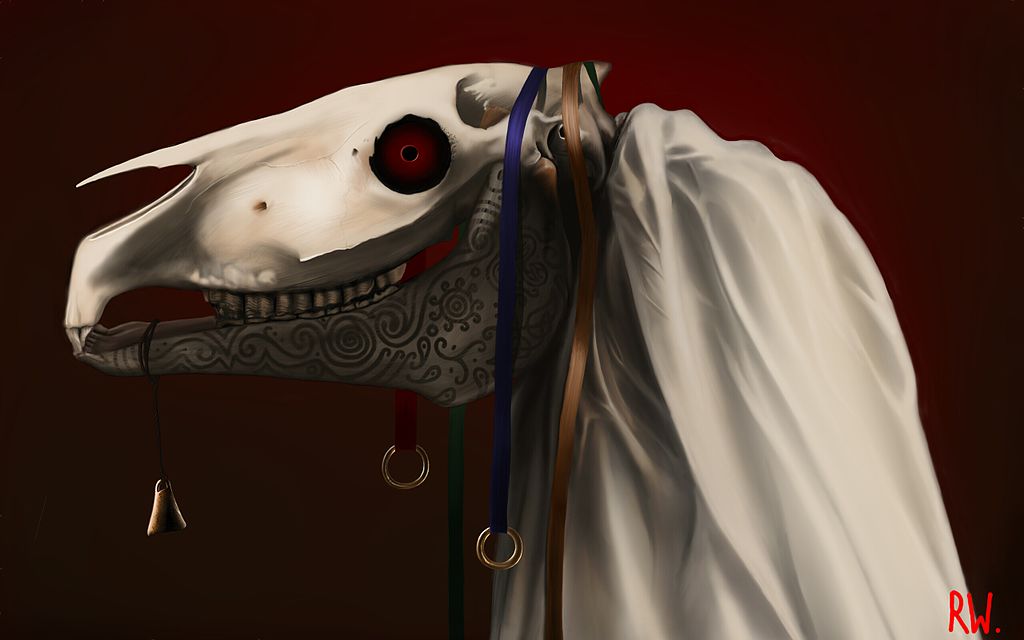






 FLAPPERHOUSE
