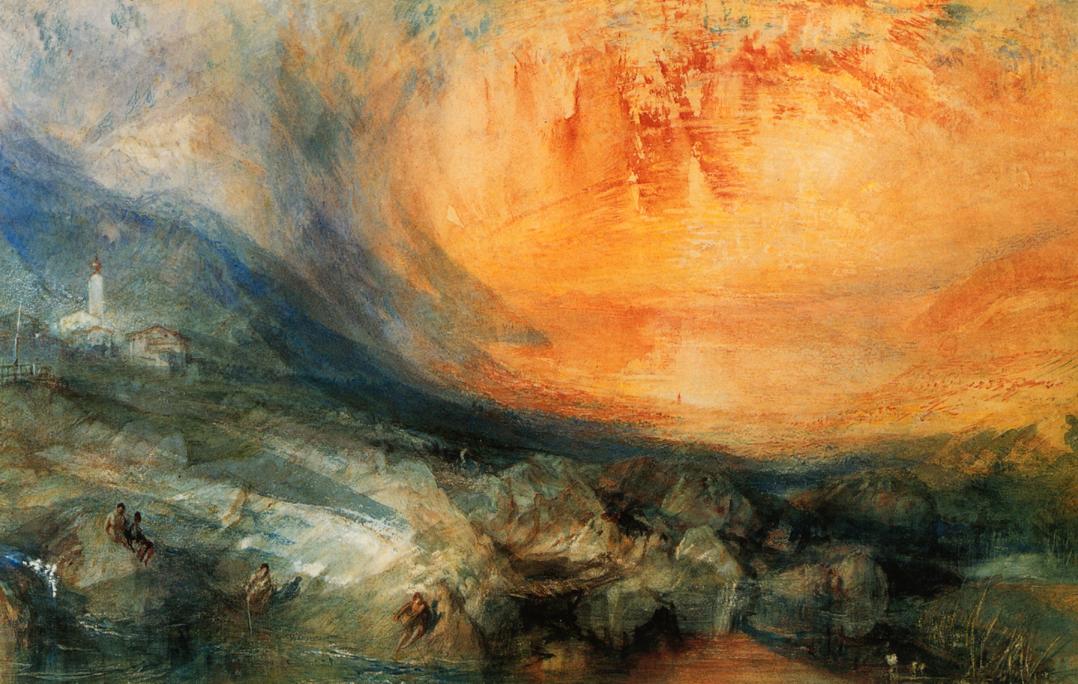
Oddball humor & profound pathos collide in B. Diehl ‘s poem “The World Smells of Boogers,” one of many flappy lits featured in our Fall 2015 issue.
{ X }
I WATCHED THE SKY SWELLING
like a pus-filled boil.
And you ate your way to the core
of the apple of my eye
only to find a fat, ugly worm.
With cobwebbed lungs, I lifted my soul
from beneath the lilac bush,
wiped the crust from my yellowing eyes,
and we watched the sky swelling
like a pus-filled boil.
You swallowed me whole ––
spat out the flaws
like watermelon seeds,
but I see them now, starting to sprout
within the footprints of Christ ––
as the sky swells on
like a pus-filled boil.
Because it’s springtime again ––
so water my pain
and I’ll watch it bloom into a rose.
Play my spinal chord all day like an E minor ––
as the sky swells on
like a pus-filled boil.
You are a glacier in the middle of Egypt.
You are a genuine smile at a funeral,
the ticking of a rusty-handed clock,
the wrinkle on my cheek,
the hoarse voice, waking me
in the middle of a daydream:
“If you ever find happiness,
cut off its legs.”
But as the sky swells on
like a pus-filled boil,
my purpose is beckoning.
My purpose is a lighthouse
outside the storm,
gleaming brighter
with every last second.
So I’m heading west,
against the wind,
shunning the sky,
while tearing off the Band-Aid
at lightning-speed.
A naive young model gets caught in a reckless artist’s dangerous game in Joel Enos & Angela Enos‘ elegantly menacing story “Posing for Tarkins,” oneof many flappy lits you can read in our Fall 2015 issue.
{ X }
THE LADY QUARANTAINE BLAMED HER MOOD’S SUDDEN SWING toward nostalgic melancholy on Stella. It was always Stella’s fault. It always had been.
“Scandalous!” Stella Potter laughed her horse’s neigh across the dinner table, prompting a look of shame from Philip, her long-suffering husband, and a chortle from another slightly intoxicated dinner guest, Carlotta Dunn.
“Who? Winifred Bunton?” This from Oscar Culmel, a dashing Spaniard and an artist in his own right, but only when his philandering allowed him time. “How do you mean?”
“No, no,” Ms. Potter took another large sip of wine. “Winifred is a class act. But that other artist back in the colony, the one who wanted to be Winifred but didn’t have half her talent…you know…Tarrrrrkinnnnnssss…” Another neigh. “Elaine, remember Tarkins? You knew him, didn’t you?”
The hostess of the evening, the Lady Elaine Quarantaine, smiled sadly at her unintentionally amusing friend. “Tarkins?” she said thoughtfully. “No, I don’t think I did know him.”
But in truth, Lady Quarantaine most definitely knew Tarkins. She had killed him.
Elaine was not yet the Lady Quarantaine back then. She didn’t even go by Elaine. Of all the guests at this dinner that she’d prepared to celebrate her husband’s most recent art acquisition, only Stella knew that for a brief year, back in that faraway colony so awfully many years ago, the Lady Elaine had been much better known as the highly sought-after artist’s model, Durissa.
{ X }
The young Elaine and her family were in the colony because her father, though not as fortunate in business as some, had been entrepreneurial enough to know that the small ports and towns on the far reaches of the Empire were full of potential. He had a young wife, two small children, and an older daughter from his first marriage to Elaine’s mother. It was Elaine who would rechristen herself as the more glamorous-sounding “Durissa” and launch herself among the artists and thinkers of the expatriate community, all seeking their fortune in a rough but seductive land.
Durissa was the name of a port Elaine had never been to, but had found on a map. It made her feel as though she belonged with the self-invented artists she was cautiously mingling with, far more so than plain old Elaine ever could. The assumed name also bore the advantage of preventing her father from learning what his dear eldest daughter was up to; modeling for artists was not something a woman of her station did without permanent social repercussions. Of course, it was actually quite demure compared to what the other girls were doing and not at all, as her friend Stella would hiss in mock shock, “Scandalous!”
Stella, being a few years older and having already discovered suitors, kept a small flat of her own under the pretense of taking respectable art classes, as well as dictation, near city hall. Durissa, under the guise of doing the same, was using Stella’s new living quarters as a home base for her “Scandalous!” new life.
One night at a private exhibit, Durissa was feeling quite lost in the shadow of Stella, who had, as usual, been very loud while wearing a daring new gown. Durissa arrived at Stella’s flat earlier that day in her third-best party dress, because her friend had assured her that while true bohemians should never be the best dressed at a party, they must always the most interestingly dressed. The second part of the maxim was fulfilled by a bright red shawl of Stella’s own that she wrapped around Durissa’s shoulders as she admonished her for her lack of creativity.
“It’ll cover how hopelessly bourgeois your dress is and create a sense of mystery,” Stella assured her. “If you want to be someone’s muse, you’ve got to look like you know things they don’t and then make them desperately want to find out. It’s easy, really.”
Durissa nodded, allowed herself to be anointed with Stella’s pungent perfume, and felt almost transformed.
The transformation lasted until an hour into the party, when Stella and her “Scandalous!” dress had disappeared onto the balcony with a stranger. Once alone, she felt more like Elaine than Durissa. She fumbled with the shawl, attempting to remove it.
“No, don’t move an inch! Stay perfectly still.” A sharp voice cut through the hum of conversation around her, startling Durissa into the desired stillness.
A man stepped out of the crowd of black tuxedoes and grabbed Durissa firmly by the chin, turning her face in profile. “There. I had to see it. I never trust a woman without a strong profile,” he said, releasing his grip on her face. She could see him now, a man of middling height and looks that would be unremarkable without a personality that obviously was not lacking in certain panache. The brocade waistcoat, the impractical rings, the precision of his hair’s unkemptness: This man was certainly a bohemian. Stella’s absurd red shawl had worked.
“Forgive me, I was so taken with your profile that I forgot my manners. I’m Tarkins, artist. And you have a magnificent profile. Just the sort I’ve been looking for.”
“My name is Durissa.”
It was the first time she’d said it aloud to a stranger. With the artist Tarkins as witness, it became true.
THREE, TWO ONE. hop on board my bottle rocket. we’re taking off.
haven’t we landed on the moon? i saw it with my own
moon eyes. right through the television screen. one small step
means beam me up, set me free. if you love something, if you love something.
but we’re all thumbs. we fumble and drop with nowhere to hitch.
to the moon, to mars, it doesn’t matter.
rev the engines, let’s go be alien somewhere up, up and away
sending smoke signals to the stars wailing past. you’re all just voices
in my head. look inside my metal cap.
maybe you’re the sick one, maybe i’m.
maybe i’m inkjet, maybe i’m rocket fuel. stardust.
on a scale of one to floating, is this a magic carpet ride
or helium? we’re all just spacing out and i’ll have what he’s having.
we’ll change our cosmic address, elope, become living time capsule,
a sanctuary in the nucleus of a trilobite. to know thyself is to blink
in fractals for eons and eons. the horizon is nothing more than an illusion
and so are we. we can’t even make food out of sunlight. ours has always been a story
of survival. a psychedelic spectra caterwauling. far and away i hear the creak
of a door opening. it is the destiny of the stars to collapse.
we’ve always turned to the sky for answers, excreting
the tiniest tentacle into the outreaches, the out-of-bounds,
hoping something will stick to us like flypaper. and we’ll reel
it in, dissect and devour—for scientific purposes.
what’s our trajectory? don’t let this be an arc.
i can’t come right back down. earth is calling.
but i’m with the satellites now. no signal out here.
they tell me it’s inescapable. that i’m bouncing
off walls. so tell me, are you coming with me?
{ X }
LAURIN DeCHAEis an M.F.A. candidate for poetry at the University of New Orleans, where she acts as the associate editor for Bayou Magazine. She is active in the fields of education and composition, assisting in programs such as the Greater New Orleans Writing Project, Scholastic Art & Writing Awards, and the Tennessee Williams Literary Festival. Her work appears or is forthcoming in Harpur Palate, Cleaver Magazine, burntdistrict, S/WORD, and Rose Red Review.
Oh, how we wish we could actually read the titles listed in “an inventory of instruction manuals,” one of two exquisite poems by Joyce Chong in our Fall 2015 issue.
{ X }
“HOW TO DISASSEMBLE ROBOTICS” “how to reassemble robots” “how to dissect the human condition” “how to extract meaning out of the inherently meaningless” “how to exacerbate the mundane” “how to be inanimate” “how to splice” “how to emerge whilst sinking” “how to build a shipwreck” “how to money launder” “how to tear apart” “how to reassemble the torn pages of an instruction manual” “how to wind up time like a toy” “how to spill” “how to endure melancholy” “how to breathe” “how to breathe” “how to breathe” “how to spill, convincingly”.
 B. DIEHL is a poet, quasi-recluse, and cat enthusiast from Phillipsburg, NJ. His poetry has been featured in Lehigh Valley Vanguard, Poydras Review, Torrid Literature Journal, Cartagena Journal, Foliate Oak Literary Magazine, Synchronized Chaos, and more. When he is not writing, you can usually find him at home, hanging out with his cats and/or feeding his social media addiction.

 FLAPPERHOUSE