Category Archives: Fiction

“The Thrill of a Lifetime” – Fiction by Phyllis Green

landfillThe spiel of a dotty, highly-caffeinated, eerily chipper employee at an absurdly morbid vacation ranch is the basis for Phyllis Green‘s “The Thrill of a Lifetime,” one of the many flappery lits in our Spring 2014 Issue.

{ X }

WELCOME TO YOUR FIRST DAY OF VACATION! You’ll have the thrill of a lifetime. We have 36 acres to explore and there are yes, 36 of you SOOOOOOooooo you each begin with a whole acre to yourselves. Just you and those gorgeous gleaming yellow backhoes! Yes you will be trained to drive a backhoe, first thing we’ll do. Now you all look great in your hazmat get-ups! All I can see are little men in white coats-oh oh! And white pants and white foot coverings! Of course the ladies are all in white too. And let’s not forget the little tikes on vacation. All right! Now, you all okay with those plastic helmets? Remember, ask one of my assistants if you are the least bit unsure of the fit or feel. We want everyone comfortable. There is pure mountain air filtered into those protective headgears and rest assured we have not had one accident over someone not being able to breathe or getting hysterical or anything like that. They are perfectly safe. There will be no odor for you to worry about, just pure fresh mountain clean air going into your precious lungs because that’s how we do things here at the Rocky’s Ranch, your ultimate vacation. We promise big results, a truly happy week of exploration and lots of fun party things planned for the evenings. You’ll love this unique vacation and want to come back every summer! Guaranteed!

Now let’s get down to business and not waste another minute. Hope you all had a delicious breakfast? Good! Wasn’t that bacon crisp and tasty? During the morning you’ll have a coffee thermos in case you are a coffee addict like me. And you little kids who look so excited to be driving those huge and I mean huge yellow backhoes– well we have a lemonade thermos for you tikes. So everyone will be hydrated, right?

Let’s take a look at your graphs. Everyone pull out the graphs. See the 36 acres, and can you all see where your own particular acre is? If not, hold up your retriever (make sure the sharp point is not pointed at yourself!) and my assistants will come by and show you your specific acre.

Now we have marked what you may locate on your acre. Besides the usual cantaloupe rinds and peach pits and other things folks throw away in their garbage cans, there are treasures here. In Acre 1 for instance, that is where the darling little Tacy Jones’ body was tossed in a dumpster and deposited. Now most of Tacy has been found, all except for her two eyeballs. And her parents are willing to pay big bucks for either one or two eyeballs, and then there are the collectors and they really have big bucks and don’t forget the horror museums that are popping up everywhere, they have millions to spend. So who is on Acre 1? Raise your long-handled spike, that’s your retriever. Okay, that looks like Johnny Kacinski. Johnny, you find an eyeball or two and if they belong to little Tacy– oh and we do have a DNA lab right on the grounds here– then Johnny, you are going to be rich! Yes, folks, let’s give a cheer for Johnny! Continue reading “The Thrill of a Lifetime” – Fiction by Phyllis Green

“Angels Howling in the Trees” – Fiction by Misti Rainwater-Lites

Bunworth Banshee - W.H. Brooke, 1825
Bunworth Banshee – W.H. Brooke, 1825

“Angels Howling in the Trees” is a sketch from an American girlhood in the disco era, from the barbed yet soulful pen of Misti Rainwater-Lites. It reminds us of a clip from some punk rock Wonder Years where bitterness & nostalgia roll around on the carpet pulling each other’s hair. It’s also one of the many multi-flavored literaries you can read in our Spring 2014 Issue, available in full for 3 bucks. 

{ X }

IN THE HOUSE IN THE TOWN THAT WASN’T SEYMOUR or Bridgeport but somewhere in between, somewhere forgettable, another ugly bump in the Texas road, Merissa slept or did not sleep in a canopy bed in a bedroom she shared with her baby sister. One night Maternal Grandmother was visiting and she was sleeping with Merissa in the canopy bed but Merissa kept getting out of the canopy bed and tiptoeing down the hallway and getting into bed with the mother and the father. Maternal Grandmother would come get Merissa and bring her back to the canopy bed and Merissa was restless and unhappy but didn’t know why. Merissa looked out the window from the canopy bed and saw the trees in the backyard and she could hear angels howling tangled in the black branches. The angels voiced the despair she was too young and mute to name.

“Will the angels always howl, Ava? Will I always be searching for the warmest, most hospitable bed?”

“You are cursed, niece. I hate to be the one to tell you the truth.”

Buddy Holly was on the stereo and The Newlywed Game was on the television and Merissa was in love with John Travolta as Tony in Saturday Night Fever and when she played house with her least favorite cousin, Sonny’s big sister, she learned what it was to be female because the cousin pretended to be talking to John Travolta, Merissa’s husband. Continue reading “Angels Howling in the Trees” – Fiction by Misti Rainwater-Lites

“Axis Mundi” – Fiction by Cameron Suey

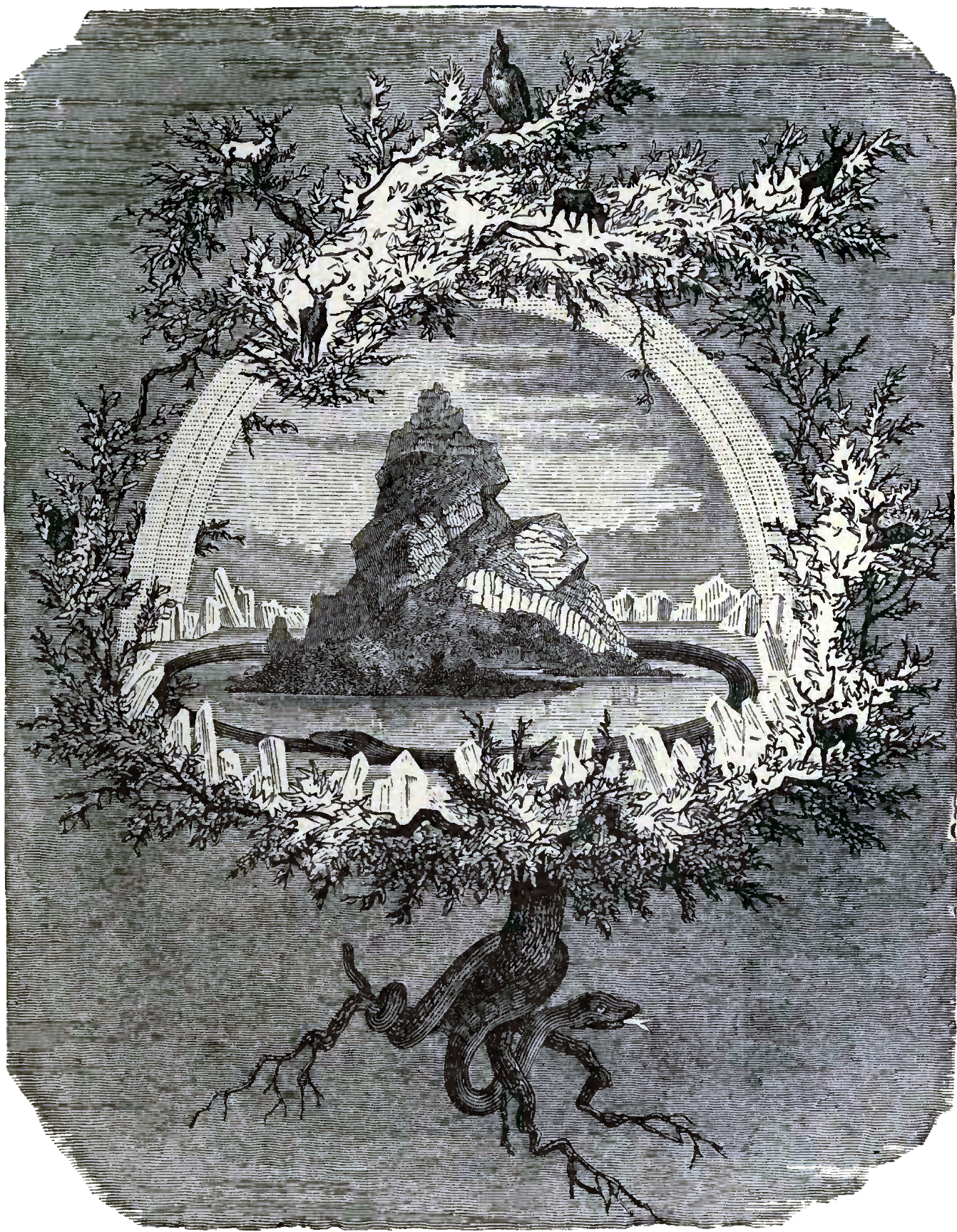
The Ash Yggdrasil - Friedrich Wilhelm Heine
The Ash Yggdrasil – Friedrich Wilhelm Heine, 1886

Cameron Suey has been one of our favorite storytellers for several years now. His tales of horror and dark fantasy have filled our heads with some of the most deliciously terrifying images our minds’ eyes have ever seen, and we’re eternally grateful to him for that. We’re excited to present his story “Axis Mundi” below, as well as in our Spring 2014 Issue.

{ X }

CAPTAIN ELISHA DRIFTS BACK TO HER BODY. Sedative fog curls around her edges for a long, liquid minute before she remembers she has eyes to open. Lids slide across her sclera, a syrupy-sweet motion that tingles her spine like some small secret pleasure. Her forearms feel hot and then cold, as catheters spit the next layer of the wakeup cocktail into her blood. Already, the induced euphoria’s fading, shepherding the last of the delirium and confusion away to be replaced by a conscious, knowing glee. They’ve arrived.

Her new stateroom smells of wood and leather, warm aromas painted in crimson and deep oak hues. The armchair creaks as she moves, and smartbands retreat into its folds like startled snakes. The catheters slip from her flesh, spraying a thin mist of skinbond to cover their tracks, and constrict away into the arms of the chair.

Her vision drifts to a far wall, her eyes looping on a pleasing swirl in the burlwood, where Mithradates projects her feeds in layers of soft amber light. The most important detail rises to the surface in pulsing cobalt: No one has followed. Right up until their unscheduled departure, no alarms were even raised.

Now the slip is over, only a few hours passed, and the slick ebon needle of her new ship, the Mithra, drifts above the ecliptic of Gliese 667C. Mithradates maps the bewildering orbits of the neighboring stars and the six rocky planets around 667C, adjusting for any local eccentricities since the stellar event. The third star, a dull red coal, squats at the center of a tangle of scorched planets. Elisha waits for Mithradates to find any sign of their quarry, but so far she only sees the purples and oranges of worlds and moons.

The nausea arrives as she scans the display, inevitable postslip vomit rising up at the back of her throat. A small basin of burnished silver extends on a silent pseudopod, awaiting her purge. Everyone must sleep during the slip, and only Goetsch claims to have conquered the purge. Elisha could have asked Mithradates to confirm, to see if it’s just more bluster from the mission’s XO, but she’d rather let the man keep his boasts.

With a twinkling of glass bells, a white dot appears in the orbital map, then another. The Odin, and the Yggdrasil. The ghost ships, in the shadow of the third planet. Elation rises up in her, along with something else. Elisha leans into the gleaming mouth of the basin and gags before her throat unlocks to spray a hot foam of sweet pepper bisque, her last meal before their covert flight from Terrapin Yards.

As she blots her lips with a soft cloth, the remains of the first slipprobe from the Reclamation Society appears on Mithradates’ map. Closer in, trailing the orbit of the third planet, it’s just a few hundred thousand kilometers from the Odin and the Yggdrasil. It reads as a scattered cloud of pinprick fragments in the readout, the slip engine still bleeding weak exotic energy signals even a few weeks after the probe’s demise. The second probe, following hours after and launched at great risk of detection, had been more circumspect. From a high and silent orbit, it brought back word of Odin and the Yggdrasil, their distant silhouettes barely visible in the shadow of the dead world.

If there were still survivors aboard, separated by more than 900 years of cultural and technological drift, they would need to be approached with cautious grace. Her spine crawled with excitement at the thought, as if the universe had unfurled to give flesh to her dreams.

When they had told her about the probes, she’d thrown every ounce of social capital she had to get the Reclamation Society’s nomination, abandoning the last of her studies. She’d been the one to propose the theft of her mother’s ship, the Mithra, and she and Goetsch had arranged to patch the ship’s entity, Mithradates, in secret. In the end, they were the only possible crew. She bent and twisted the world to deliver them to this moment.

More sounds, ringing steel this time, as Mithradates tells her the rest of the crew are awake and ready to begin. With his new software, he vibrates with excitement, almost as eager as her to begin. A third tone, hollow wooden chimes, and Mithradates paints new information in the air above the Odin and the Yggdrasil. Her brow furrows. The numinous excitement that suffused her since her selection fades into the background. She leans closer to confirm what Mithradates is showing her.

Around the great sphere of the Yggdrasil drifts a cloud of objects, an accretion disc of ablative armor shrapnel from a thousand years of micrometeorites, drifting screws and abandoned tools, and corpses. Thousands of frozen corpses, lashed by ropes. Loops and whorls of the dead sketching glyphs and geometric shapes drift around the ghost ship, held close by the Yggdrasil’s gentle gravity.

Continue reading “Axis Mundi” – Fiction by Cameron Suey

“Stage Manager” – Fiction by Rebecca Ann Jordan

GhostLight
Ghost Light on Stage, Photo by Jon Ellwood (c) 2014

Rebecca Ann Jordan‘s “Stage Manager,” one of the short stories from our Spring 2014 Issue, has a delightfully waggish voice, though that doesn’t diminish the eeriness lurking in its wings.

{ X }

EVERY THEATRE HAS A GHOST. Ours has three.

“Stage Manager is a thankless job.” This was from Stage Manager, the man I was currently apprenticed to. “Director gets artistic credit. Actors get the glory. And everyone loves the beautiful set, the lights, the costumes.” He shrugged thin little shoulders and tore purple spike tape with nimble fingers. I was a good head taller than him, with his faerie-red hair and green eyes, and I didn’t yet know the art of tearing spike tape without a pair of scissors, tucked now in my pocket like a rumble knife. “Most people don’t even know there’s such a thing as Stage Manager.”

“So why do you do it?”

“Well,” he said, “someone has to.”

We ate lunch at 8:35 exactly. A chocolate muffin, hot chocolate, and a carton of Cherry Garcia to split. It was his idea. I had no complaints.

“Do you know we have three ghosts in Smothers?”

I didn’t really want to know about it. Nightmares really liked me. “Oh really?” I wanted him to like me, too.

“Yeah.” His pixie eyes lit up. “One is an unwed bride, haunting the stage in her wedding dress because her fiancé jilted her.” I highly doubted the first place a bride-ghost would go would be Smothers Theatre, but I nodded anyway. “The second is a crying baby. You can hear it sometimes, wailing on the catwalk.”

We were back in Smothers, sitting down on stage and alternating between spike tape and ice cream. “You ever heard it?”

“Me? No. But I’ve seen the bride.” He grinned. “The last one is my favorite. The Stage Manager.”

I laughed. “The collective ghost of all the managers jilted from glory and appreciation?”

“Something like that. I usually lock up. First to arrive and last to leave…” He ripped the spike tape and raised it, a toast to me, and I followed him as he eyeballed its placement. “You can hear him clapping.”

I tucked the finished tub of Cherry Garcia under my arm and grabbed the opposite end of the spike tape as he strolled to stage left. “You’re so full of shit.”

Stage Manager smiled. “You’ll see,” was all he said. “You can lock up tonight.”

“No thanks.”

“I mean, I have to go work on Millie.” The other play he was managing. He was determined to get as much opportunity to be forgotten as possible. “Here.” He tossed me the keys.

Maybe I would get one of the stage hands to stay with me afterward. Unfortunately, I believed in ghosts.

Continue reading “Stage Manager” – Fiction by Rebecca Ann Jordan

“The Root of Everything Arty” – Fiction by Jenean McBrearty

The Truth at the bottom of a Well Jean-Leon Gerome, 1895
The Truth at the bottom of a Well
Jean-Leon Gerome, 1895

The truth about ourselves is at the bottom of a well, says Donnie Babcock in “The Root of Everything Arty.” Jenean McBrearty‘s story is a droll, twisted riff on art, violence, vanity, and the subconscious, co-starring Gala Dali. Read it alongside other exciting lit in our Spring 2014 Issue (FLAPPERHOUSE #1), now on sale for just $3.

{ X }

“AN APPOINTMENT IS IMPOSSIBLE, and Salvador wouldn’t keep it anyway,” Gala told Mrs. Green, the crinkled-lipped woman who had roused her at ten. It was too early to juggle American dilettantes. The Dali Ball had been tiresome after the first half hour. Dali’s glass case and brassiere, worn on his chest to shock the fawners, would work well with the press, but would soon be followed by a what’s next? from the American public.

“I spoke to him about my nephew. Donald. Bunny Babcock’s son. He’s an artist.”

“I know my husband’s an artist, Madame.” Gala was at the phone about to order breakfast.

“No, Donald’s an artist.” Although just sixteen, he was also a high school graduate and his Uncle Marion’s protégé.  “Senor Dali will remember, I’m sure…”

It’s clear why time melts under the persistence of memory. Americans seemed to have infinite recall capabilities no matter how much gin they consumed, and their persistence jellied the nerves. “Could you bring tres huevos and toast?” she said into the phone, and gave Mrs. Green a nod. “Perhaps this afternoon.”

Mrs. Green hoisted a brown leather portfolio case in front of her. “Donald gave me this. He’s says they’re his best portraits. You could tell me if Dali would be interested in them.”

The woman in the crepe dress and open-toed shoes was giving her a way out. She’d take a quick look and deliver a swift dissuasion. “All right.” Gala removed the white porcelain vase stuffed with orange and yellow gladiolas from the table and set the case on it, untied the laces and peeled back one side. She turned the separators slowly, as though reading a manuscript, feeling Mrs. Green’s expectation at her back.  “Have you seen your nephew’s portraits, Madame? They’re all pudenda.”

Continue reading “The Root of Everything Arty” – Fiction by Jenean McBrearty

“Rebel, Rebel” – Fiction by T. Mazzara

ChargerBe warned: T. Mazzara‘s “Rebel, Rebel,” one of the short stories from our Spring 2014 issue, contains some extremely salty language. But beneath all that salt there’s also tremendous tenderness. 

{ X }

for Shawn

I GOTTA GET TO NEW YORK BEFORE 3 AM or Big Meanie, Jimmy Dread, is gonna fuckin stick-rape me with a broom handle and feed my bones to his bulls, gonna cut off my ears and chop off my head. I been driving this route and driving it drifted for two years now, trying to buy the ticket on dad’s ranch house. Buy it back from my sunk-headed Moms. She’s got not a marble left and they’re gonna take the dump from her, she don’t get square with the bank. I been driving this route since Jean Genie bit the big assfuckin farm on it. That’s my cousin, Jean Genie.

Jean died when his box truck launched off this elevated road (that’s Route 17 East to New York-fuckin-Shitty). Jean buried truck and driver in the woods just betwixt Beaver Kill and Roscoe. And that’s Roscoe “Trout Town USA.” Upstate. He buried Jean Genie good too. Fucker was a mess of blood and knotty, greasy hair and white meat and wood and red meat and metal splinters, buried in bark and sticks and branches, cloaked in wet red and steam and smoke and brake lights. Twisted metal, twisted Genie. Twisted sister. Jean Genie. Ziggy Stardust.

I’m carrying a load of H (and some blow on the side). All packaged neat in 50 pound bags of organic flour. Genie still talks to me. I’m the Jazz. It’s something I do. It’s something I do for the Dread. It’s something that’s done.

I’m passing Slaterville Springs, now. Bug zappers zapping and flashing and it’s 35mph thru here so they’re easy to hear over this godawful loud engine. I’m still on east 79. It goes up to 55mph after here and then I’ll be headed thru Richford and past Robinson’s Hollow Road and there’s fuckin nothing out there.

But there is a red Dodge Charger here now and he’s been behind me and beside me and I’ve passed him real careful-like, twice now, and he’s weaving like a motherfucker. There’s drunks at night out here. Small town, not much to do at night. Day too. Not certain if this one’s a drunk. Can’t never be certain of anything, really, Jean Genie used to say. But Dodge Charger keeps slowing and I pass him and then he’ll waggle in my rearviews and he’s in and out of lanes and I lose sight of him around a bend til he guns it and smashes past me, suckin wind and shakin the Bigtop.

You never can be sure of much. Jean Genie used to say black holes was planets that had evolved some species into machines that needed to eat and needed power to eat and they then went off and e’en everything. And it wasn’t like astronomers said and what the hell did astronomers know? They had theories and observations. Hell, we could make theories and observations. We could make observations and theories all we fuckin wanted, but unless they could magic his ass up to the center of the galaxy and let him stick his finger in a supermassive black hole, he didn’t believe in black holes and thought the center of the galaxy must just be filled with unicorn farts and marshmallow fluff.

He always said that the world as we know it was coming to an end and that everything that is just now, even as I say this sentence here, is now the past and everything back then is questionable and every configuration of us was different from one moment to the next. Or some shit like that. I think I said it right. I don’t know. He was a confusing shit and I was faced when he told me that.

Never seen you so faced.

Continue reading “Rebel, Rebel” – Fiction by T. Mazzara

“Stanley Kubrick’s Shit Happens” – Review by Joseph P. O’Brien

Kubrick

Only in FLAPPERHOUSE could you read a review of Stanley Kubrick’s least-famous Lost Film, “Stanley Kubrick’s Shit Happens.” Hey look up there: Stanley Kubrick took selfies.

{ X }

IT’S EASY TO FORGET THAT STANLEY KUBRICK, the pensive, punctilious director of 2001 and The Shining, was also the cheeky, impish ringmaster behind wickedly funny films like Dr. Strangelove and Full Metal Jacket.  Read any critique of Kubrick’s work– even a favorable one– and chances are you’ll find words like “clinical” and “icy-balls.”

Perhaps that’s because so few have ever seen (or even heard of) this esteemed filmmaker’s least-famous Lost Film.

SHITHAPPENSLegend has it that after wrapping up The Shining in 1980, Kubrick was, as you might expect, hungry for a more jocular project.  One night he rents a stack of videotapes, comedy movies he’s been meaning to watch for a personal film festival. About 20 minutes into the first film there’s a loud, plasticky smash. Kubrick’s daughter hears it from all the way up in her bedroom, and she runs to her father’s screening room to see what’s the matter. “I’m fine,” he tells her, standing over shards of shattered videocassette. “Just  disposing of some dreadfully boring cinema. Don’t be alarmed if you hear it again later.”

Sure enough, Kubrick’s daughter hears the smash of VHS-versus-wall roughly every 20 minutes for the next couple hours. Until she hears laughter. Ecstatic, soul-saving laughter, like she’s never heard her father laugh before.

He’s watching  Airplane!

Continue reading “Stanley Kubrick’s Shit Happens” – Review by Joseph P. O’Brien

“The Better Cowboy” – Fiction by Todd Pate

BetterCowboyThe first piece we snatched up for our Spring 2014 issue was a short story called “The Better Cowboy,” written by our good friend Todd Pate. We were quickly seduced by its mix of Western American mythology and cosmic psychological horror– we like to think of it as a bad-ass bastard spawn of Cormac McCarthy and HP Lovecraft.

{ X }

ELLIOT ROUNDED THE BEND in the dry Paria River bed and came face to face with his own shadow. He pulled the reins, stopped his horse. He’d seen his shadow all along, bouncing across the red wall of the dry riverbank as he followed the missing calf’s hoof-prints through the desert. But the bend in the river put the sun at his back. Now his shadow confronted him, stood still and clear in form but filled only with darkness. The tracks continued through his shadow and beyond but he went no further.

Instead he rode out of the river bed onto a slight hill. Standing in his stirrups, he gazed far out at the massive canyon into which the river flowed, when there was water. A shadow rose out of the giant, jagged canyon as the sun lowered and his own shadow stretched toward the abyss as if he and his horse were caught by a massive black hole. As his shadow grew longer and thinner, a heavy, dark feeling came over him. For a moment Elliot thought it could be loneliness. It was easy to be lonely out in the high desert on the Utah-Arizona border at the end of an incinerating day. Breathing, strictly voluntary. Sandblasted, sun-burnt face. Hands swollen, cracked open, stinging wherever they weren’t calloused. Nothing left to sweat out, shivering in the evening wind. Under those conditions, one could admit he’s lonely. That’d be acceptable, maybe even admirable for a cowboy.

But Elliot knew he couldn’t call it loneliness. He saw Hedges at the line shack that morning, and would see Hedges there in the evening, just like the day before, the day before that, just like all summer long. He searched for a name for the feeling until his shadow stretched to a form no longer human. He closed his eyes just before it touched the darkness of the canyon. Whatever the feeling was, he would never call it fear.

From the darkness of his mind came the high-pitched bays of a calf.

Never fear.

The calf.

When he finally opened his eyes, most of the land before him was in shadow.

No calf. Only the soft whistle of wind.

He rode away. The deep wound in the land, its bottomless darkness sucking in all earth, sound, and light to certain annihilation, would be there for Hedges tomorrow.

Maybe even the lost calf, too. Elliot didn’t care. He’d go back to the rest of the herd and do nothing until dusk. Then he’d take the twilight ride back to the line shack.

Continue reading “The Better Cowboy” – Fiction by Todd Pate